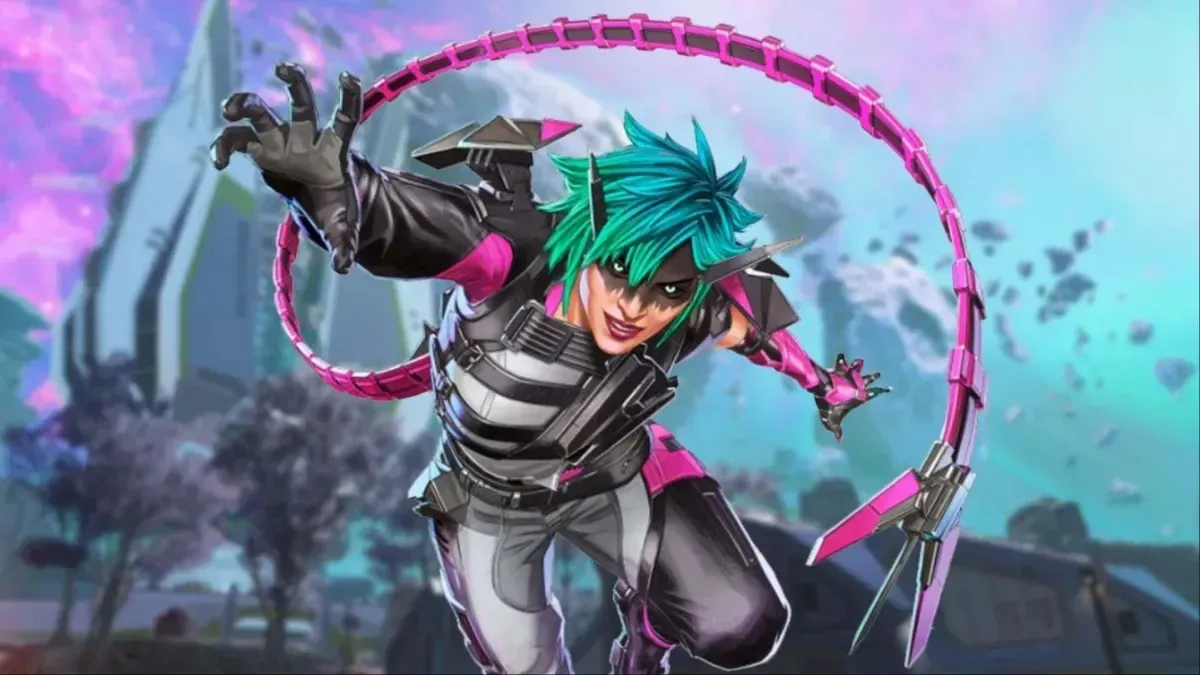

The Aftershock event is one of the more mechanically dense updates Apex Legends has seen in recent memory. Every Legend in Wildcard: Charged Up mode gets access to the Vortex Shield, a deployable that catches incoming bullets and fires them back. On top of that, Gibraltar, Wraith, and Wattson all received targeted reworks, the Elite Hemlok entered the weapon pool, and Olympus got a POI reshuffle. There's a lot to process before you drop in.
What is the Aftershock event and when does it run?
The Aftershock event ran from March 31 to April 21, 2026, with the Collection Store remaining open until May 5, 2026. The headline mode is Wildcard: Charged Up on Broken Moon, built around the universal Vortex Shield mechanic. The map rotation for Pubs and Ranked covers Olympus, Storm Point, and World's Edge.
Here's the quick-reference overview:
| Detail | Info |
|---|---|
| Event dates | March 31 – April 21, 2026 |
| Collection Store closes | May 5, 2026 |
| Featured mode | Wildcard: Charged Up (Broken Moon) |
| Core mechanic | Universal Vortex Shield + EMP Blast |
| Premium reward | Fuse Prestige skin — "Apex Inferno" |
| Free progression | Reward Shop via Cells, two rotation windows |
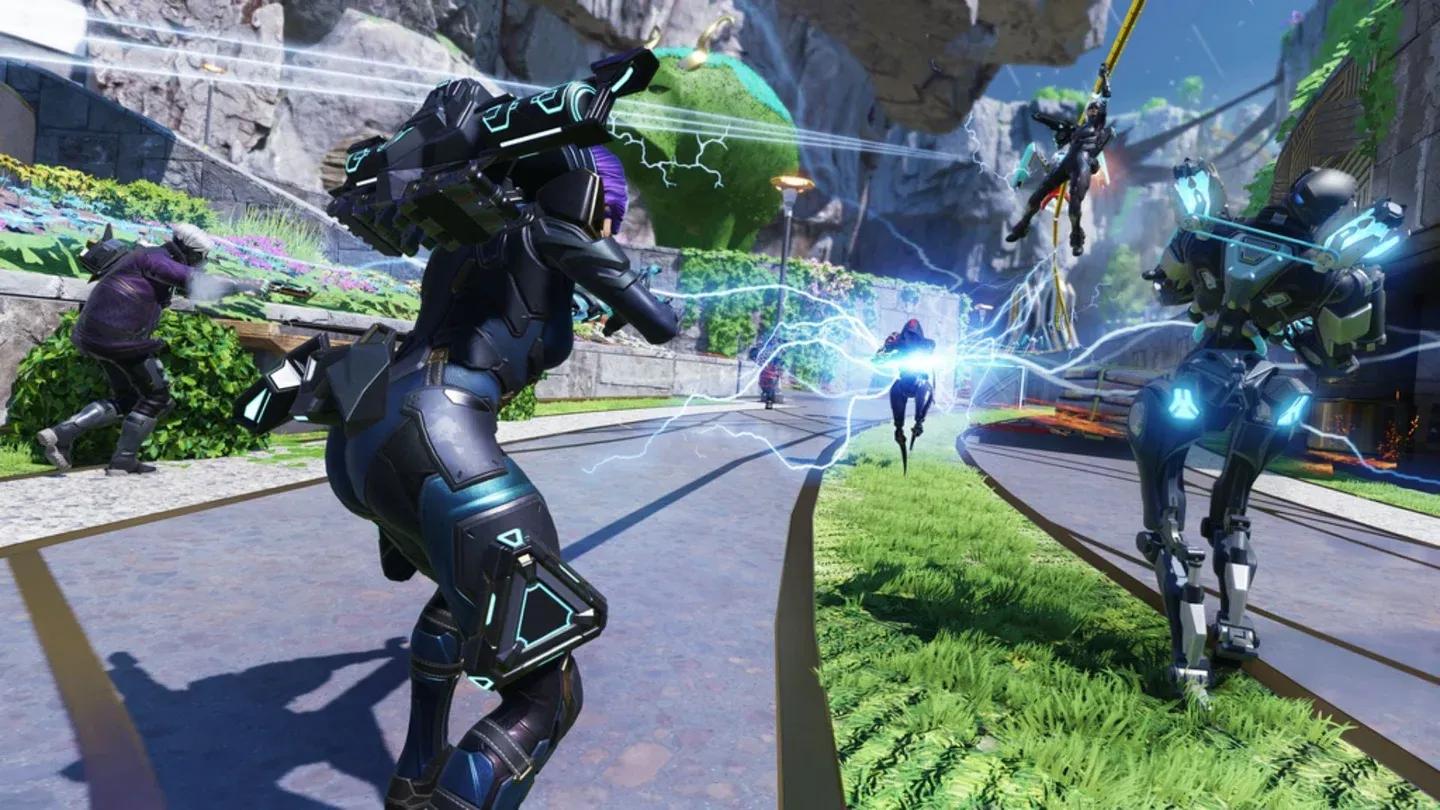
Vortex Shield deploy UI


How does the Vortex Shield work?
The Vortex Shield is available to every Legend in Wildcard: Charged Up. It blocks incoming projectiles and stores them rather than simply absorbing damage. Once charged, you trigger Return Fire to release those stored bullets back at enemies.
A few mechanics that matter in practice:
- High-fire-rate weapons like SMGs and LMGs charge the shield faster and produce a more potent Return Fire release. Snipers and shotguns are a different story.
- Return Fire has natural spread, so it's most effective at close to medium range. Don't expect pinpoint accuracy on a return volley at 80 meters.
- A visual indicator activates when the shield holds enough charge for a meaningful release. Watch for it before committing.
- Return Fire carries a slight knockback effect that can push enemies off a position or create disengagement space.
- Shield energy replenishes by collecting EVO during the match.
What are the Vortex Shield's weaknesses?
The shield drains passively while active, even without incoming fire. Sustained fire depletes it faster than the passive drain rate. At roughly 25% charge remaining, a visible warning state kicks in. That's your signal to either disengage or trigger Return Fire before the shield collapses entirely.
High-damage single shots can partially bleed through. The Vortex Shield is not a hard counter to sniper rifles or shotguns. It rewards you against automatic fire, not burst damage.
How does the EMP Blast work?
The EMP Blast is the Vortex Shield's offensive counterpart. The EMP Battery recharges through three sources:
- Blocking damage with the Vortex Shield
- Collecting EVO during the match
- Certain Wildcards (see the table below)
Once the EMP reaches full charge, it starts to decay. Sitting on a full charge while playing passively wastes the resource. The EMP Blast functions primarily as a disruption tool rather than a direct damage source, excelling at disabling fences, traps, and domes, and creating push windows by disrupting fortified defensive setups.
All 9 Wildcards explained: which combinations are strongest?
Nine Wildcards are available in Aftershock, each modifying how the Vortex Shield and EMP behave. You interact with a teal Replicator to select them, once per round and up to three times per match.
| Wildcard | Effect |
|---|---|
| Bigger and Better | Greatly increases shield size, speeds up deploy and stow time |
| Duck and Cover | Increases protective area but disables Return Fire |
| Energy Efficient | EMP blasts cost 50% less energy, enabling two uses per charge |
| Sonic Boom | Upgrades EMP Blast damage and adds knockback |
| Static Charge | EMP Battery remains fully charged even after use |
| Extra Juice | Reviving a teammate grants EMP battery charge |
| Background Process | Grants passive EMP battery charging; rate increases while sprinting |
| Kinetic Converter | Increases movement speed based on EMP Battery charge percentage |
| Heat Signature | Spend EMP battery charge to highlight enemies through walls |
Energy Efficient + Sonic Boom is the strongest aggressive pairing. Two knockback-capable EMP blasts per charge creates consistent pressure that's hard for opponents to play around. Background Process + Heat Signature rewards mobile scouting: sprint between positions, build charge passively, verify enemy locations before committing to a push. Extra Juice adds meaningful value if your squad runs a dedicated support Legend.
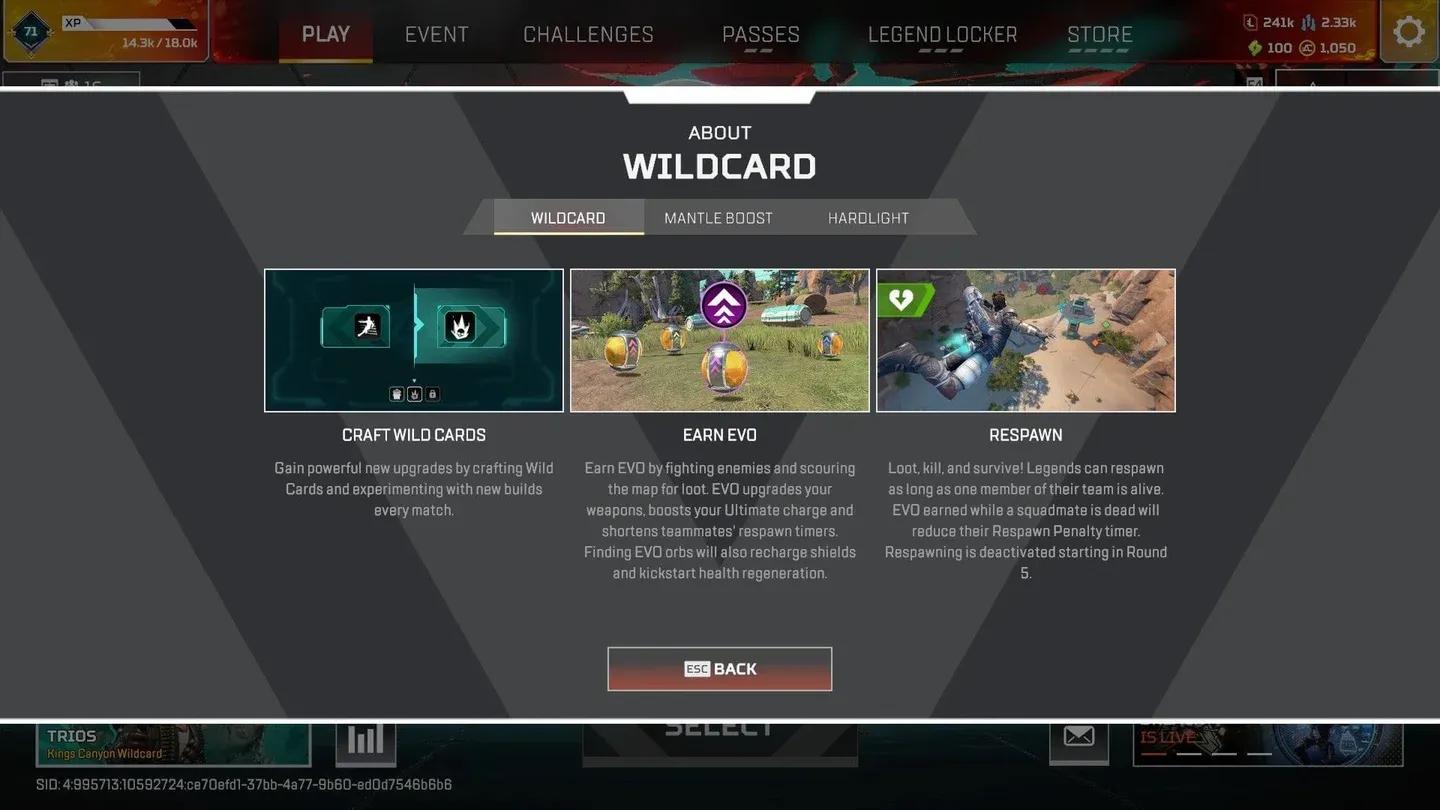
Wildcard selection at Replicator
What changed for Gibraltar, Wraith, and Wattson?
Gibraltar
Gibraltar's overhaul is the most significant of the three. He now gains a speed boost after sustained sprinting through a new Momentum Boost passive, bringing his movement closer to faster Legends. Gibraltar Punch now deals double damage to Hardlight as part of this passive.
The Dome of Protection cooldown dropped from 17 seconds to 13 seconds. The Defensive Bombardment ultimate received a 20% radius increase baked into the base kit, an accelerated missile call-in time, and the ability to throw the ultimate during quip animations.
Level 2 upgrades (choose one):
- Thunderdome: Electrifies the dome, dealing 50 damage and slowing the first enemy who enters
- Healing Dome: Extends dome duration by 4 seconds and doubles healing item effectiveness inside
Level 3 upgrade:
- Triple Bombardment: Splits the ultimate into three smaller, more precise charges for sustained area denial
The Big Bruddah, Bubble Bunker, and Baby Bubble upgrades were removed entirely.
Wraith
Wraith's rework pushes her toward aggression. Tactical cooldown drops from 20 to 15 seconds; the ultimate drops from 2 minutes 30 seconds to 1 minute 30 seconds. Activation animations are faster across both abilities.
Level 2 upgrade: Channelling the ultimate now creates a Phase Dome lasting 30 seconds. Enemies who enter are sent into the void.
Level 3 upgrade (Phase Jumper): Tactical duration increases from 4 to 6 seconds and grants a double-jump while in the void, adding verticality that Wraith hasn't historically had.
Wattson
Fence damage increased from 20 to 35. Fence deployment time was cut from 1 second to 0.5 seconds. Placing a fence in front of a Hardlight mesh reinforces it, and if the mesh is destroyed, the fence automatically rebuilds it. The Ultimate Pylon now reinforces all Hardlight meshes within its radius.
The 0.5-second deployment time is the change that will feel most impactful in doorway contests. Wattson's setups are now substantially harder to contest or race against.
Wattson Hardlight fence setup
What is the Elite Hemlok and how does it change the meta?
The Elite Hemlok (also called the Hemlok Breach AR) replaces the RE-45 in the elite tier. It fires in fully automatic mode and comes pre-attached with a barrel and integrated silencer.
Stat breakdown:
- Body damage: 23
- Headshot damage: 32
- Secondary fire — Breach Charge: Explosive shot with a 15-second cooldown, dealing 38 damage to players with radial falloff plus significant damage to structures and Hardlight meshes
The Breach Charge gives the Hemlok a dual role: reliable gunfight weapon and structure-clearing tool. It's a natural counter to fortified or Hardlight-heavy defensive setups.
Other weapon adjustments:
- 30-30 Repeater: Damage increased from 41 to 43
- P2020: Magazine size increased to 9; Hammerpoints unlock cost reduced to 425
- RE-45: Now permanently an energy weapon with burst fire as the default; only the elite visual treatment was removed
- EVA-8: Improved base reload speed
- Prowler: Reduced burst delay and improved recoil profile
For reliable loadouts heading into Aftershock, the R-301 paired with a Peacekeeper or R-99 remains one of the most forgiving combinations. The RE-45 in its energy form still performs strongly in close-range situations. In Wildcard mode specifically, pairing your preferred primary with mobile Legends and building around Vortex Shield trades is the more consistent path than chasing raw TTK.
What are the best Legends to play in Aftershock?
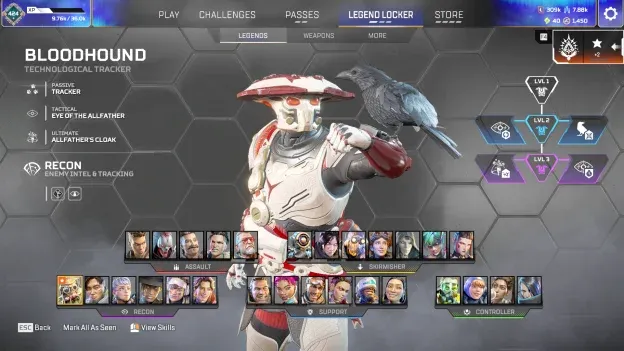
Pre-Aftershock data placed Octane, Fuse, Lifeline, and Alter at the top of the tier list, with Bloodhound, Catalyst, Newcastle, Horizon, Bangalore, Revenant, Valkyrie, and Conduit forming a strong second group. Wraith, Wattson, and Gibraltar sat noticeably lower, which explains why Aftershock targeted exactly those three.
The safest approach in the early weeks is to run proven anchors like Octane, Fuse, Lifeline, and Alter while testing the buffed Legends in unranked before committing them to ranked. Wraith and Wattson look like the clearest winners of the patch. Gibraltar is the highest-risk, highest-change rework of the three. The mobility and dome changes are significant, but it takes time to see whether the community adapts his playstyle effectively.
For deeper dives on specific Legends, the Apex Legends strategy guides collection covers individual character breakdowns in full detail.
How to win more games in Wildcard: Charged Up
Positioning
The Vortex Shield needs incoming fire to function. You want to control when that fire arrives, not absorb it from every direction at once. Prioritise high ground and solid cover over open angles. Avoid heavy traffic areas in early-to-mid game. These zones burn resources faster than they generate value.
Combat approach
Apply consistent, sustained pressure rather than burst aggression. The Vortex Shield rewards time. A broken enemy shield is your signal to push, not to consolidate. The window between shield break and recharge is the highest-percentage moment to advance.
In multi-team fights, avoid overcommitting to finish a squad. Taking pressure damage from a third party while running low on EMP charge is a losing trade in most scenarios.
Punishing revives
An enemy team attempting a revive has at least one player stationary and one occupied. Push immediately before the revive completes. Denying a revive is frequently worth more than the elimination itself. A full squad with a recently-revived, low-HP player is weaker than a two-person squad at full strength.
Endgame and resource management
Rotate early. Forced movement in a late zone with a depleted Vortex Shield is almost always fatal. Use Replicators for consistent mid-game upgrades. Craft before major late-game engagements, not after. Resources spent post-fight are frequently wasted if the ring forces movement before you benefit from the upgrade.
For players working on climbing ranks alongside the event, the guide on ranking up fast in Apex Legends covers RP strategy and positioning principles that carry directly into Wildcard play.
Olympus and audio changes
The Elysium point of interest on Olympus was relocated near Rift, decoupling it from its previous proximity to Summer's University. The intent is to balance early-game drop distribution and reduce POI clustering in the western section. If Elysium was part of your standard rotation, spend a few unranked matches re-familiarising yourself with the new layout before taking it into ranked.
The audio update changes how you process flanks. Footstep volume is now dynamic based on enemy position relative to your field of view. Footsteps from enemies outside your field of view are louder than those directly in front. Volume increases significantly as an enemy moves to your rear arc. If you're in a building and footsteps get noticeably louder without anything appearing ahead of you, that's the system flagging a flank. Trust it.
The sound of Hardlight mesh shattering was also reduced to prevent audio clutter in fights where multiple meshes are being destroyed rapidly.
All Aftershock rewards and how to earn them
Fuse Prestige skin: "Apex Inferno"
The event's centrepiece is a Mythic-tier Prestige skin for Fuse with a three-tier visual progression system that evolves as you deal damage while it's equipped. At Tier 3, you unlock the exclusive finisher "Light it up" and a high-voltage custom dive trail. Complete the full event collection to obtain it. After the Collection Store closes on May 5, 2026, it becomes available in the Mythic Shop for 150 Heirloom Shards.
If you're a Fuse main, our Fuse guide covering his full ability kit and grenade combos is worth reviewing alongside this skin unlock, since the Prestige skin's damage-based progression rewards active play with his kit.
Featured Legendary skins
Each featured Legendary event skin is priced at 1,800 Apex Coins or 2,400 Crafting Metals:
- Wattson — "Space Avenger"
- Pathfinder — "Robot Overlord"
- Ash — "Red Dead Ronin"
- Horizon — "Blind Ambition"
- Crypto — "Code Breaker"
- Gibraltar — "Unbreachable"
Additional cosmetics for Conduit, Vantage, and Bangalore are available through the reward track.
Weapon cosmetics
New skins for the EVA-8 ("Hard Core"), Havoc ("Technoforged"), and CAR SMG ("Static Discharge") headline the weapon cosmetics. The Charge Rifle and L-STAR also receive event-themed skins. Several feature reactive elements with energy cores that animate during firing and reload sequences.
Reward Shop and free progression
Players earn Cells through daily and event-specific challenges and spend them in the Reward Shop. The shop runs two distinct windows:
- March 31 – April 10: Free Aftershock Pack, Epic Lifeline skin, Tracker Set
- April 10 – April 21: Second free Aftershock Pack, Epic Lifeline Banner Frame, additional rewards
You can earn two free Aftershock Packs total, but only if you engage with both windows before each one closes.
Badge progression: Energized → Amplified → Invigorated → Final Animated Badge (unlocked by earning Cells).
What is the cheapest way to get the Prestige skin?
The milestone collection system uses scaled pack pricing that increases from 100 to 1,000 Apex Coins as your collection grows. To minimise total cost:
- Buy the lowest-cost packs first (100 and 300 AC). These tiers disappear once your collection grows, so purchase them before doing anything else.
- Claim free event packs from the Reward Shop after buying discounted tiers, not before. Opening free packs early can push you past cheaper pricing tiers permanently.
- Use Crafting Metals to acquire items and reduce the number of high-cost packs required.
- Finish the remaining collection at standard pricing to unlock the Prestige skin.
The Collection Store stays open until May 5, giving players approximately two weeks after the event ends to complete the set.
Is the Aftershock event worth it?
Worth it if:
- You main Fuse and want a Prestige skin. This is the most direct path to one currently available.
- You're a completionist who can take advantage of both Reward Shop rotations and the two free packs.
- You enjoy the Wildcard: Charged Up mechanics and would be playing the mode regardless of rewards.
Less compelling if:
- You have no interest in Fuse's cosmetics. The premium path is a milestone collection structure, not a cheap standalone unlock.
- You only want one or two specific Legendary skins. At 1,800 AC each, individual skins are priced at standard event rates. The event's value concentrates in the free reward track and the Prestige skin for collection completers.
Split 2 Battle Pass
The Aftershock event runs alongside the Split 2 Battle Pass at 950 Apex Coins. It includes Legendary skins for Catalyst and Loba, weapon skins for the R-99, Havoc, and Bocek, and one notable structural change: the animated badge is now awarded at Level 60 rather than Level 100, significantly reducing the grind required to feel like you've completed the pass.
For broader legend-specific strategy beyond what the event covers, the Apex Legends guides hub has detailed breakdowns for every major character in the current meta.