Search games, articles, guides...CtrlK
Sign InGet Started

Build the perfect Road to Glory athlete in CFB 27. Master physique, Max Potential, archetypes, and all 13 Legend Templates.

Written by Abdalla
Content Writer
See more GAMES.GG guides on Google
Add us as a preferred source and our guides show up first in your results.

College Football 27 Road to Glory QB Archetypes: Which Build Wins?
All four QB archetypes in CFB 27 Road to Glory ranked and explained, so you pick the right build before your first snap.

CFB 27 Legend Templates Guide: All 13 Ranked by Playstyle
All 13 CFB 27 Road to Glory Legend Templates ranked by playstyle, from J.J. Watt to Arch Manning. Find your best fit fast.

EA Sports College Football 27 Exact Release Date and Start Times
College Football 27 drops July 9, 2026. Here are the exact start times for every region so you know when to jump in.
Here's the short answer: you pick your position, shape your physique, allocate Max Potential points across attributes, let the game dynamically assign your archetype, then finish with gear and visual customization. The whole system in EA Sports College Football 27 is built around discovery rather than locking you into a preset identity from the start.
What makes this year's creation engine different from previous entries is that your archetype is never manually selected. It shifts in real time as you spend points, which means a quarterback build can pivot from pocket passer to dual-threat mid-allocation if you start investing in athleticism. That flexibility is the whole point.
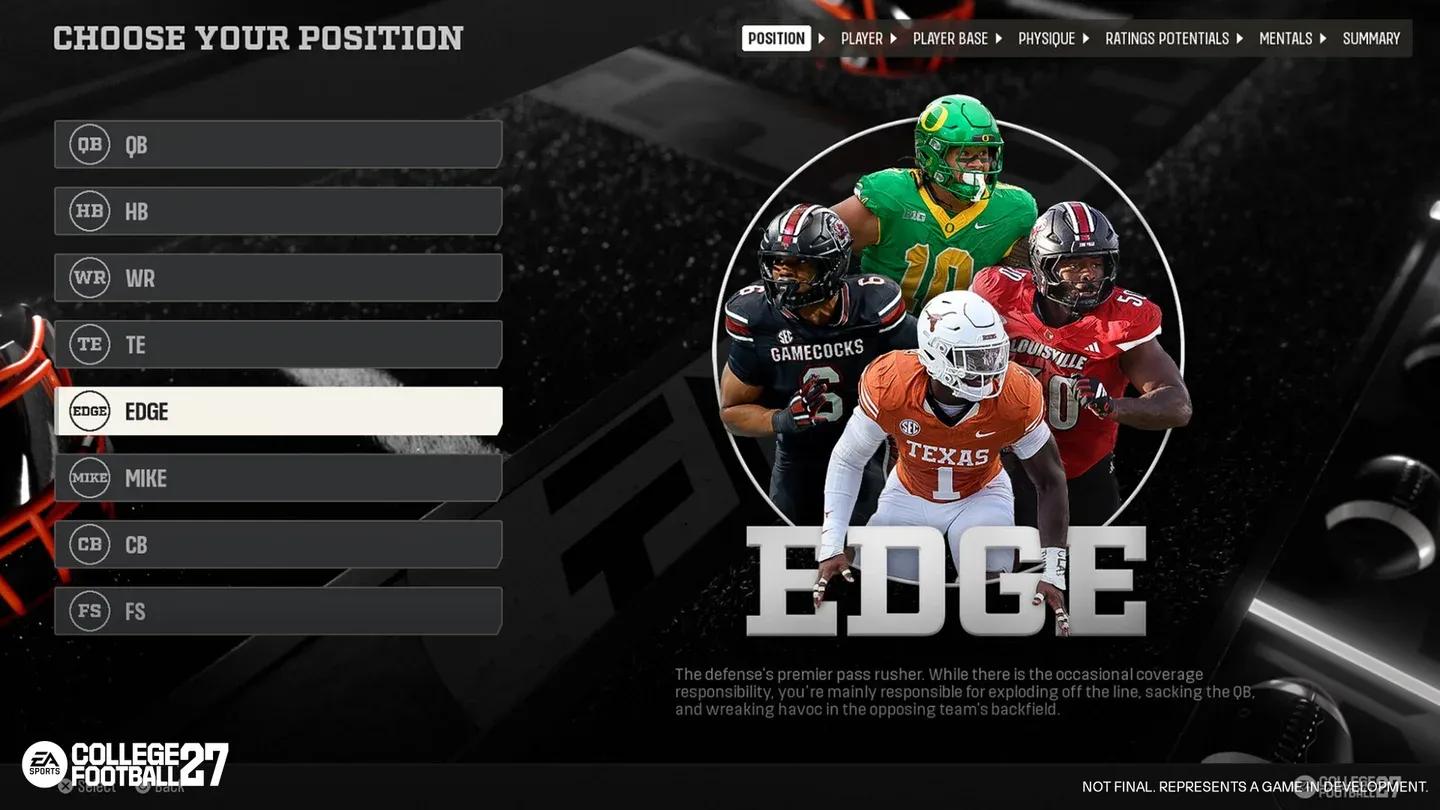
Position selection in Road to Glory
Position selection is the first decision and the most consequential. It determines your baseline physical parameters, available attribute categories, and the ceiling of what your athlete can become.
The three positions added in Title Update 4 fill long-requested gaps:
Think about how you actually want to spend your time on the field. A pass rusher and a quarterback give you completely different Road to Glory experiences, and no amount of attribute allocation changes that fundamental reality.
Once you have a position, you shape the athlete's body. Height, weight, and body type are all adjustable, but they are not independent choices. The system works in a strict cascade:
As you move sliders, the game updates your physique-driven attribute caps in real time. These caps represent the physical ceiling for each attribute category based purely on your body type, not your skill investment.
| Physical build | Attribute advantages | Tradeoffs |
|---|---|---|
| Taller / heavier | Higher caps in strength, power, blocking, and tackling | Lower maximum speed caps, reduced baseline movement ability |
| Smaller / lighter | Higher caps in speed, acceleration, agility, and quickness | Lower blocking and tackling caps, reduced raw power |
The mistake most players make here is optimizing physique for a single attribute without checking what it sacrifices across the rest of the profile. A maximum-height wide receiver might gain catch radius but lose the agility cap that makes separation routes work.
After physique is set, you receive a pool of Max Potential points to distribute across your position's attribute categories. Every attribute starts at a base value of 25 if you build a custom player from scratch.
Three rules govern how points behave:
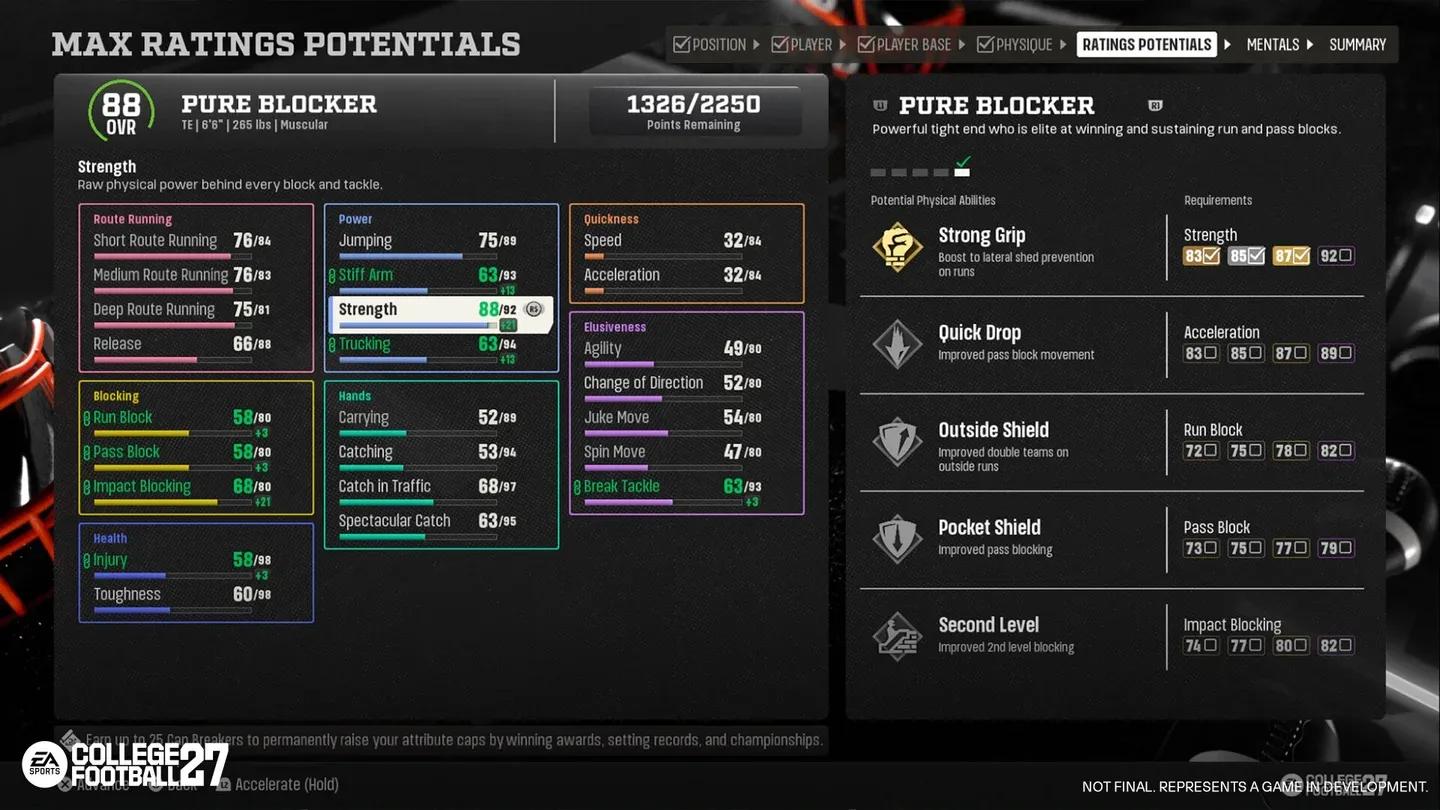
Max Potential allocation screen
Max Potential does not set your starting ratings. It defines the ceiling of what your athlete can eventually reach through training, games, and offseason work. Reaching that ceiling is the actual Road to Glory journey.
For a deeper look at how Max Potential interacts with Mental Abilities and the weekly agenda system, the complete Road to Glory build guide covers the full progression loop in detail.
This is the part of creation that trips up players expecting a traditional menu. You never select "Pocket Passer" or "Power Back" manually. Your archetype is calculated from your attribute distribution and updates live as you allocate points.
Watch the top of the screen during allocation. Your Overall Rating (OVR), remaining points, and current designation all update simultaneously.
Two examples from the sources illustrate how this plays out:
The practical implication is that you should decide your intended archetype before touching the allocation screen, then work backward to figure out which attribute categories support that identity. Chasing the OVR number without a plan will land you in an archetype that does not match how you want to play.
Once physical caps and developmental limits are locked in, the final step is appearance. Title Update 4 added several community-requested gear options:
On the footwear side, the update added Nike Kobe 6, Diamond Turf 93, Diamond Turf V2, Foam Posits, and multiple Alpha Menace models. New Under Armour cleat variants also arrived for affiliated programs. Dozens of face masks now work with Speed Flex, Vicis, and Axiom helmets.
Save your athlete to lock in the build and begin your freshman campaign.
Title Update 4 added 13 Legend Templates, giving you a preset height, weight, archetype, and potential setup based on a real player. Here's the short answer on which path to take: templates are faster, custom builds give you more control.
Templates are the right call if you already know what position and playstyle you want. They skip the allocation phase entirely and drop you into a recognizable football identity. Building from scratch makes sense if you have a specific attribute distribution in mind that no template covers.
| Template | Position | Best for |
|---|---|---|
| J.J. Watt | Edge Rusher | Constant pass rush pressure, sacks, TFLs |
| Julius Peppers | Edge Rusher | Athletic edge disruption |
| Sean Taylor | Free Safety | Interceptions, big hits, secondary highlights |
| Jerome Bettis | Running Back | Power running, clock control, breaking tackles |
| Derrick Johnson | Linebacker | All-around defensive coverage |
| Luke Kuechly | Linebacker | Middle-field control, balanced run/pass defense |
| Tony Gonzalez | Tight End | Receiving-focused TE, pass-catching production |
| Heath Miller | Tight End | Blocking-oriented TE role |
| Torry Holt | Wide Receiver | Route running, vertical receiving |
| Mohamed Sanu | Wide Receiver | Versatile receiver role |
| Braxton Miller | Quarterback | Mobile, dual-threat QB style |
| Arch Manning | Quarterback | Traditional pocket passer experience |
| Jeremiah Smith | Quarterback/Skill | Unique offensive template |
For offense, Jerome Bettis is the standout if you want to run the ball and punish defenders rather than outrun them. Tony Gonzalez is the better tight end pick if receiving production is your priority over blocking. Braxton Miller suits players who want to extend plays with their legs, while Arch Manning is the cleaner choice for a traditional dropback style.
Luke Kuechly is the safest all-around linebacker option. He puts you in the middle of almost every defensive situation, covering both run stops and pass coverage assignments rather than specializing in one.
If you are playing on PC and want the game running at its best while you grind through your career, the best PC settings guide for College Football 27 covers optimized graphics configurations for every hardware tier.
Can you change your archetype after creation? Your archetype updates dynamically based on attribute distribution throughout your career. It is not locked at creation, but shifting it significantly requires substantial point investment in different categories.
Do Legend Templates lock your attribute allocation? Templates provide a preset starting point for height, weight, and potential setup. You still develop your player through training and games rather than having everything handed to you.
Which position gets the most impactful Road to Glory experience? Quarterback influences almost every possession, making it the most decision-heavy role. Defensive positions like Edge Rusher and Free Safety offer more reactive, highlight-focused gameplay. Neither is objectively better; it depends on what you want from the mode.
Are the new positions (TE, EDGE, FS) worth trying? Trust me on this one: if you have only played quarterback or running back in Road to Glory, tight end is worth a career just for the different perspective it gives you on both the passing and running game.
For the full list of trophies and achievements tied to Road to Glory progress, check the College Football 27 trophy list for a breakdown of every unlock across all game modes. More guides covering every aspect of the game are available in the EA Sports College Football 27 guide collection.