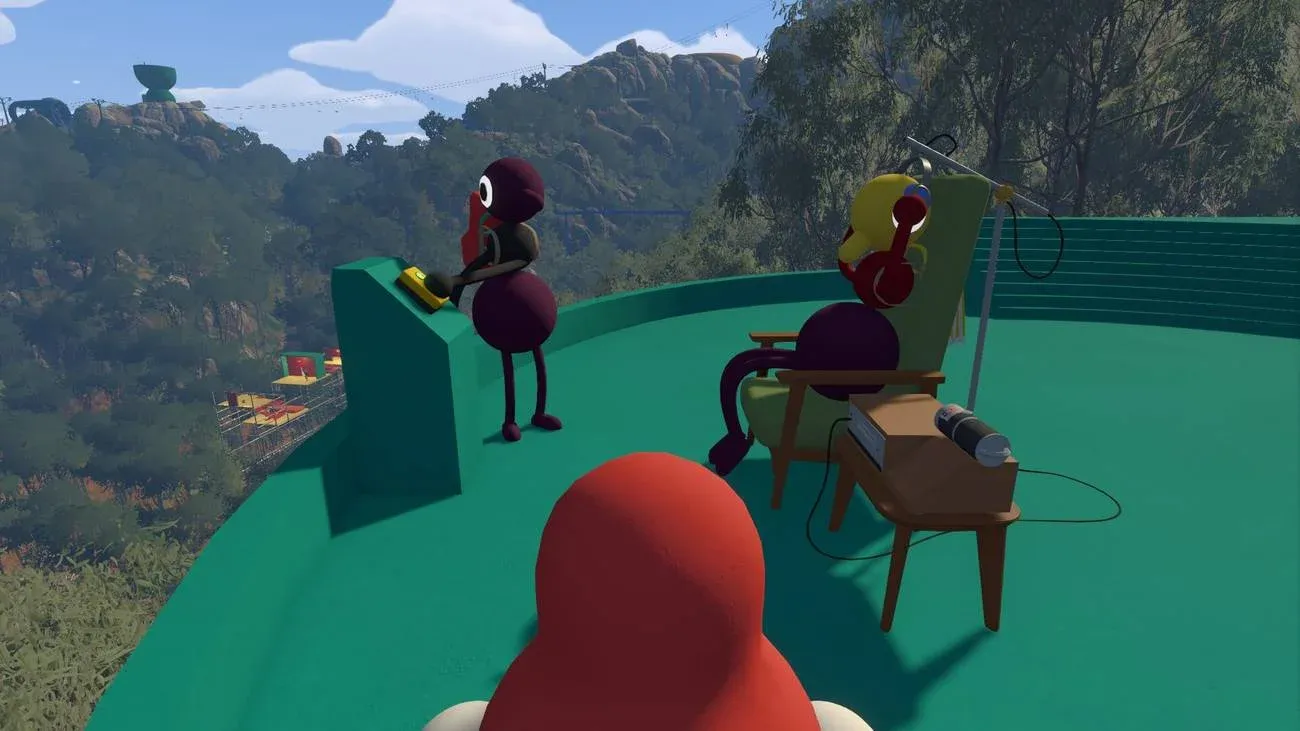


The moment you first get separated from your group in Big Walk and realize you can't hear each other anymore, the megaphone goes from a nice-to-have to a genuine priority. House House's co-op adventure has one of the most unforgiving proximity chat systems in recent memory, and the megaphone is the closest thing the game has to a fix.
Why the proximity chat makes this item matter
Big Walk's voice chat drops off fast. Even roughly 10 meters of separation between players can break communication entirely, which sounds minor until someone clips a rock, takes a wrong turn in the dark, or just drifts slightly off course during exploration. At that point, you're jogging through the world shouting into silence.
The problem compounds at night. Without a flashlight or one of the world's scattered light orbs, visibility is minimal, and the only audio cue you have is the voice of whoever is nearby. Lose that, and you're genuinely on your own until someone backtracks.
The megaphone extends your ability to call out across that distance. It's not a walkie-talkie (that's a separate item with its own tradeoffs), but it gives you the range to actually be heard when the group starts to fragment.
The one-item rule and what it costs you
Here's the thing: getting a megaphone means giving up your hands for everything else. Big Walk only lets you carry one item at a time, so the moment you pick up a megaphone, you're no longer the person holding the map, the flashlight, the walkie-talkie, or the coordinates box. That's a real decision in a game where every carried item has a specific job.
With a larger group, this tradeoff is manageable. Twelve players can distribute roles easily, with dedicated map carriers, light holders, and communication specialists. With two or three players, handing one person a megaphone means the rest of the group has to cover more ground with fewer tools.
The megaphone itself can be found as you explore the island's open world. Like most items in Big Walk, it appears within the environment rather than being handed to you through a tutorial. The starting building walks you through the core mechanics, including how to hold, use, throw, and pick up items, but specific loot like the megaphone is discovered through exploration.
What the community has figured out about item management
Players who've spent time with Big Walk have quickly learned that role assignment is the game's real meta. Designating one person as the megaphone carrier before heading out, rather than grabbing it reactively when someone gets lost, makes a noticeable difference. The same logic applies to the map, which unfolds to an almost comically large size and requires a second player to actually read it effectively.
The megaphone's value spikes specifically at night and in terrain with lots of elevation changes or blind corners. On flatter, well-lit stretches of the island, proximity chat holds up well enough that carrying something more utility-focused makes more sense.
For groups curious about how the multiplayer structure works before committing to a session, our guide on how many players can play Big Walk breaks down the player count options and how puzzle difficulty scales between two and twelve players.
Big Walk launched on PS5, PC, Mac, and Switch 2, and it's part of August's PlayStation Plus Monthly Games selection, which has pushed a lot of players into the game with larger groups than they might otherwise have assembled. More players means more hands, and more hands means someone can actually afford to carry the megaphone full-time without the group feeling the absence.
For everything else you need to navigate the island, the full Big Walk guide collection covers the essentials, and our in-depth review digs into what makes the co-op design tick.