
If you've seen the leaked DLSS 5 footage floating around and thought Nvidia had lost its mind, that reaction is completely understandable. Cloud from Final Fantasy looking like something that crawled out of a horror game tends to do that. But here's the thing: that footage was never what DLSS 5 was designed for.
What the leaked footage actually showed
The chaos started when a mod leaked DLSS 5 applied to games it was never intended for. Stylized characters from Final Fantasy and The Legend of Heroes series ended up looking genuinely disturbing, with multiple layers of the AI filter stacked on top of already non-photorealistic designs. The backlash was fast and loud, with players calling the results "unrecognizable" and the feature getting written off before it even launched officially.
To be fair to everyone who reacted that way: the footage was bad. There's no spinning it. But context matters here, and the context was almost entirely missing from the leak.
Edward Liu, Nvidia's director of applied deep learning research, was direct about the intent at Gamescom: "DLSS 5 is intended to be used for photorealistic situations and characters." That means Final Fantasy is explicitly out of scope. Kingdom Hearts is out. Any game built around a stylized, non-photorealistic art direction is simply not what this tool was designed to touch.
How the filter actually works, and who controls it
The key here is that DLSS 5 is a developer-facing tool first. Studios have to actively opt in, and they get a meaningful degree of control over how it's applied.
Developers can build masks that restrict DLSS 5 to specific parts of a scene. Want it on the crowd of NPCs but not the main character? Done. Want to apply it only to foliage and environmental detail? That's possible too. The intensity is fully adjustable, and the filter can be toggled off entirely by players from within the game's settings menu.
On the technical side, DLSS 5 is trained to recognize three specific layers: surface albedo (how much light a surface reflects), lighting semantics (the design intent behind the lighting), and surface normals (the direction surfaces face). The goal is to add photorealistic detail without altering those three foundational elements. Nvidia's position is that the original artistic intent is preserved because the filter works within those constraints rather than overriding them.
That's a meaningful distinction from what the leaked footage suggested. Applying DLSS 5 to a stylized anime character essentially throws all three of those recognition layers into chaos, which is why the results looked the way they did.
NBA 2K27 is the launch test case
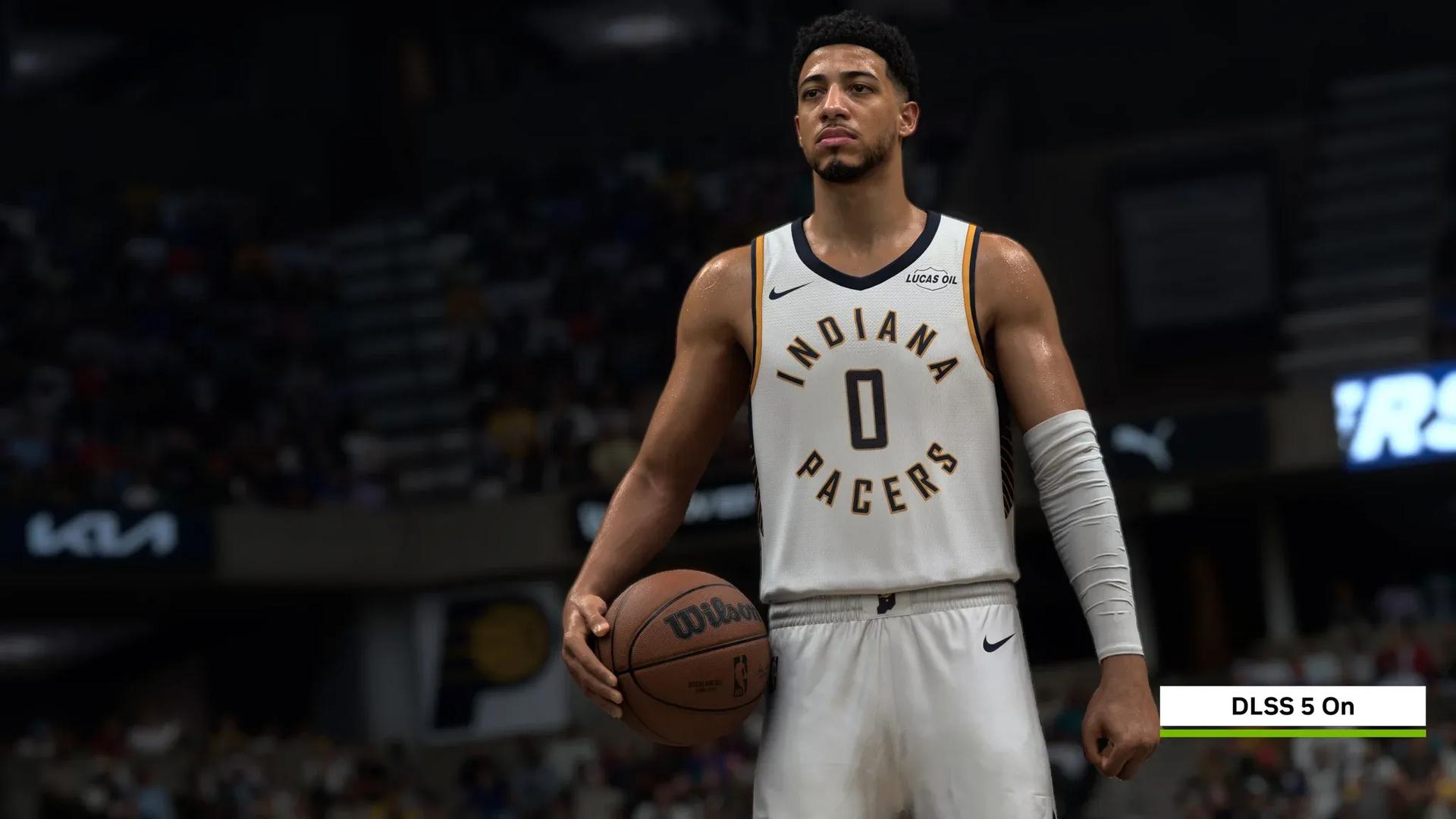
The first game to officially ship with DLSS 5 support is NBA 2K27, which launches September 4, 2026. Photorealism is the entire point of a sports sim like 2K, which makes it a logical first use case. Player models get more detail, and the technology scales well to large crowds of NPCs where individual model quality typically drops off.
On the performance side, Nvidia's own benchmarks are predictably impressive. Running NBA 2K27 at 1080p Ultra with 6x Multi Frame Gen on a system with a 9800X3D and 64GB of RAM, the RTX 5090 averages 797 frames per second. The 5080 hits 602, the 5070 Ti reaches 530, the 5070 lands at 386, the 5060 Ti sits at 325, and the 5060 comes in at 258. Those numbers were produced under controlled conditions that most players won't replicate at home, so real-world results will vary. Still, the demo showed mid-range builds running the game cleanly, which is at least a decent signal.
What most players miss in the performance conversation is that DLSS 5 on 50-series GPUs is designed to have minimal overhead. The heavy lifting happens at the driver and AI inference level, not by taxing the traditional rendering pipeline.
The leak did real damage, but the picture is more complicated
The gap between what the leak showed and what Nvidia actually demonstrated at Gamescom is significant. One was a mod forcing an AI photorealism filter onto characters that were never designed to receive it. The other was a controlled, developer-integrated system with masking, intensity controls, and a player-facing off switch.
That doesn't mean DLSS 5 is without legitimate questions. Independent verification of those performance figures hasn't happened yet, and how developers actually implement the tool in practice will determine whether the player-facing toggle gets used often. If studios apply the filter too aggressively, the off switch will get flipped a lot.
For now, NBA 2K27 is the real-world test. How it looks and performs at launch will tell more than any controlled demo or leaked mod ever could. Keep an eye on our game reviews section when it drops, and if you're looking to stay sharp on other games in the meantime, the gaming guides hub has you covered across a wide range of titles.