

The best prize a game can offer is not always cash, a trophy, or a rare item. Sometimes, it is another reason to keep playing.
Finish a difficult level and another one opens. Complete a side quest and a new section of the map becomes available. Beat a challenge and the game presents another objective. These systems are rarely accidental. Giving players more to play is one of the most established ways to build a satisfying gameplay loop.
Modern game design often treats rewards as more than simple prizes. Quests, progression systems, bonus stages, extra lives, and new challenges can all encourage players to continue interacting with the same mechanics. Roblox's game design documentation, for example, describes quests as a way to provide goals, add variety, facilitate progression, and encourage players to explore different parts of a game.
That design principle appears across genres, from sprawling RPGs to arcade games and online games.

Use code TRYHARD33 at checkout to redeem this offer before code expires again.
Get 33% Off GAMES+ Subscription
Playing More as an In-Game Currency
From a developer's perspective, additional play can be one of the most useful rewards available.
A physical prize costs money to produce and distribute. An extra life, bonus stage, new quest, or additional challenge is already part of the game's digital environment. Once created, it can be used to extend the player's experience without requiring a separate physical reward.
The result is a simple exchange: the player completes something and receives more content to experience.
This is one reason progression systems are so common. A reward does not necessarily need to end the gameplay loop. Instead, it can feed directly back into it. Completing one objective unlocks another, which creates another opportunity to play.
The balance is important. Rewards that arrive too frequently can lose their significance, while rewards that take too long to reach can make progression feel like a chore. Game designers therefore have to consider both the effort required and the value of what comes next.
Every Genre Extends the Session Differently
The reward-with-play concept appears across almost every major game genre, although each uses it differently.
Role-playing games frequently use side quests to extend both gameplay and narrative. The Witcher 3, for example, uses optional contracts and storylines to encourage players to explore areas beyond the main campaign. Side content can introduce new characters, locations, and pieces of the game's wider world.
Platformers and arcade games have traditionally relied on extra lives, continues, bonus stages, and increasingly difficult levels. Losing a life does not necessarily end the experience. Instead, another attempt gives the player an opportunity to apply what they have learned.
Roguelikes take the idea further by making repeated attempts part of the core structure. A failed run can provide knowledge, unlocks, or progression that influences the next attempt. The reward is therefore partly the opportunity to try again with a better understanding of the game.
Online games use quests, seasonal objectives, daily challenges, and progression tracks to provide short- and long-term reasons to return. Game developers increasingly build these systems around a repeating cycle of motivation, action, and reward.
Online slots provide another straightforward example. A bonus round can award additional ilmaiskierrokset, allowing the player to continue using the same game's mechanics without immediately making another stake.
The underlying principle remains similar across these examples: the reward creates momentum rather than bringing the session to an immediate end.
When the Reward Loop Respects the Player
There is an important distinction between rewarding players with more of what they enjoy and using rewards to pressure them into continuing.
A well-designed side quest can add meaningful story content to an RPG. A new level can give a platformer player another opportunity to master its mechanics. A progression system can give an online game a clear set of goals.
Other systems can feel very different when they use deadlines, streaks, or deliberately frustrating progression to encourage players to return. The mechanics may look similar on the surface, but the experience depends heavily on how transparent and proportionate the system is.
Research and industry discussions around player motivation have repeatedly examined the relationship between reward systems, engagement, and retention. GDC's work on player motivation, for example, distinguishes between different forms of motivation and notes that some reward mechanisms can support player relationships while others can create feelings of control.
That distinction matters particularly in games that combine progression with monetisation. Players need to understand what they are receiving, what continuing will cost, and what is expected of them.
Transparency is therefore not separate from game design. It can be part of the design itself.
Designing Rewards That Actually Last
Several principles apply when designing reward systems across different genres.
Make the next goal visible. Players are more likely to work toward something when they understand what they are trying to achieve. A visible progression path can provide a sense of direction without giving away every outcome.
Match effort with payoff. A reward that arrives after almost no effort may quickly become unimportant. At the other extreme, a reward that requires excessive repetition can turn progression into a grind.
Keep rewards connected to the core loop. A new level, ability, quest, character, or challenge usually gives players another reason to engage with the game's central mechanics. This keeps progression connected to the actual experience rather than feeling like a separate system.
Use variety to prevent repetition. Quests can encourage players to approach familiar mechanics in different ways. Roblox's design guidance notes that quests can introduce variety and encourage players to interact with systems they might otherwise overlook.
Be clear about the cost of continuing. This becomes particularly important when real money is involved. Players should be able to understand what they are receiving and what they are paying for before continuing.
At GAMES.GG we also explored how modern games use reward pacing, visual feedback, and progression to make individual gameplay moments feel satisfying.
Why More Play Can Be the Reward
The most interesting part of these systems is that the reward does not always need to exist outside the game.
A new weapon can be useful because it changes how the player approaches the next encounter. A side quest can be valuable because it reveals another part of a game's story. An extra life matters because it provides another opportunity to overcome a difficult section.
In each case, the reward has value because it creates another experience.
That is also why progression systems can be more effective when they remain connected to gameplay. A reward that simply sits in an inventory may be satisfying, but a reward that changes what the player can do can immediately create another reason to continue.
The Takeaway
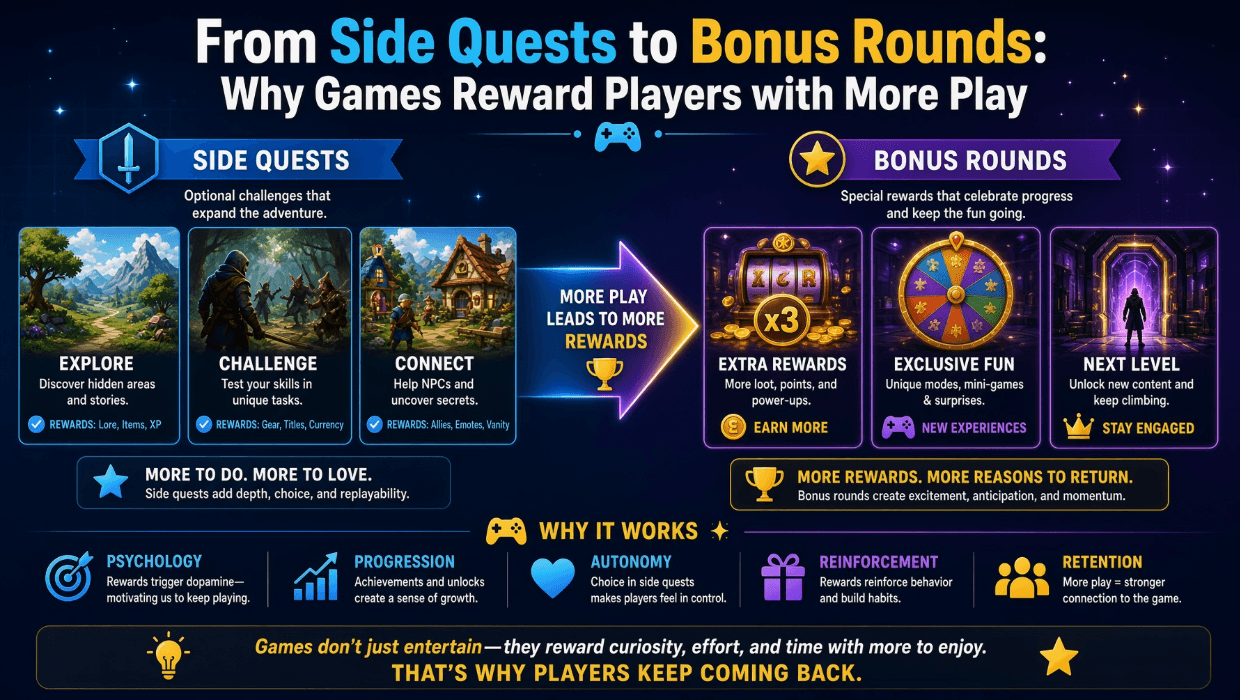
Games reward play with more play because continued interaction is built into the structure of many game experiences. Side quests, bonus stages, extra lives, progression systems, and bonus rounds all use variations of the same basic idea: complete something, receive a new opportunity, and decide whether to continue.
The strongest systems do not rely entirely on the size of the reward. They make the next step interesting enough that players want to see what happens.
For developers, that means balancing progression, effort, variety, and transparency. For players, understanding these systems can make it easier to recognise why certain games encourage one more level, one more quest, or one more attempt long after the original objective has been completed.
Curious how your favorite games keep you coming back? Dig into reviews and guides and start spotting the reward loops for yourself.