

Use a Palworld breeding calculator to predict offspring, find parents for your target Pal, and plan chains using Pals you already own. Most pairings work with either species as the male or female parent, but Katress and Wixen have gender-dependent results. Getting the species right is only part of the job: cakes, passive inheritance, and mutations affect what you hatch. This guide covers Palworld 1.0 breeding, including fixed combinations and the restrictions that can stop a breeding plan before it starts.
Version scope: Palworld 1.0. Recheck saved combinations after updates that change breeding data.
How do you choose the right breeding calculator search?
Start with the question you need answered. A parent-pair search tells you what your current Pals produce, while a target search works backward to show which parents can produce the Pal you want.
| Your goal | Calculator feature to use | What to check |
|---|---|---|
| See what two owned Pals produce | Find a Child or parent-pair lookup | Both complete species names and variants |
| Breed a particular Pal | Find Parents or target search | Which compatible pair you already own |
| Explore one Pal's breeding options | Breeding matrix | Results with different partners |
| Reach a target through intermediate offspring | Shortest breeding path or chain planner | Every intermediate parent and breeding step |
| Explore possibilities using your collection | My Pals or owned-Pal selection | Your selected collection, including variants |
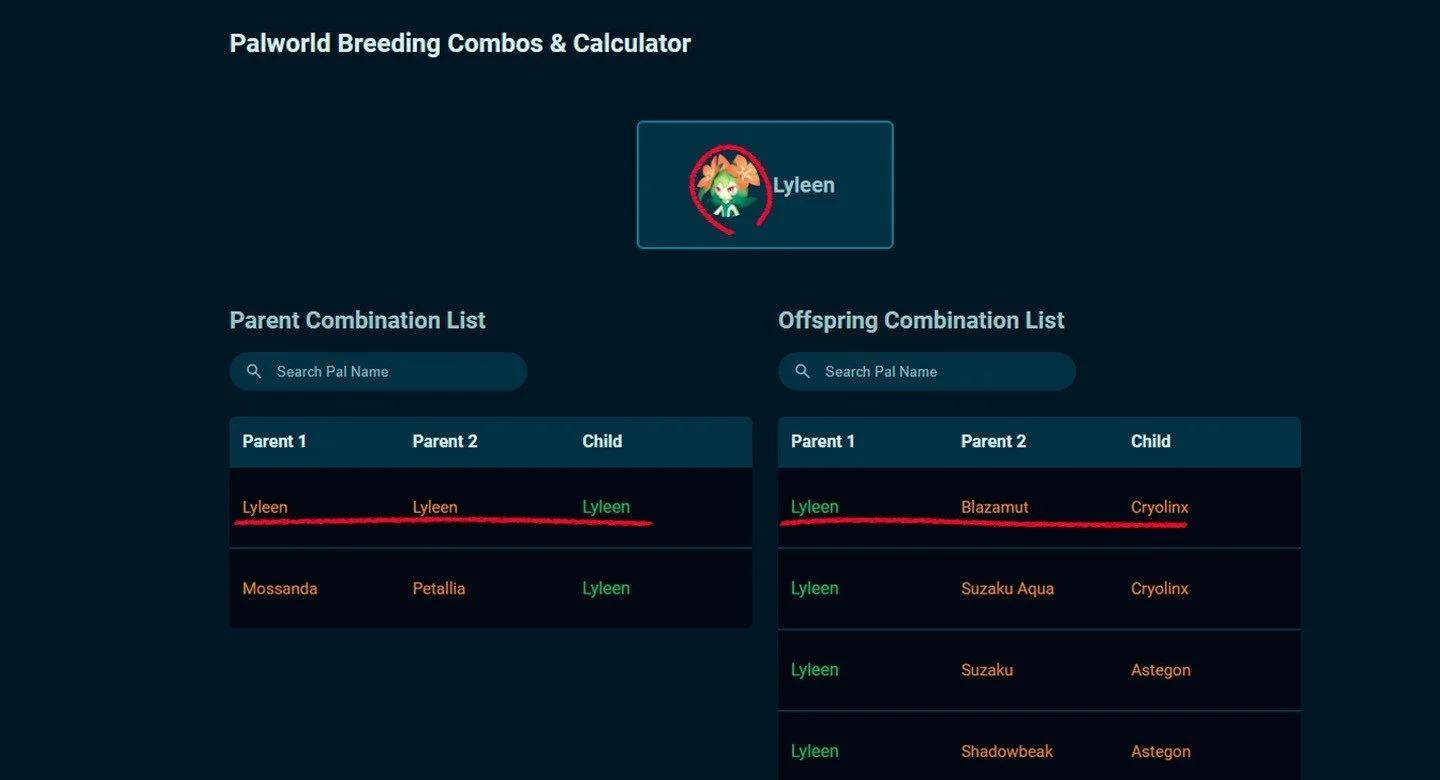
Check the predicted child species


How does the game determine the offspring?
Ordinary pairings use hidden breeding-power values assigned to Pal species. The game averages the parents' values and selects the species with the closest value. Special combinations use fixed results instead of that normal calculation.
You rarely need to work out those values yourself. For example, Dumud + Sweepa and Caprity + Azurobe both produce Kingpaca, giving you alternatives depending on your collection.
How do you check a multi-step breeding chain?
Choose your target, then compare its direct parents with your Palbox. If you need an intermediate offspring, check that pairing separately before committing to the whole chain. The Palworld 1.0 breeding combos guide can help you compare breeding targets while planning your route.
A shortest chain measures species-producing steps, not the number of eggs needed for your finished Pal. An intermediate offspring may need further breeding attempts to carry the passive skills you want into the next generation.
If a planner returns no path, check the target's direct parents. Your selected collection might not connect within the search depth, even though the target has valid breeding combinations.
How do you turn a parent pairing into an egg?
You need a Breeding Farm or Ancient Hatchery, a male and female Pal, and Cake. The calculator handles the species prediction; you still need to assign compatible parents and supply the breeding facility.
Follow this sequence:
- Check both parents' complete names, including suffixes such as Noct, Cryst, or Lux.
- Confirm that you have one male and one female.
- Assign both Pals to your Breeding Farm or Ancient Hatchery.
- Supply Cake, choosing a specialty cake if its effect matches your goal.
- Wait for the Pal Egg, then incubate it.
Before repeating a pairing, inspect the hatched Pal's species and passive skills. A correct species result is useful, but it does not mean that offspring is ready to become the next parent in a passive-inheritance project.
When do parent genders change the breeding result?
For ordinary combinations, either species can fill the male or female role without changing the expected child. Katress + Wixen is the exception: the female parent's species determines which variant you get.
| Female parent | Male parent | Normal offspring |
|---|---|---|
| Wixen | Katress | Wixen Noct |
| Katress | Wixen | Katress Ignis |
Changing the parents' visual order in a calculator is harmless. Changing which species is female changes this pairing's result, so record the gender roles alongside the names.
Which special breeding combinations should you check?
Fixed combinations are worth checking before you search through ordinary parent options. They provide specific routes to variants such as Mau Cryst, Relaxaurus Lux, and Frostallion Noct.
The following examples use one male and one female. Their species can exchange gender roles without changing the normal offspring.
| Target offspring | Required parent pair |
|---|---|
| Broncherry Aqua | Broncherry + Fuack |
| Dinossom Lux | Dinossom + Rayhound |
| Eikthyrdeer Terra | Eikthyrdeer + Hangyu |
| Frostallion Noct | Frostallion + Helzephyr |
| Incineram Noct | Incineram + Maraith |
| Jolthog Cryst | Jolthog + Pengullet |
| Kingpaca Cryst | Kingpaca + Reindrix |
| Lyleen Noct | Lyleen + Menasting |
| Mau Cryst | Mau + Pengullet |
| Mossanda Lux | Mossanda + Grizzbolt |
| Relaxaurus Lux | Relaxaurus + Sparkit |
| Reptyro Cryst | Reptyro + Foxcicle |
| Suzaku Aqua | Suzaku + Jormuntide |
| Vanwyrm Cryst | Vanwyrm + Foxcicle |
These are specific pairings, not a rule that any elemental Pal creates a matching variant. Foxcicle works with Vanwyrm and Reptyro for the results above; that does not establish a recipe for another species.
Which Pals require parents of the same species?
Some targets have no cross-species breeding route in Palworld 1.0. For these Pals, breeding reproduces a species you already own rather than providing your first one.
| Target | Required parents |
|---|---|
| Faleris | Faleris + Faleris |
| Frostallion | Frostallion + Frostallion |
| Grizzbolt | Grizzbolt + Grizzbolt |
| Jetragon | Jetragon + Jetragon |
| Jormuntide Ignis | Jormuntide Ignis + Jormuntide Ignis |
| Lyleen | Lyleen + Lyleen |
| Necromus | Necromus + Necromus |
| Orserk | Orserk + Orserk |
| Paladius | Paladius + Paladius |
| Shadowbeak | Shadowbeak + Shadowbeak |
For Frostallion, you need a male Frostallion and a female Frostallion. Adding intermediate species to a chain cannot bypass its same-species requirement.
Which cake should you use for breeding?
Choose your cake around the outcome you want beyond the normal species result. Palworld 1.0 has regular Cake plus four specialty options, and their effects serve different breeding projects.
| Cake | Breeding effect | Best for |
|---|---|---|
| Cake | No additional effect | Breeding when you do not need a specialty effect |
| Mushroom Cake | Slightly increases the chance of higher hidden stats | Projects focused on hidden stats |
| Vegetable Cake | Produces 2 eggs instead of 1 | Increasing egg output |
| Extravagant Vegetable Cake | Increases mutation chances and the chance of better hidden stats | Mutation-focused breeding |
| Special Cake | Increases the chance of inheriting parents' passive skills | Passing desired passives into offspring |
Use Special Cake when inherited passive skills are your priority, because its effect directly supports that goal. For ingredient lists and preparation, check the Palworld cake recipes guide.
Vegetable Cake is the practical choice when you want more eggs per breeding result. Mushroom Cake targets hidden stats, while Extravagant Vegetable Cake suits players deliberately pursuing mutations.
Mutation is a separate complication for species planning. A mutated egg produces a different outcome than the parents normally would and always has a mutation-exclusive passive skill.
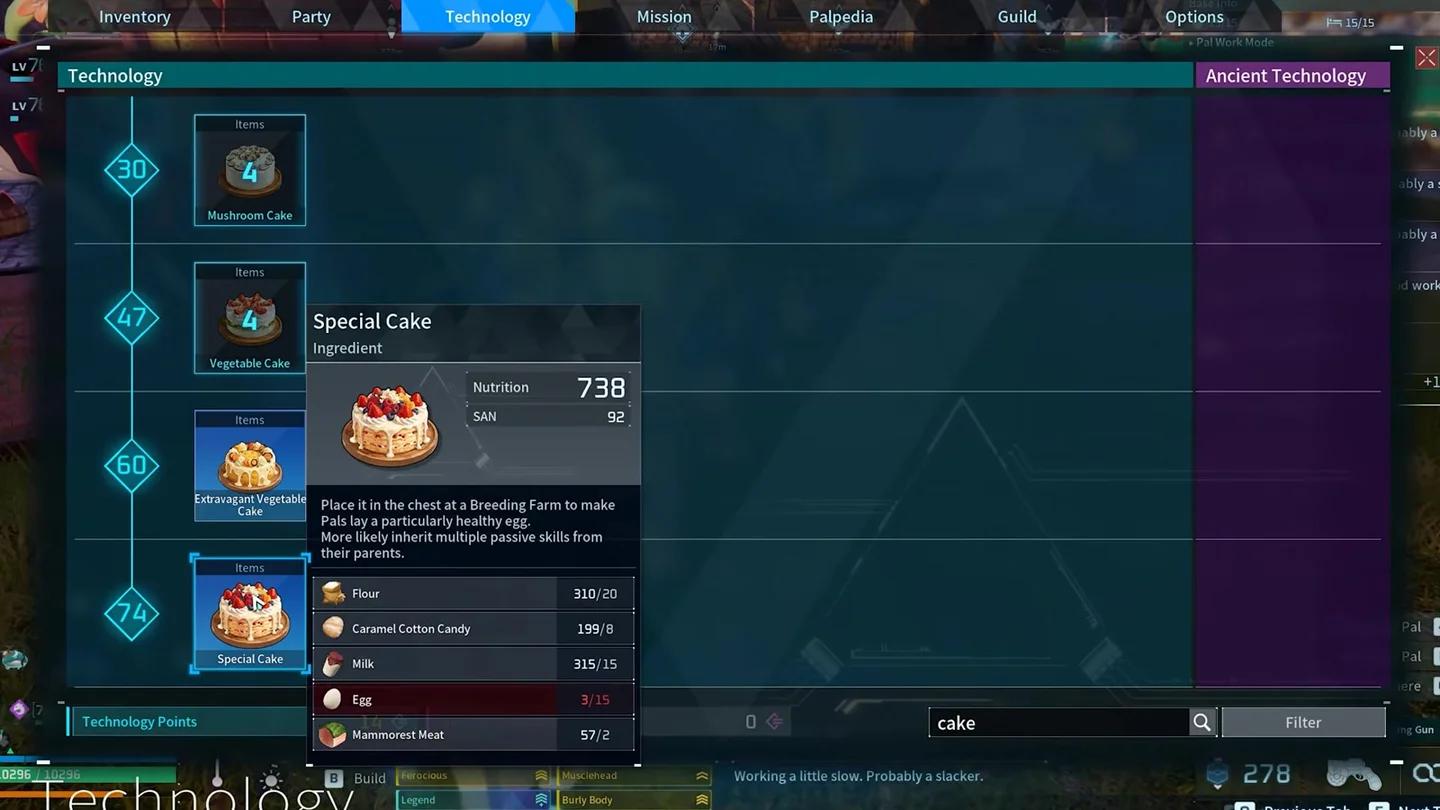
Choose cake for your breeding goal
Common mistakes
These breeding errors can waste attempts even when your parent species look correct:
- Selecting the wrong variant. Frostallion and Frostallion Noct are separate breeding selections. Match the complete name rather than just the species family.
- Copying Katress and Wixen without genders. Female Wixen produces Wixen Noct with male Katress; female Katress produces Katress Ignis with male Wixen.
- Expecting a calculator to guarantee passives. A normal species prediction does not promise passive skills, individual values, mutations, or the offspring's gender.
- Treating no path as proof a Pal cannot be bred. Check direct parents and your planner's search depth before abandoning the target.
- Continuing an old chain without checking its next step. Palworld 1.0 changed breeding combinations, so an Early Access screenshot can send you toward the wrong offspring.
Pro tips
Keep useful fixed-combination partners
Keep Pengullet available if you want both Mau Cryst and Jolthog Cryst. Keep Foxcicle for Vanwyrm Cryst and Reptyro Cryst. These partners support multiple fixed recipes, making them useful for players filling out variant collections.
Choose parents around your actual Palbox
A calculator's rarity-sorted first result is not automatically your easiest option. For players with an established collection, an already-owned compatible pair is a better starting point than a pair that requires obtaining both parents.
Check each intermediate offspring
For passive-focused chains, inspect every intermediate Pal before using it as a parent. Reaching the correct species without the desired passive skills may require more attempts before the next generation is ready.
Frequently asked questions
Do parents need to be the same species?
No. Many Pals can be produced through cross-species pairings. Targets such as Frostallion, Jetragon, and Shadowbeak require two parents of their own species in Palworld 1.0.
Can you breed your first Frostallion using other Pals?
No. Frostallion's direct pairing is Frostallion + Frostallion, so you already need a compatible pair to reproduce it through breeding.
Does the shortest breeding chain guarantee the fewest eggs?
No. A shortest chain counts species-producing steps. Getting the passive skills, hidden stats, or gender you need can require additional eggs.
How do you start pursuing mutation eggs?
Extravagant Vegetable Cake increases mutation chances, and mutated offspring have a mutation-exclusive passive skill. Plan mutations as a separate breeding goal, then use the Mutation Pals and eggs guide to work through that project.