Overview
Spyro the Dragon is a 3D platformer developed by Insomniac Games and released for PlayStation in September 1998. The premise is clean and immediately compelling: the villainous Gnasty Gnorc has encased every dragon in the land in crystal and converted their gem hoards into soldiers. Every dragon, that is, except Spyro, a small purple dragon who was too insignificant for Gnasty Gnorc to bother with. That oversight proves costly.
The game spreads across six distinct homeworlds, each acting as a hub connecting several smaller levels. Spyro moves between them freely, which gives the whole experience a looser, more exploratory feel than the strictly linear platformers of the era. There are 80 dragons to free and thousands of gems to collect across the game's worlds, and chasing full completion keeps the adventure going well beyond the credits.
Sparx the dragonfly travels alongside Spyro throughout the game, serving as both a health indicator and a gem magnet. Sparx changes color as Spyro takes damage and disappears entirely when health runs critically low, giving players an intuitive read on their situation without cluttering the screen with UI.

Spyro the Dragon content image
Gameplay and mechanics
Spyro's core moveset is small but satisfying to master. His primary tools are:

Spyro the Dragon content image
- Flame breath to defeat enemies and light torches
- A charging headbutt for armored foes
- Gliding from elevated positions to reach distant platforms
- Gem collection scattered throughout every level
- Dragon rescue by touching frozen crystal statues
The controls are tight for a 1998 3D game. Spyro turns quickly, the camera is manageable, and the jump-to-glide arc gives movement a physical logic that feels rewarding to exploit. Levels are designed to reward players who look up, who run to the edges, and who circle back after unlocking new areas.

Spyro the Dragon content image
World and setting
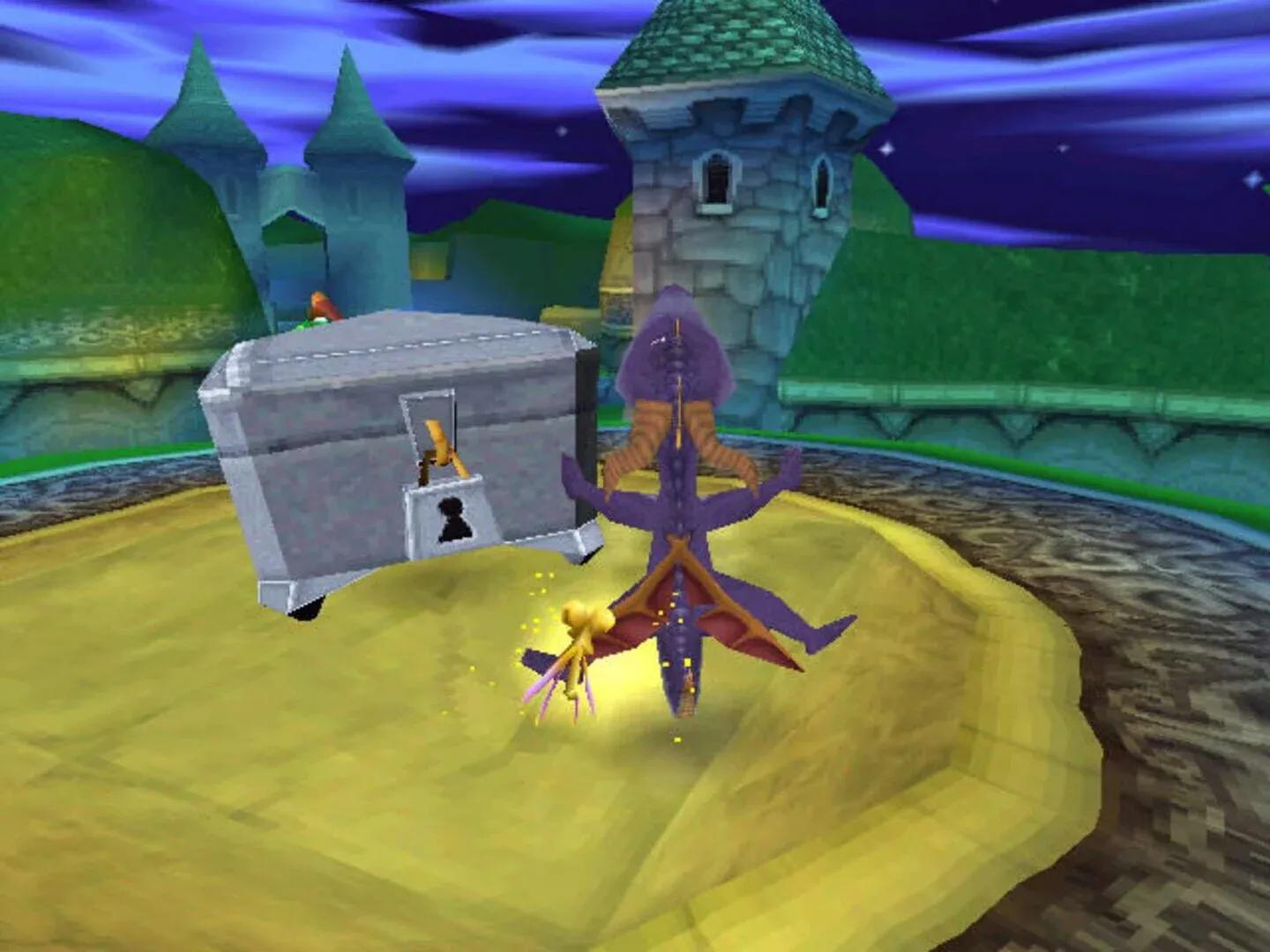
The Dragon Lands are split into themed homeworlds: Artisans, Peace Keepers, Magic Crafters, Beast Makers, and Dream Weavers, each feeding into a final confrontation with Gnasty Gnorc himself. Every homeworld has its own visual identity and introduces enemies and geometry that match its theme.
Spyro the Dragon content image
Artisans opens the game with gentle green hills and stone castles, easing players in. By the time the Dream Weavers homeworld appears, the environments have shifted to surreal floating islands and nightmare creatures. The tonal range across those worlds is one of the game's quiet strengths, keeping the visual experience fresh across the full runtime.
Visual and audio design
For a 1998 PlayStation release, Spyro the Dragon pushes the hardware noticeably. Insomniac built a custom engine that eliminated load screens between the hub worlds and their connected levels by streaming geometry dynamically, a technical achievement that made the world feel genuinely connected rather than segmented.
Stewart Copeland, drummer for The Police, composed the soundtrack. His score matches the game's tone precisely: playful and slightly eccentric in the lighter worlds, tense and atmospheric in the darker ones. The music is one of the most distinct elements of the original game and holds up as a defining piece of late-1990s game audio.
Impact and legacy
Spyro the Dragon sold over five million copies and became one of PlayStation's signature platform games, sitting alongside Crash Bandicoot as a defining mascot of the era. The game spawned two direct sequels on PlayStation, and the character remained active in gaming for decades afterward.
The original trilogy received a full remaster collection, Spyro Reignited Trilogy, released in 2018, introducing the character to a new generation while preserving the structure and pacing of the originals. The 1998 game's influence on 3D platformer design, particularly its approach to open hub worlds and collectible-driven progression, remains visible in the genre today.