Search games, articles, guides...CtrlK
Sign InGet Started
Master Soul Binding in Aion 2: learn how Bind, Sync, and Reset work, which stats to target, and when to invest your materials.

Written by Abdalla
Content Writer
See more GAMES.GG guides on Google
Add us as a preferred source and our guides show up first in your results.
Aion 2 Combat Analysis Guide: How to Read and Use the DPS Meter
Learn how to open Aion 2's built-in Combat Analysis, read every stat, compare builds on Training Scarecrows, and set up macros.

Aion 2 Draupnir Expedition Guide: All Bosses and Rewards
Beat every boss in Aion 2's Draupnir dungeon, survive Bakarma's wave phases, and maximize your Anguish and Bakarma gear drops.

Aion 2 Krao Cave Expedition Guide: Clear Every Boss Fast
Master Krao Cave in Aion 2 with boss mechanics, stagger timing, and reward tips for both Exploration and Conquest modes.
Soul Binding is where a large chunk of your real character power lives in Aion 2. The system stamps extra stats directly onto your gear, and those bonuses stack on top of everything else: base item stats, manastones, theostones. Get the right rolls and push them to their ceiling, and you will notice the difference in every fight. Get the wrong rolls and spend everything maxing them out, and you have wasted a pile of materials for nothing.
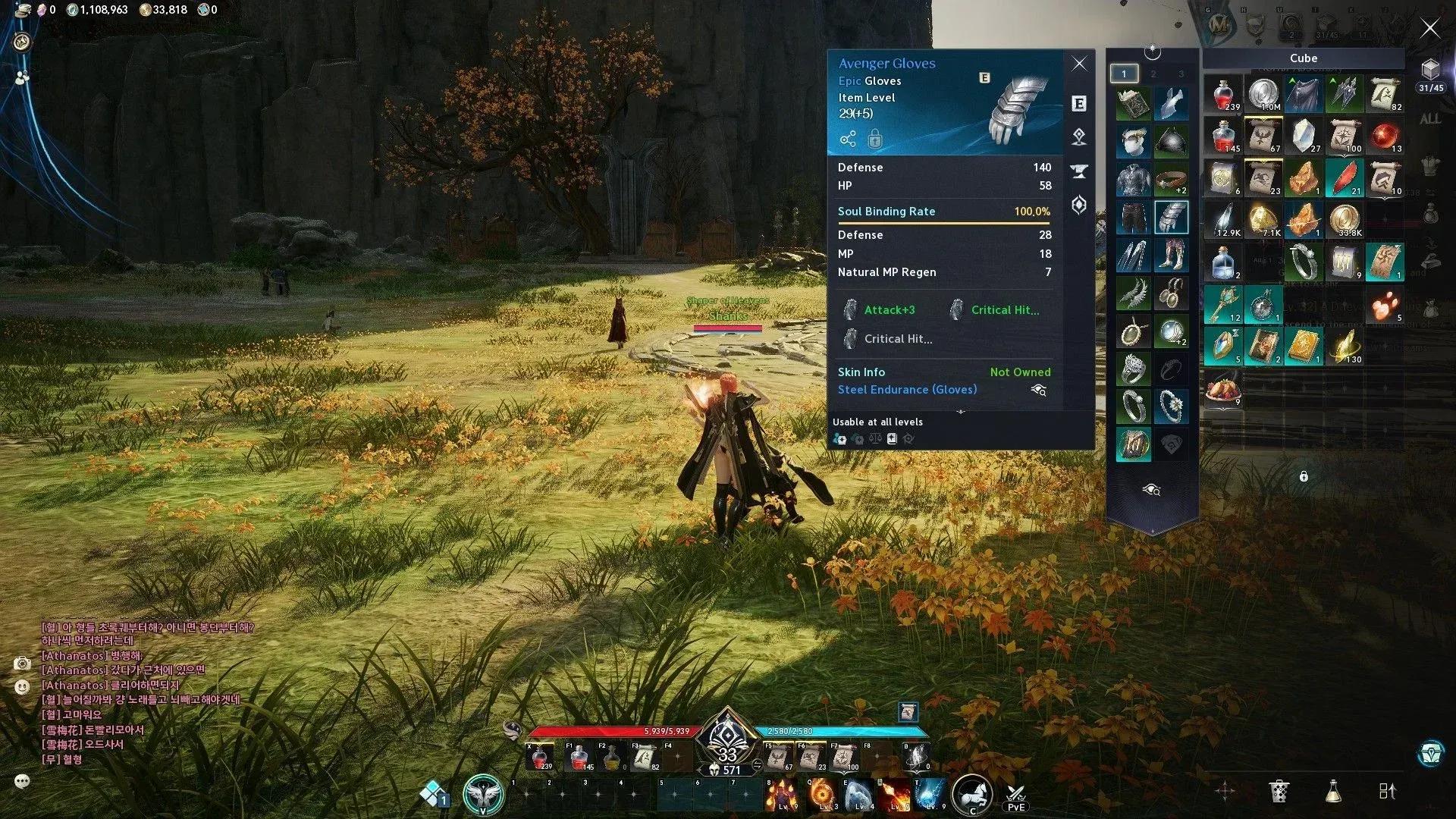
Soul Binding adds extra stat slots to a piece of gear. The number of slots depends on the item's grade, and the stats that land in those slots are drawn at random from a pool specific to the equipment type. Binding an item locks it to your character permanently, so anything that was tradeable before you started is gone from the market the moment you commit.
The slot counts by grade are fixed:
| Grade | Soul Binding slots |
|---|---|
| Common | 1 |
| Rare | 2 |
| Epic | 3 |
| Unique | 3 to 5 |
| Heroic | 4 to 6 |
Unique and Heroic pieces can also unlock one additional slot beyond these counts, but that comes later and costs more. Rare and Epic gear sometimes drops as unbound loot you can still sell. Check whether you actually want to keep a piece before you touch it.
Open the Enhance All window and select the Soul Binding tab. You will see three distinct operations: Bind, Sync, and Reset. They are not interchangeable tools for the same job. Each one handles a different problem, and using the wrong one at the wrong time burns materials for no gain.
The sensible order is always: fix the stats first with Sync or Reset, then spend your Codex raising them with Bind. Binding bad stats to their ceiling is the most common and most expensive mistake in this system.
Bind pushes the values of whatever stats are already on your gear toward their maximum. Every attempt is a guaranteed increase, but the amount gained is random, and the higher a stat climbs the harder it becomes to push further. Each attempt costs 30,000 Kinah plus one or more Soul Codex, with the Codex count rising as a stat approaches its cap.
The item's Soul Binding Rate tracks overall progress. When it hits 100%, every stat on the piece is at its ceiling and the item drops out of the editing window entirely. You cannot change stats on a maxed item, so only commit to Bind once you are satisfied with the rolls.
To illustrate how the probability curve works, consider a Unique dagger with Critical Attack sitting at 48 out of a maximum of 51:
| Target value | Chance |
|---|---|
| 49 | 42.33% |
| 50 | 32.60% |
| 51 | 25.07% |
Stat ranges with wider spreads get significantly harder at the top. An HP roll on that same dagger running from 226 to 265 has only a 0.65% chance of hitting the absolute maximum on any given attempt. Plan your Codex budget accordingly.
Sync is the surgical option. You select a single stat you want replaced, feed in a sacrifice item of the same grade and type, and that one slot gets rerolled into something new from the pool. The sacrifice item is destroyed regardless of outcome, so double-check what you are feeding before confirming.
This is why you should never automatically dismantle every spare Unique drop. Those duplicates are Sync fodder for your main pieces. A Sync Stone Fragment can substitute for a duplicate item if you do not have one, but there is a catch: a Sync Stone below the target gear's grade only applies 10% of the time. Never try to sync a Unique-grade stone into Heroic gear expecting it to work.
Reset shuffles all Soul Binding stats on a piece at once and wipes the Soul Binding Rate back to zero. It requires a Soul Codex: Reset plus Kinah, and the results are completely random. You cannot steer the outcome.
Use Reset when two or more slots are rolling stats that are useless for your build and the item itself is worth keeping long-term. In that situation, a full reroll is generally cheaper than sacrificing multiple items through Sync to fix each bad slot individually. If only one stat is the problem, Sync is the better call.
Soul Binding is one of the heavier resource drains in the game. Knowing where each material comes from before you start farming saves a lot of confusion.
| Material | Used for | Sources |
|---|---|---|
| Soul Codex | Bind | Dungeon drops, Expeditions, Dimensional Invasion, Shugo Festival, Nightmare Shop, Hidden Cubes, Trade Shop |
| Soul Codex: Reset | Reset | Nightmare Shop, quest and achievement rewards, seasonal trade shops, Hidden Cubes |
| Sync Stone Fragment | Sync | Sanctuary, dungeon morphs, spare Unique pieces |
| Philosopher's Stone | Extra slot unlock | Conquest dungeons |
The Nightmare Trade Shop sells both Soul Codex and Soul Codex: Reset with weekly purchase limits per character, so it is worth hitting every reset. Hidden Cubes can drop either type as well, making them worth opening when you have them.
For players building out their daily routine around farming these materials efficiently, a structured daily and weekly activity checklist helps ensure you never skip a reset that could drop Codex.
Unique and Heroic pieces support one additional slot beyond their base count, but only after every existing slot has been maxed. The item must be sitting at 100% Soul Binding Rate before the option becomes available.
From there, the unlock costs 2 Philosopher's Stones and 1,000,000 Kinah, and it always succeeds. There is no RNG on the unlock itself, only on what stat the new slot rolls.
Here is where it gets specific: there are two Philosopher's Stone variants, Philosopher's Stone: Revelation and Philosopher's Stone: Power, and roughly four out of five pieces require Revelation while the rest need Power. Which one your item needs is stamped on the item itself and cannot be predicted from grade, tier, or item level alone. Two Unique boots at the same level can require different stones. Check the piece before you farm.
This is the part that makes Soul Binding worth doing even on gear you plan to replace later. When you transfer enhancements to a new piece, the base Soul Binding stats carry over at exactly the values you had reached.
| On transfer | Result |
|---|---|
| Base stats at their bound values | Carry over |
| Philosopher's Stone extra stat | Does not transfer, rerolls from scratch |
The extra slot is the only exception. It gets rerolled on the new piece and you must spend the Philosopher's Stones again. Everything else you invested in Bind carries forward, which makes the base Soul Binding work a lower-risk investment than it might initially appear.
Stat pools are split by equipment category, and about one draw in five lands on a class skill bonus instead of a regular stat. Weapons, guards, and rings draw from the 12 active skills your class uses with that weapon type. Armor, earrings, and necklaces draw from the class's 10 passive skills. Weapons are class-locked, so a dagger only ever rolls Assassin skills.
For the remaining four draws in five, the stat depends on what slot you are rolling. The percentages below represent the odds within the stat portion of the draw only.
| Stat | Chance | Stat | Chance |
|---|---|---|---|
| Accuracy | 8% | HP | 8% |
| Critical Attack | 8% | MP | 8% |
| Attack | 7% | Multi-hit Chance | 6% |
| Back Attack | 7% | Might | 6% |
| Block | 7% | Precision | 7% |
| Critical Hit | 7% | Combat Speed | 4% |
| Frontal Attack | 7% | Status Effect Chance | 4% |
| Weapon Damage Boost | 4% | Damage Boost | 2% |
Damage Boost at 2% is the rarest stat in the weapon pool and the one most builds want. Every time you see it roll, treat it as a keeper.
| Stat | Chance | Stat | Chance |
|---|---|---|---|
| Block | 6% | Accuracy | 5% |
| Critical Damage Defense | 6% | Back Defense | 5% |
| Critical Hit Resist | 6% | Critical Hit | 5% |
| HP | 6% | Defense | 5% |
| MP | 6% | Evasion | 5% |
| Natural HP Regen | 6% | Frontal Defense | 5% |
| Natural MP Regen | 6% | Attack | 4% |
| Constitution | 4% | Dexterity | 4% |
| Willpower | 4% | Status Effect Resist | 3% |
Certain armor pieces have exclusive stats that appear nowhere else in the armor category. Chest is the only armor source of Damage Boost. Shoulder is the only armor source of Critical Damage Boost. Gloves are the only armor source of Combat Speed. Smite only rolls on helmet and cape. These slot-exclusive stats are worth planning builds around.
| Stat | Chance | Stat | Chance |
|---|---|---|---|
| Natural HP Regen | 10% | Natural MP Regen | 10% |
| Block | 9% | Critical Hit Resist | 9% |
| HP | 9% | MP | 9% |
| Accuracy | 7% | Attack | 7% |
| Critical Hit | 7% | Defense | 7% |
| Evasion | 7% | Flight Power | 5% |
| Intelligence | 4% |
Putting it all together, here is the sequence that avoids wasting materials:
The biggest waste in this system is binding an item to 100% before deciding whether its stat combination is actually good. Reversing that decision costs a Soul Codex: Reset on top of everything already spent.
For class-specific stat priorities to target during your rolls, the Aion 2 Assassin build guide covers exactly which offensive stats matter most for that class, and the same logic applies when evaluating your weapon rolls.
For a broader look at all the gear systems running in parallel, the full Aion 2 strategy guides collection covers everything from hotbar setup to Genus Insight stat rerolling.