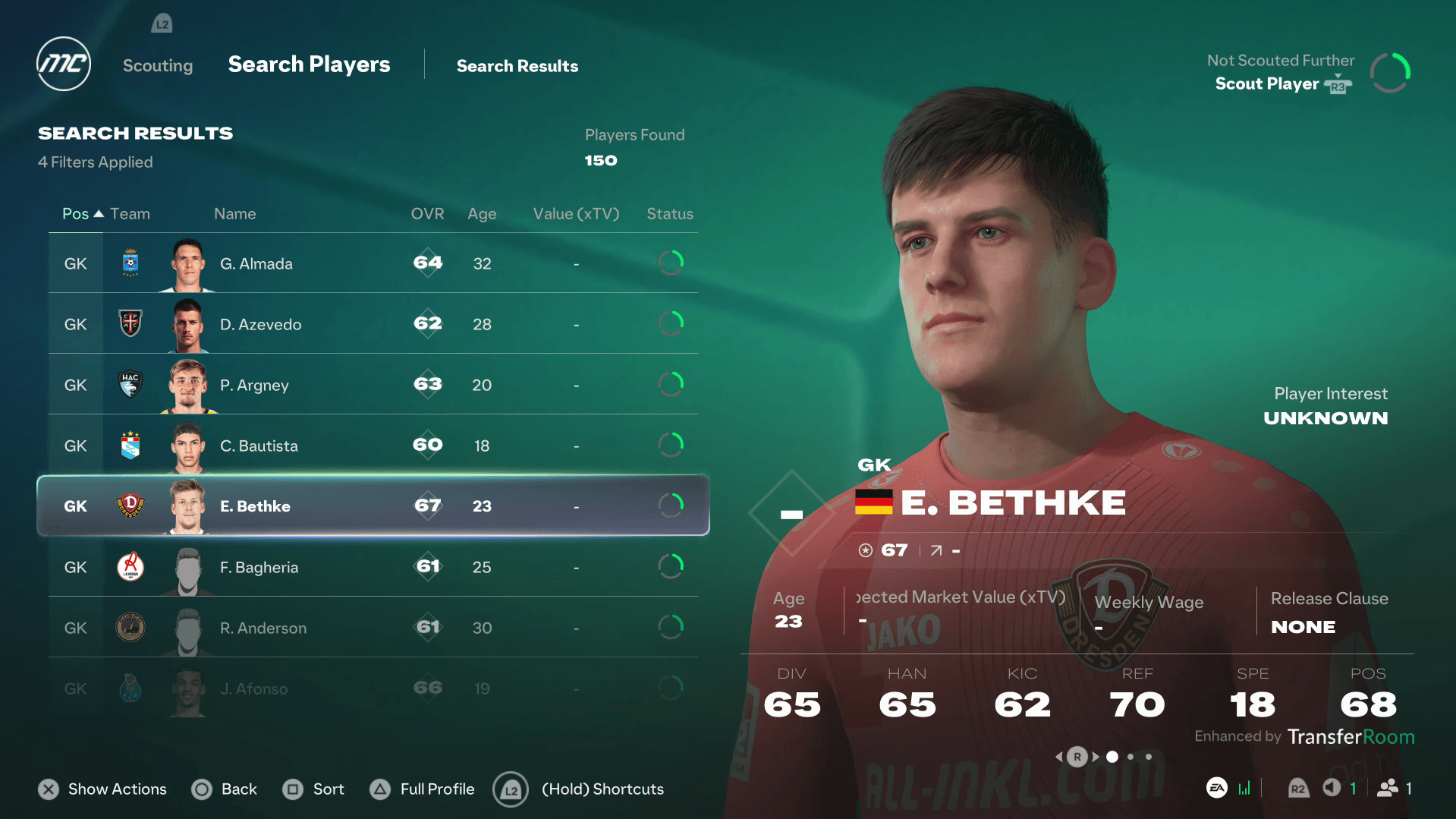

EA Sports FC 27 gives you something previous entries never did: a fully transparent potential rating for every player in the database. No more guessing whether that 72-rated teenager will become elite or plateau at 80. The number is right there. What that means for Career Mode is that the wonderkid hunt is now less about discovery and more about prioritization. Which players offer the best growth for your budget? Which ones can contribute immediately while still developing? This guide answers both questions, position by position.
Transparent potential ratings in FC 27
How does Dynamic Potential change wonderkid development in FC 27?
Before getting into names and numbers, the development system itself deserves attention because it changes how you should evaluate every signing.
FC 27 replaces the old fixed development curve with two connected systems. Growth Profiles assign each player one of six development paths that control when he peaks, how fast he improves, and how quickly he declines after his prime. Two 19-year-olds with identical OVR and potential ratings can end up on completely different trajectories depending on their profile, so checking the Future stage of a scout report before committing big money matters more than ever.
Dynamic Potential is the second piece. Long-term growth is now tied directly to on-pitch performance. Players who consistently exceed expectations raise their ceiling above the listed potential number. Players who sit on the bench or go through prolonged poor form lose development momentum. The system also runs for AI clubs in every league set to Deeper Simulation, which now supports up to ten leagues, meaning a 70-rated teenager at a mid-table club can break out on his own between windows.
Training Plans are gone in FC 27. Match Fitness replaces them as the readiness system, so squad rotation is now the primary tool for keeping young players sharp. The squad role you promise a wonderkid also sets expectations for playing time, and breaking that promise damages morale and suppresses Dynamic OVR growth.

Who are the highest-potential wonderkids in FC 27?
The ten men's players aged 21 or younger with the highest starting potential cover a wide price range, from untouchable Barcelona stars to genuinely accessible signings.
| Player | Club | OVR | POT | Growth Gap |
|---|---|---|---|---|
| Lamine Yamal | FC Barcelona | 90 | 95 | +5 |
| João Neves | Paris Saint-Germain | 88 | 92 | +4 |
| Désiré Doué | Paris Saint-Germain | 86 | 92 | +6 |
| Pau Cubarsí | FC Barcelona | 86 | 91 | +5 |
| Yan Diomande | Real Madrid | 84 | 90 | +6 |
| Estêvão | Chelsea | 80 | 90 | +10 |
| Kenan Yıldız | Juventus | 84 | 89 | +5 |
| Arda Güler | Real Madrid | 83 | 89 | +6 |
| Warren Zaïre-Emery | Paris Saint-Germain | 83 | 89 | +6 |
| Luka Vušković | Brighton | 81 | 89 | +8 |
Yamal is the headline, starting at 90 OVR with a 95 potential ceiling. Only the likes of Messi and Ronaldo have reached those heights in this game series. The problem is the price tag, which sits north of $250m. For most Career Mode saves, he belongs in the admire-from-afar category unless you start with a takeover budget.
Estêvão is the smarter development pick among the elite tier. His +10 growth gap is twice what Yamal or Cubarsí offer, and his cost is significantly lower than the PSG and Barcelona names above him. Vušković offers similar logic at center-back with +8 growth from an 81 starting OVR.
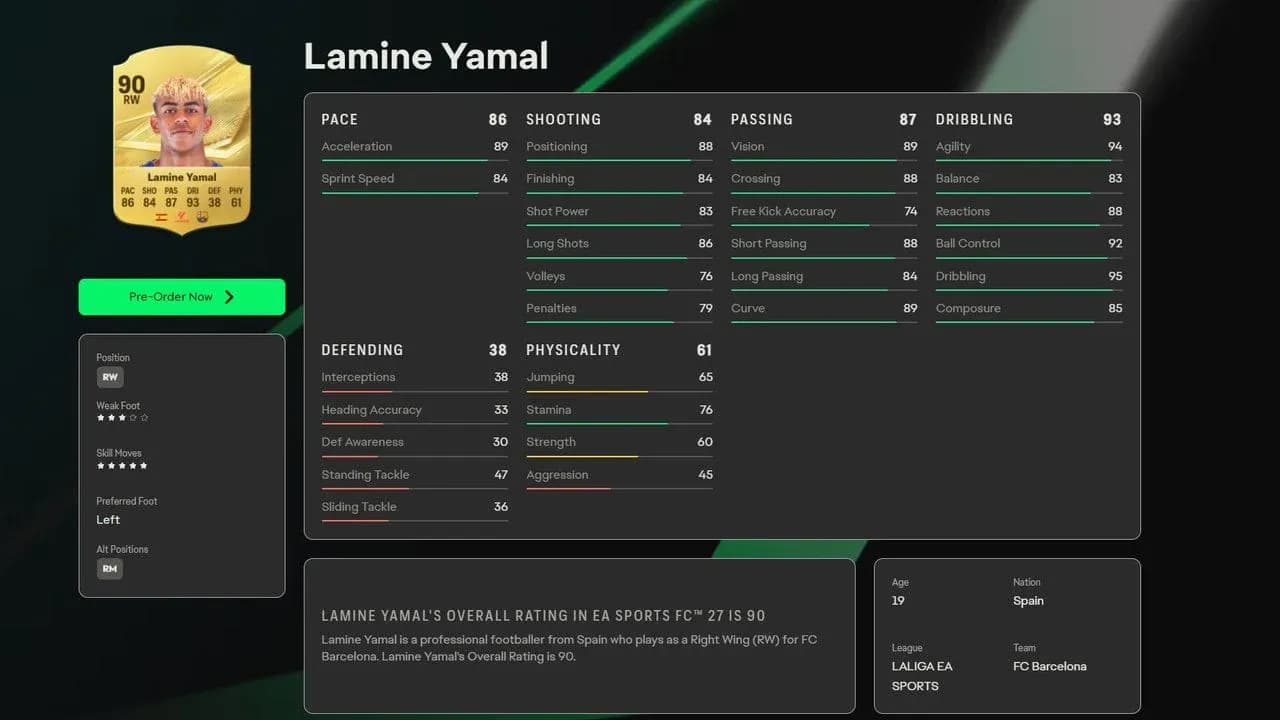
Yamal leads all FC 27 wonderkids
Best cheap wonderkids under $10m: Where are the real bargains?
This is where Career Mode gets genuinely interesting. The budget tier of wonderkids in FC 27 is stacked, and several of them carry 87 or 88 potential for starting fees well under $10m.
Justin Lerma (Borussia Dortmund, CAM) is the standout. The 18-year-old Ecuadorian starts at 66 OVR with 87 potential, costs around $3m, and earns under $10k per week. He plays CAM, CM, and LM, and his 76 Pace gives him usable rotation value from day one rather than forcing you to hide him on the bench for two seasons.
Mathis Albert (Borussia Dortmund, LM) is the highest-potential cheap winger in the game at 88 potential from a 66 OVR start, also for around $3m. The growth gap of +22 is the largest on either flank.
Francesco Camarda (AC Milan, ST) is the equivalent for strikers. At 18 with a 66 OVR and 87 potential, he costs approximately $2.7m and represents the cheapest route to an elite-level forward. He spent time on loan at Lecce in real life, and Serie A's reluctance to hand teenagers consistent minutes has kept his rating modest. In your save, that changes immediately.
| Player | Position | Club | OVR | POT | Approx. Value |
|---|---|---|---|---|---|
| Justin Lerma | CAM | Borussia Dortmund | 66 | 87 | ~$3m |
| Mathis Albert | LM | Borussia Dortmund | 66 | 88 | ~$3m |
| Francesco Camarda | ST | AC Milan | 66 | 87 | ~$3m |
| Abdellah Ouazane | CAM | Ajax | 66 | 87 | ~$3m |
| Florian Hellstern | GK | SpVgg Greuther Fürth | 66 | 86 | ~$1.4m |
| Nathan De Cat | CDM | TSG Hoffenheim | 71 | 88 | ~$4.8m |
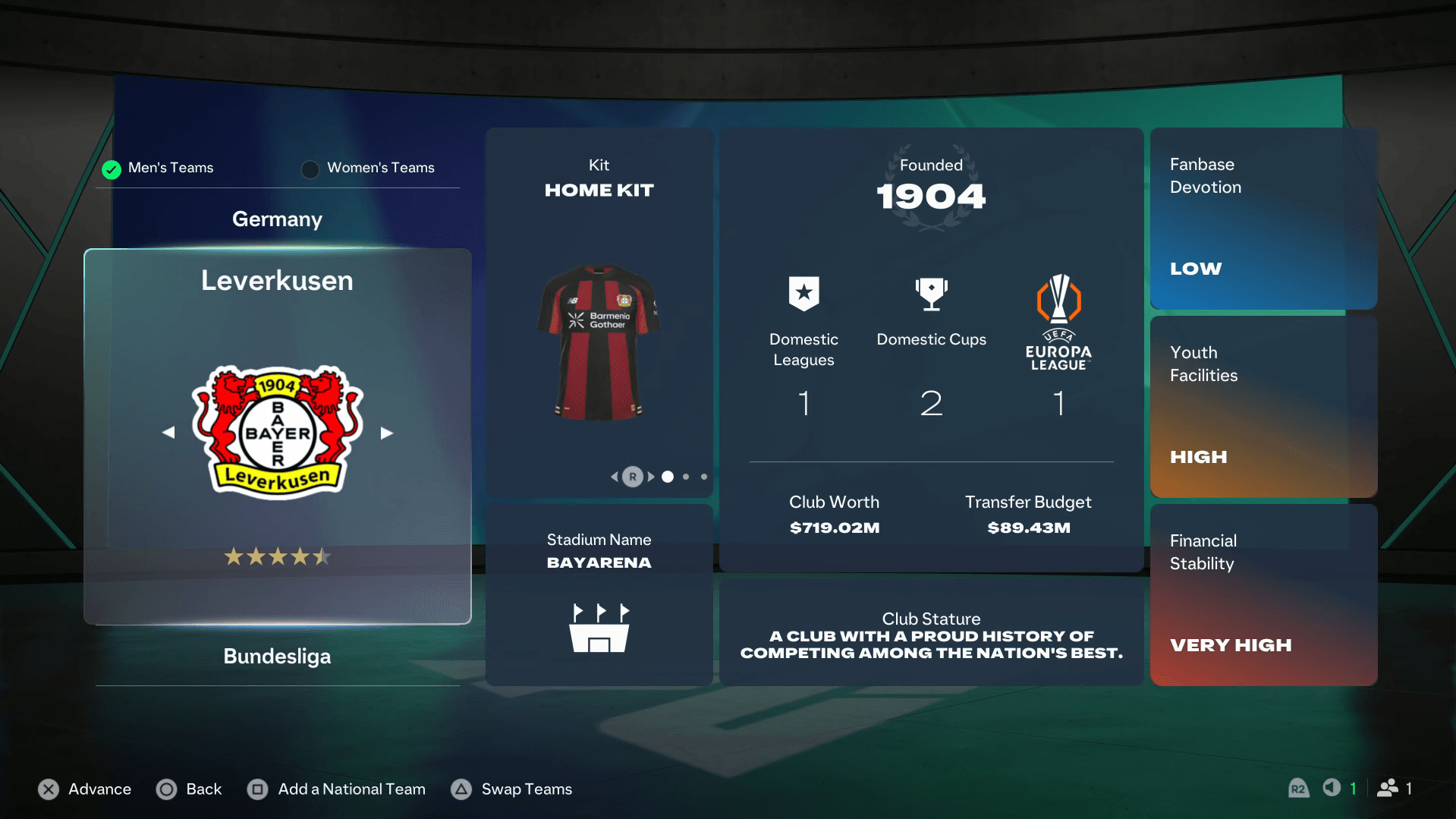
| Kennet Eichhorn | CDM | Bayer Leverkusen | 68 | 88 | ~$3.4m |
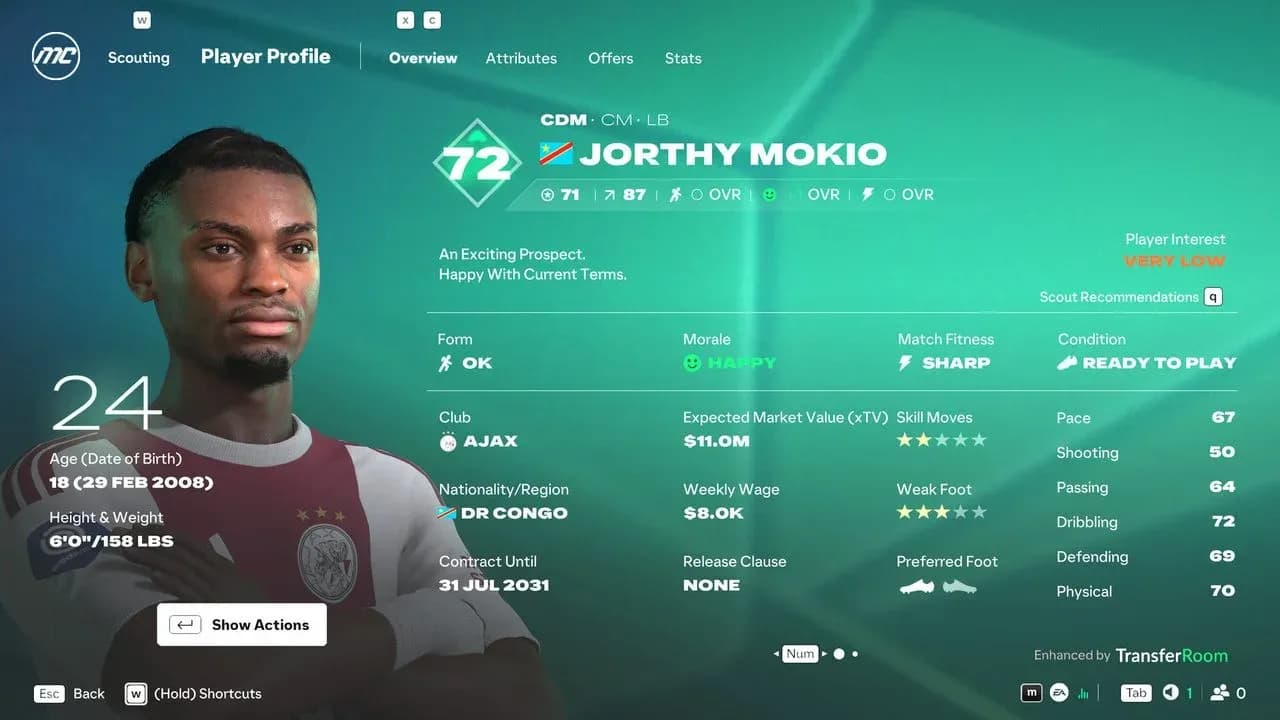
| Jorthy Mokio | CDM/LB | Ajax | 71 | 87 | ~$4.9m |
| Saba Kharebashvili | LB | İstanbul Başakşehir | 67 | 86 | ~$2.6m |
| Ruud Nijstad | CB | FC Twente | 70 | 86 | ~$4.2m |
The CDM bracket is the deepest value position in FC 27. Nathan De Cat, Kennet Eichhorn, and Jorthy Mokio all reach 87 or 88 potential for under $5m. De Cat at Hoffenheim starts at 71 OVR, meaning he can contribute in rotation immediately while still developing, which matters for Dynamic Potential since playing time accelerates growth.
For a complete breakdown of clubs worth building around before you start signing anyone, the best teams to manage in EA FC 27 Career Mode guide covers which setups give you the best platform for a wonderkid rebuild.
Best wonderkids by position: Who should you target first?
Goalkeepers
This is the thinnest position for young talent in FC 27. Robin Risser (RC Lens, 81 OVR, 87 POT) is the only wonderkid goalkeeper ready to start for a top-flight side from day one, and he costs around $25m. Dennis Seimen (VfB Stuttgart, 72 OVR, 87 POT) matches Risser's ceiling for approximately $7.9m, making him the clear value pick if you have a serviceable starter already in place. Florian Hellstern (SpVgg Greuther Fürth, 66 OVR, 86 POT) is the long-term budget option at roughly $1.4m, playing in Germany's second tier with a +20 growth gap.
Defenders
Pau Cubarsí (FC Barcelona, 86 OVR, 91 POT) is the best young defender in the game, and at 19 he is already a world champion with Spain. The fee is around $165m. Luka Vušković (Brighton, 81 OVR, 89 POT) is the next-best option at $119m, and at 19 with an 81 OVR he can hold his own in the Premier League while still developing.
For full-backs, Givairo Read (Feyenoord, 76 OVR, 88 POT) leads the specialist young options. His pace means he can cover at RM if needed, and his $21m fee is reasonable for the ceiling. Myles Lewis-Skelly (Arsenal, 78 OVR, 87 POT) is the best young left-back after the PSG and Barcelona names.
Budget center-back options worth considering: Finn Jeltsch (VfB Stuttgart, 76 OVR, 87 POT, ~$27m) and Ruud Nijstad (FC Twente, 70 OVR, 86 POT, ~$4.2m) for lower-league rebuilds.
Midfielders
João Neves (PSG, 88 OVR, 92 POT) is the best young central midfielder, full stop. PSG teammate Warren Zaïre-Emery (83 OVR, 89 POT) costs at least $165m but offers similar long-term value. Victor Froholdt (FC Porto, 82 OVR, 88 POT) is the more accessible option at around $61-72m, and his versatility across CDM, CM, and attacking midfield makes him genuinely useful from the start.
At CAM, Kenan Yıldız (Juventus, 84 OVR, 89 POT) and Arda Güler (Real Madrid, 83 OVR, 89 POT) lead the position. Güler at 21 has the passing and dribbling stats to operate at the top level already, with pace and shooting still to come as he develops.
Nico Paz (Como, 85 OVR, 89 POT) is the most interesting CAM on the list. At $100m he is not cheap, but he is still at Como rather than a superclub, which makes him more attainable than his talent level suggests. Creative, elusive on the ball, and a genuine match-winner.
For wingers, Michael Olise (Bayern Munich, 90 OVR, 92 POT) and Désiré Doué (PSG, 86 OVR, 92 POT) lead the right side. On the left, Rio Ngumoha (Liverpool, 75 OVR, 88 POT) has a 13-point growth gap and costs around $74m. Assane Diao (Como, 76 OVR, 87 POT) is the value pick at $16m.
Strikers
No male striker aged 21 or under reaches 90 potential in FC 27. Eli Junior Kroupi (Bournemouth, 80 OVR, 88 POT) and Endrick (Real Madrid, 79 OVR, 88 POT) lead the position. Endrick has been loaned to Lyon in the game, which keeps his fee around $55m. Kroupi costs approximately $40m.
Hugo Ekitike (Liverpool, 88 POT) and Rayan (Bournemouth, 79 OVR, 88 POT) are strong attacking options in the RM/RW mold if you need pace and direct running rather than a pure striker. Samu Omorodion (FC Porto, 81 OVR, 87 POT) at around $49m is the best physical target man in this age bracket, combining aerial presence with the ability to hold up play.
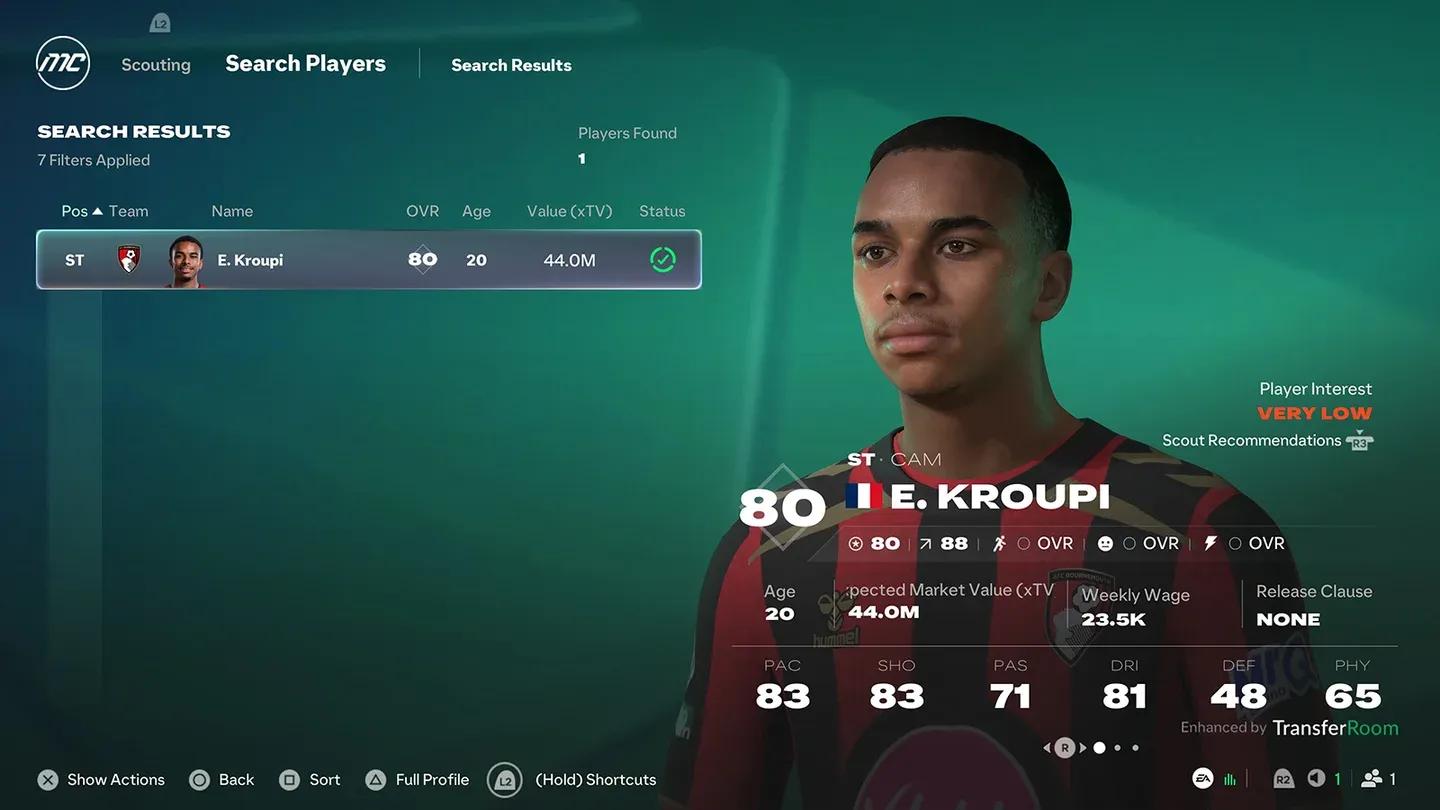
Kroupi leads FC 27 young strikers
How to sign wonderkids without overpaying
FC 27's rebuilt transfer market means deals are now staged negotiations where rival clubs can hijack approaches or force late renegotiations. Moving early, before a breakout season inflates a player's expected transfer value, is the single most effective way to keep costs down.
The process works like this:
- Request a scout report first. Attributes appear quickly, but the Financial Assessment stage is what tells you what the move will actually cost before you commit.
- Check the Interest indicator. Low interest means a harder negotiation. Declaring interest publicly first lets you gauge how open the player is before you approach his club.
- Spread the fee with installments. Split transfer fees across multiple seasons or add achievement-based bonuses to close a valuation gap without paying everything upfront.
- Use a loan-back clause. If your squad is full, a loan-back keeps the new signing at his current club so he keeps playing and developing before he joins you.
- Watch the tension meter during talks. Walk away when it spikes. You are no longer locked into a failing deal in FC 27.
- Add a buyback or sell-on clause when selling a wonderkid who does not fit. If he develops elsewhere, you profit.
For players you want but cannot afford immediately, the best free agents in FC 27 Career Mode covers high-quality options with zero transfer fees, which frees up budget for the wonderkids who require a fee.
How to develop wonderkids once you have signed them
Signing a high-potential player is the start, not the finish. Development in FC 27 depends on how you manage minutes, morale, and fitness across an entire season.
Regular minutes are the foundation. Strong performances raise Form, which pushes the long-term Dynamic OVR ceiling upward. A wonderkid who sits on the bench for half a season loses development momentum that is difficult to recover.
Secondary positions open more routes to minutes. Players have up to seven positions in FC 27 and take no penalty in their six secondary ones. A CDM who can also play CM or LB has more ways to get on the pitch, which means faster development.
Rotation beats overloading. Match Fitness penalizes players who start without being physically ready. Starting a wonderkid in every match without rotation hurts his development rather than accelerating it.
For a deeper look at how Career Mode's new systems work together, including the Dynamic OVR system and Creator Challenges, the EA FC 27 Career Mode deep dive covers the full overhaul in detail. For everything else across the game, the full EA FC 27 strategy guides collection has position-specific breakdowns, formation advice, and more to help you build the squad you want.