

For Football Manager 27 transfers, scout for a defined role, compare current attributes with development needs, and set a fee ceiling before negotiating.
Start with the weakness in your squad, not the most impressive name you can find. A versatile defender, an immediate starter, and a teenage prospect solve different problems and should compete for different parts of your recruitment budget.
The player examples below reflect the launch-preview database. Check their details in your save before pursuing a deal, and remember that some prospects have variable potential. A promising name is a starting point for scouting, not a guaranteed future star.
Identify the position and profile you need


Define the job before choosing a player
Write a short recruitment brief containing three decisions:
- Position: Where does your squad need another player?
- Profile: Which attributes or positional options would solve the problem?
- Time frame: Do you need help immediately, or can the player develop over several seasons?
Keep those decisions separate. A shortage at right-back could justify a dedicated replacement, but it could also make a versatile defender worth investigating. Xavi Espart can play on both sides and in defensive midfield. Kyllian Antonio offers right-back and centre-back coverage.
Treat recruitment as a resource decision, as you would in other [simulation games]: identify the problem before choosing where to spend. Do not pay for versatility unless those additional positions are useful to your squad.
Separate immediate help from development
Pau Cubarsí is an example of a young defender capable of contributing at a high level from the start. Ethan Degny, a teenage centre-back at Nice, is a longer-term development option. Both belong in a young-player search, but they do not answer the same recruitment brief.
Goalkeepers need the same distinction. Dennis Seimen is worth investigating if you want someone who can challenge for a starting place relatively quickly. Quenten Attigah is more of a development project requiring patience over several seasons.
Label a prospect as a development target in your planning. Do not count that signing as the solution to an immediate first-team weakness unless his current profile supports it.
Find targets and assess scouting information
Build a role-based target list
Search beyond the biggest European clubs when assembling alternatives. The preview database includes prospects at Boston River, Emelec, Gamba Osaka, and New York Red Bulls, alongside the more familiar academy names.
These players provide concrete starting points for different recruitment briefs. The table compares positions and listed strengths, not guaranteed transfer availability.
| Player | Club | Position or profile | What makes him worth inspecting |
|---|---|---|---|
| Facundo Aristegui | Boston River | Wide attacker | 14 dribbling, 15 finishing, 15 flair, 15 acceleration, and 15 determination |
| Luis Fragozo | Emelec | Inside forward | 14 dribbling, 14 flair, 14 off the ball, and 16 work rate |
| Bruno Cabral | River Plate | Striker | 14 finishing, 14 anticipation, and 14 acceleration |
| Simon Escobar | Vélez Sarsfield | Left wing-back | 15 decisions |
| Adri Mehmeti | New York Red Bulls | Central midfielder | Passing ability and composure |
| Rui Araki | Gamba Osaka | Goalkeeper | A prospect to investigate for a long-term goalkeeping plan |
Compare attributes against your actual requirement
Start with the target's current attributes and positions. Compare him with the player he would replace, then ask whether the differences address your recruitment brief.
Aristegui and Fragozo are both attacking options, but their listed strengths suggest different comparison points. Inspect Aristegui when finishing from a wide position is part of the brief. Fragozo is worth examining when work rate and movement are priorities. Neither recommendation replaces checking the rest of the profile.
Use potential to decide whom to investigate for the future. Do not treat a wonderkid ranking as proof that a player is ready for your starting lineup. For a development signing, decide where he fits over the next several seasons before allocating money to him.
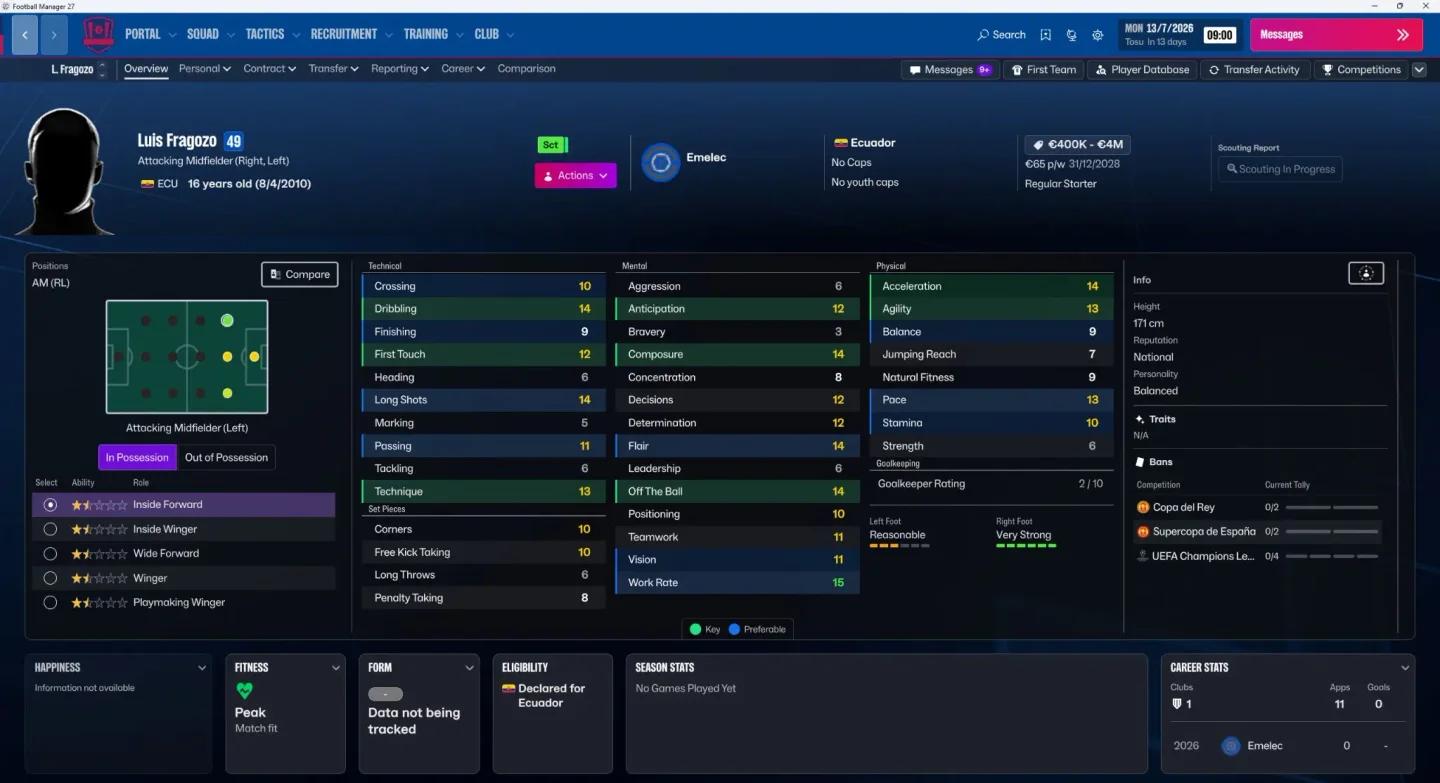
Assess Fragozo's current strengths
Check affordability before making an offer
Put squad priorities ahead of reputation
Separate an interesting scouting target from a realistic purchase. Players already established at major clubs can be difficult or expensive to sign. Jorrel Hato at Chelsea and Warren Zaïre-Emery at Paris Saint-Germain belong in a different spending conversation from less-established prospects.
If your budget is limited, investigate alternatives before committing to an expensive name. Mohanad El Shamy at Al Ahly is a left-back worth scouting outside Europe's biggest leagues. Gomolemo Kekana at Mamelodi Sundowns is another option to inspect when looking for a defensive midfielder on a smaller budget.
Set your spending order before entering negotiations:
- Address the position that needs an immediate replacement.
- Consider useful cover for positions with limited alternatives.
- Allocate what remains to longer-term prospects.
This is a planning order, not a rule that every squad needs three signings. If one purchase would consume the money reserved for a more urgent weakness, reconsider that target.
Establish your fee ceiling
Choose the maximum fee you would accept for the player's intended job. Keep a separate ceiling for each target, because a first-team replacement and a speculative prospect do not have the same priority.
Ângelo at São Paulo and Iago Machado at Corinthians illustrate why a promising database entry still needs investigation. Their starting valuations make them worth checking, but those figures do not establish what their clubs will accept.
Plan and negotiate a transfer offer
Use the negotiation to test whether the player fits your budget, not to justify spending more because you have already chosen him.
- Confirm the recruitment brief. Keep the position, intended contribution, and development time frame in front of you.
- Choose a fallback. Identify another player who could meet the same need before concentrating on one deal.
- Set your limit. Base it on the player's value to your squad and the other positions you still need to address.
- Compare the seller's response with that limit. Decide whether the requested fee still fits your original plan.
- Stop if the deal no longer fits. Return to your alternative instead of increasing the ceiling simply to complete a signing.
A fallback should solve the same problem, even if the players have different reputations. For example, a search for a defender who covers several positions could include Finn Jeltsch, who can play at centre-back, right-back, or defensive midfield. Compare that coverage with what your squad actually lacks.
Avoid setting one universal discount target or assuming every club will accept a similar offer. A player's initial valuation and his final negotiated fee are separate considerations.
Know when to pursue another target
Do not build your window around a difficult signing
Lamine Yamal is already an elite option at Barcelona, but signing him is close to impossible for most clubs. Max Dowman offers exceptional potential at Arsenal, yet persuading his club to sell can also be difficult. Neither should be your only answer to an urgent attacking vacancy.
Monitor difficult targets without making the rest of your recruitment depend on them. Roony Bardghji at Barcelona and Endrick at Real Madrid are players worth watching if competition for first-team football limits their opportunities. That is a reason to review their situation, not a guarantee that a deal will become possible.
Before continuing with any offer, answer three questions:
- Does this player address the position and profile you identified?
- Is his current ability appropriate for the contribution you expect?
- Does the proposed fee leave enough money for your remaining priorities?
Pursue the signing when all three answers are yes. If one answer is no, change the target, the expected contribution, or the spending plan before negotiating further.