

Unscathed is a Roblox RNG game where every decision either multiplies your rolls per hour or quietly wastes them. The difference between a player who lands a rare Aura in two sessions and one who grinds for two weeks usually comes down to three things: when they use their best potions, whether their skill tree actually finishes any chain, and whether they let Expeditions sit idle. This guide covers all of it, from your first 50 rolls to endgame biome routines.
What is the best progression route in Unscathed?
The fastest path through Unscathed follows a specific order. Skipping steps does not save time; it just means redoing the same grind with worse tools.
- Reach 50 total rolls. Auto Roll unlocks at this threshold, and it is the single most important early milestone. Until then, keep the first copy of every Aura you find, equip the best combat option available, and only sell safe duplicates.
- Start all available Expeditions immediately. Three Expedition slots run passively while you play and return Fragments, Lucky Potions, and Speed Potions. Treat them like a background income stream, not a menu you check occasionally.
- Build Hot Streak before spreading skill points. Bonus Roll chance climbs through the Hot Streak chain, and each Bonus Roll is another chance for your Gem effects to trigger. Get this moving early.
- Clear Story at a pace your build supports. Story Acts reward skill points and account resources. Spend enough on combat to keep progressing, but do not dump every point into damage if Aura farming is the priority.
- Pick one elemental target once broad farming slows down. A matching biome already gives +35% elemental luck. Layer a matching Gem, Trait, and potion on top of that and the odds shift significantly.
- Upgrade Gems at Flow with Fragments, reroll Traits with Shards. Keep those two budgets separate. Burning Shards on random Trait rerolls before you have a clear element target is one of the most common ways to stall progression.
- Save Divine and Destiny Potions for a full setup. Both last one second. Using them in Normal biome without the rest of your permanent bonuses active is a waste every time.

Unscathed RNG Ultimate Progression & Farming Guide


How does luck optimization actually work?
The formula is straightforward: good pulls per hour equals the chance of a good pull per roll multiplied by total rolls per hour. A setup with massive luck but slow rolls wastes part of every buff window. A setup with high Roll Speed but no luck just reaches the next Common faster.
Pull quality comes from biome luck, Luck and elemental Gems, potions, Traits, and Luck Skill Tree nodes. Stack general luck with the bonus specific to the element you are targeting.
Pull quantity comes from Auto Roll, Quick Roll, Roll Speed, Hot Streak, and Bonus Roll cooldown reductions. These do not make a single roll luckier; they give your existing luck more chances to fire.

Unscathed RNG Ultimate Progression & Farming Guide
One thing players regularly confuse: Aura duplication, item duplication, and crate duplicate chance produce extra copies after their own conditions are met. They are useful farming stats, but they do not replace the underlying chance to hit a rare Aura.
Early in the game, universal luck works fine because almost any new Aura represents progress. Later, targeted farming pulls ahead. Once your collection fills out, switching elements every session wastes more resources than it saves.
Biome farming and potion timing
Every elemental biome applies a +35% luck bonus to its matching element. Most biomes last 10 minutes, which is enough time for a proper potion cycle. Night is the exception at only 5 minutes, which punishes any inventory fumbling. Normal biome has no elemental bonus, making it a fine place for cheap rolls and account chores but a poor venue for premium one-roll potions.
| Biome | Element boosted | Duration | Best use |
|---|---|---|---|
| Cyber | Basic +35% | 10 min | Target Basic Auras or run general luck and speed buffs during the longer window |
| Eden | Light +35% | 10 min | Pair with a Light Gem, Light Potion, and an Eden Trait |
| Inferno | Fire +35% | 10 min | Pair with a Fire Gem, Fire Potion, and an Inferno Trait |
| Monsoon | Water +35% | 10 min | Pair with a Water Gem, Water Potion, and a Monsoon Trait |
| Overgrown | Earth +35% | 10 min | The dedicated window for Earth targets including long-shot endgame pulls |
| Rapture | Demon +35% | 10 min | Pair with a Demon Gem, Demon Potion, and a Rapture Trait |
| Night | Night +35% | 5 min | Pre-equip everything before the biome starts; the short window punishes delays |
| Normal | None | 5 min | Cheap rolls, selling, crafting, and setup between valuable biome windows |
The correct order when a target biome appears
- Equip the matching elemental Gem or your best universal farming accessory.
- Confirm the right Trait is active and Auto Roll is ready.
- Apply long-duration buffs first: Fate Potion, Swift Potion, and any food effects.
- Use the matching elemental potion.
- Roll without opening menus during the window.
- Trigger Divine or Destiny immediately before the roll you want buffed. Their one-second duration leaves no margin for sightseeing.
What are the best potions for farming?
Potion strength scales with how well the duration matches the job. Long buffs belong at the start of a biome window, cheap one-minute effects are everyday fuel, and one-second effects are closers.
| Potion | Effect | Best use |
|---|---|---|
| Destiny Potion | +500,000% special luck for 1 sec | Highest-stakes single roll. Use only with full permanent setup in the correct biome |
| Divine Potion | +100,000% special luck for 1 sec | Same timing rule as Destiny. Wasted in Normal |
| Fate Potion | +100% luck for 3 min | Best repeatable centerpiece for a biome session. Crafted from 25 Lucky Potions |
| Element Potion | +35% elemental luck for 1 min | Use only in the matching biome while hunting that element |
| Lucky Potion | +50% luck for 1 min | Reliable daily luck and Expedition staple. Keep a reserve for Fate and Destiny recipes |
| Soup | +25% luck and +25% Roll Speed for 1 min | Strong farming food because it improves both sides of the pulls-per-hour equation |
| Swift Potion | +20% Roll Speed for 3 min | Standard speed partner for Fate. Crafted from 25 Speed Potions |
| Velocity Potion | +1,000% Roll Speed for 17 min | Exceptional long farming buff. Prepare the full session before drinking it |
| Knowledge Potion | +100% XP multiplier for 10 min | Drink before a planned mass Aura sell, not before a rolling session |
| Speed Potion | +10% Roll Speed for 1 min | Cheap daily throughput and a regular Expedition reward |
Different luck and speed sources stack, so watch the active buff icons rather than dumping duplicate consumables at random.
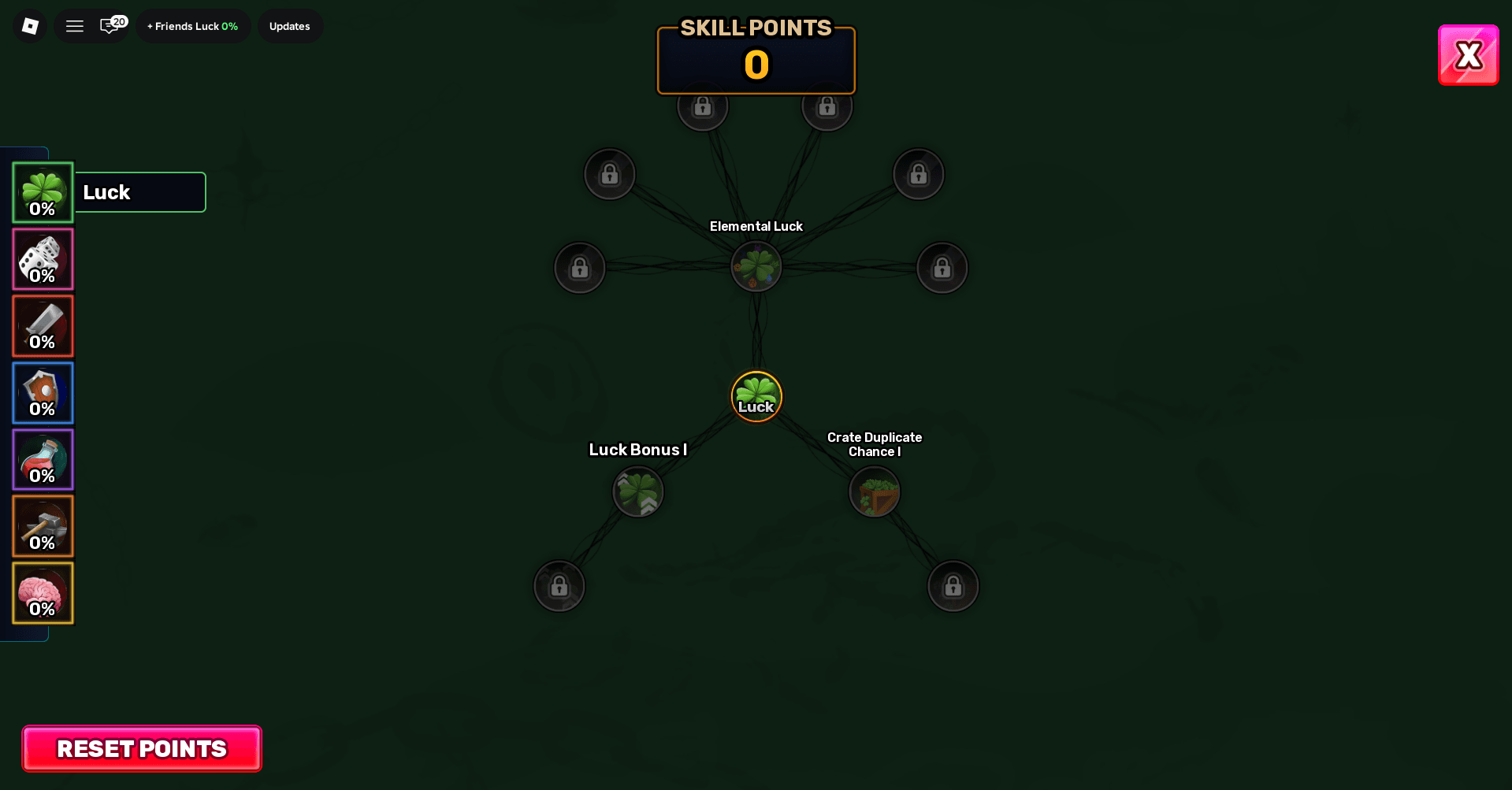
Skill tree: what order should you spend points?
Skill points come from leveling, Battlepass tiers, and Story Act rewards. Resetting all points costs Robux, so a farming account needs a plan from the start.
| Priority | Nodes | Why they matter | When to stop |
|---|---|---|---|
| 1. Roll core | Hot Streak I-V | Bonus Roll chance climbs to +50% through the chain | Max it if rolling is your main activity |
| 2. Universal luck | Four-Leaf I-V | General luck rises to +25% and helps every Aura target | Max before spreading across element branches |
| 3. Target element | Ember's, Nether's, Stone's, Light's, Night's, or Tide's Favor I-V | Each matching branch reaches +15% and compounds a focused biome setup | Complete one branch for your current chase |
| 4. Roll support | Fleetfoot and Cooldown Cut | Fleetfoot adds +5% Roll Speed; Cooldown Cut shortens the Bonus Roll interval | Fill once Hot Streak and luck priorities are online |
| 5. Potion engine | Potency, Preservation, Lucky Batch | Potency +10% potion power, Preservation +25% duration, Lucky Batch +5% Aura duplication | Invest when potions are a normal part of every session |
| 6. Account economy | Student of War, Market Savvy, Scavenger | +25% character XP, +25% Coin drop rate, +20% item duplication | Use when levels or Coins are the current bottleneck, not roll odds |
A practical early split: grab the first Hot Streak, Four-Leaf, and Fleetfoot nodes, then climb Hot Streak and Four-Leaf as their prerequisites open. The classic mistake is spreading points so every chain has one or two nodes but none of them actually does much.
Unscathed RNG Ultimate Progression & Farming Guide
Gems, Fragments, and Traits: what should you upgrade first?
Fire, Earth, Water, Light, and Demon Gems each have five levels and increase their matching elemental luck on Bonus Rolls. Luck Gems provide general luck on Bonus Rolls. Cash and XP Gems improve economy rather than Aura odds. There is no dedicated Night Gem family, so Night hunters rely more heavily on general luck gear, biome luck, skill nodes, and Traits.
- Upgrade a Luck Gem first if you are still collecting broadly or switch targets often.
- Upgrade one elemental Gem if a specific Aura is your current chase.
- Spend Fragments deliberately. Spreading them across every level-one Gem delays the first meaningful high-level accessory.
Best farming accessories
| Accessory | Bonuses | Verdict |
|---|---|---|
| Hydranium | +35% Roll Speed and +20% all-element luck | The clean universal endgame target. Both bonuses stay relevant when you switch elements |
| Cursed Bone | +25% Roll Speed and +10% Demon luck | Strongest specialized speed accessory and excellent for Rapture |
| Burning Chainmail | +20% Roll Speed and +10% Fire luck | Strong Inferno farming piece that improves both attempt count and Fire targeting |
| Heavenly Wraps | +15% Roll Speed and +10% Light luck | Useful for Eden, though its speed bonus trails the Demon and Fire alternatives |
Trait reroll priority
Flow rerolls Gem Traits for 1 Shard per attempt. Combined luck-and-speed Traits beat single-stat Traits for a specific target. After that, raw luck usually beats the matching haste Trait because Roll Speed is easier to source elsewhere.
The best-in-slot Trait is Elemental Sovereign, which grants +50% elemental-biome luck and +50% elemental Roll Speed while farming in any elemental biome. It is the clear long-term chase. Do not burn Shards chasing it before you have a clear element target and a leveled matching Gem.
Expeditions: the passive farming engine
You can send up to five Auras per Expedition and run three simultaneously. Higher-tier Auras do not improve reward chance, so do not bench a prized combat Aura on the assumption that rarity boosts the loot.
| Expedition | Guaranteed rewards | Bonus reward | Priority |
|---|---|---|---|
| Overworld | 50 Fragments, 15 Lucky Potions, 15 Speed Potions | None | Good starter route |
| Underworld | 100 Fragments, 30 Lucky Potions, 30 Speed Potions | 5% chance for a Divine Potion | Clear upgrade over Overworld |
| The Button | 150 Fragments, 50 Lucky Potions, 50 Speed Potions | 10% chance for a Divine Potion | Strong repeatable Gem and potion funding |
| The Shemi | 5 Shards, 150 Fragments, 100 Lucky Potions, 100 Speed Potions | 25% chance for a Divine Potion | Best overall package; run it whenever available |
Always keep all three slots active. Fragments fuel Gem upgrades and Shards fuel Trait rerolls. Letting Expeditions sit idle is the quietest way to slow down progression.
Which Auras should you keep, sell, or reserve?
Selling Auras is the main leveling engine, but selling every duplicate is bad advice once crafting opens. Some recipes consume hundreds of specific Auras. Use three mental piles: one protected copy for collection or combat, an exact crafting reserve, and true surplus for XP.
High-cost crafting reserves worth knowing
| Crafting goal | Key materials to reserve | Why it matters |
|---|---|---|
| Destiny Potion | 5 Ascend, 100 Legendary Aura, 150 Lucky Potions, 2 Cupid | Massive one-roll luck effect with a deceptively expensive recipe |
| Chainmail | 40 Nunchucks, 100 Legendary Aura, 10 Brass Metal Rings, 30 Spartan | The 100-Legendary requirement is obvious; Nunchucks and Spartan are easy to oversell |
| Lucky Bone | 5 Soulbound, 20 Geoshade, 40 Spartan, 100 Brushed | Brushed and Spartan look disposable until the recipe counter says otherwise |
| Magnet | 1 Stonebloom, 30 Brass Metal Rings, 10 Aqua, 50 Geoshade, 500 Epic Aura, 100 Spirited | Lock the 500 Epic Aura target before using Epic duplicates as XP |
| Teleporter | 1 Falling Crescent, 100 Crystalized, 30 Brass Metal Rings, 10 Ascend, 50 Retro, 100 Rare Aura | Several mid-rarity Auras vanish fast in a mass sell |
| Bonetanium | 10 Wraps, 1 Shogun's Wrath, 5 Chainmail, 5 Fallen, 2 Lucky Bone | Consumes other crafted gear as ingredients; this is a late-account project |
When storage is tight, sell abundant surplus above the next recipe target first. Do not sell a unique Epic or Legendary Aura to protect 200 low-value copies with no current use.
Efficient endgame farming routine
Once your account has a developed Roll tree, Luck tree, upgraded Gems, and a potion supply, the routine becomes short and repeatable:
- Choose one target Aura and note its element. Stop switching targets mid-biome.
- Equip the matching elemental Gem or Hydranium for universal farming, then select the matching Ascension Trait or Elemental Sovereign.
- Queue all three Expeditions before the active session starts.
- Wait for the correct biome. Use the downtime for quests, Story, crafting, and inventory cleanup.
- Apply long-duration buffs first: Fate, Swift, Soup, and any food effects.
- Use the matching elemental potion after the long buffs are running.
- Roll without menu downtime. Auto Roll and Hot Streak need uninterrupted time to extract full value from the buff window.
- Use Divine or Destiny immediately before an active roll, never while still arranging inventory.
- Close the loop. Claim rewards, protect recipe stock, use a Knowledge Potion for the sell batch, upgrade at Flow, and refill potions.
For more Roblox farming and RNG strategies, browse the full Roblox guides collection on GAMES.GG.