

Crafting in Solasta II is one of those systems that looks optional until it isn't. Buying Potions of Greater Healing from vendors works fine early on, but once encounters start punishing sloppy resource management, having a dedicated crafter in your party pays off fast. This guide breaks down every crafting category, the tools and proficiencies that gate them, and the key recipes worth prioritizing.
Solasta II crafting basics
How does crafting work in Solasta II?
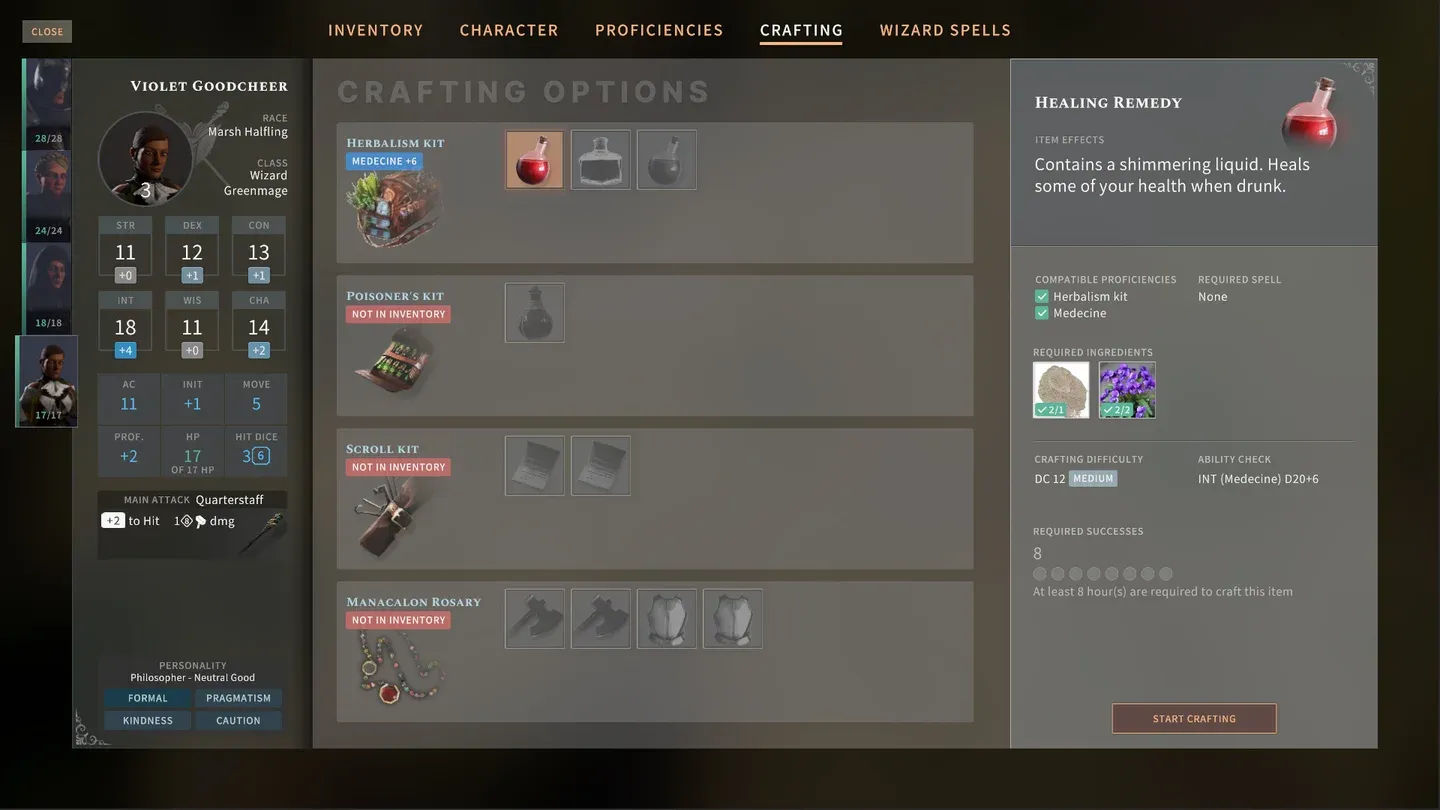
Crafting consumables always uses the Intelligence modifier, regardless of which skill is listed on the recipe. This catches a lot of players off guard. A character with high Wisdom but mediocre Intelligence will underperform at the crafting bench even if they have Medicine proficiency. The game's tooltip hints that proficiencies stack, but testing shows that's incorrect: it's either one proficiency or the other, and they do not combine.
Each recipe has a Difficulty Class and a required number of successes. The Potion of Greater Healing, for example, sits at DC 14 (Medium) and needs 3 successes. That's achievable mid-game with a decent Intelligence score and the right tool proficiency, but rushing it too early will burn ingredients.
What tools do you need?
Each consumable category ties to a specific crafting tool. You cannot substitute one for another:
Note that scroll crafting has an additional requirement beyond tools: the character must already know the spell they want to inscribe. A Wizard who hasn't learned Fireball cannot craft a Scroll of Fireball, full stop.
Solasta II crafting basics
Healing potions: which tier should you craft?
The healing potion line scales across four tiers. Here's the full breakdown with ingredients:
The Potion of Greater Healing is the sweet spot for most of the mid-game. It restores 4d4+4 HP (average 14), costs a reasonable ingredient spread, and vendors sell it for 150 gold if you'd rather buy than craft. For comparison, the Superior Healing potion needs Moonflower, which is significantly rarer than Dragonrose.
For the Potion of Greater Healing specifically, the recipe can be purchased from vendors like Dalon Lark and Telerien Purevoice, or found as loot at Aer-Elai (the Lake of Acid section). The Palace of Ice DLC also hands you the recipe at the start.
Solasta II crafting basics
What other potions are worth crafting?
Beyond healing, a few potions punch well above their ingredient cost:
- Potion of Heroism: Grants 10 temporary HP and +1d4 to attacks and saving throws. Ingredients include Acid, Troll Acanthus, Brimstone Viper Scales, and Dragonrose. Strong before difficult boss fights.
- Antitoxin: Gives advantage on Constitution saving throws against poison. Cheap to make with Gallivan Amaranth and Blood Daffodil. Worth stocking against poison-heavy encounters.
- Potion of Speed: Casts Haste on the drinker. Ingredients are Dwarven Primrose, Manacalon Orchid, Storm Heather, and Moonflower. Expensive but fight-defining.
- Potion of Invisibility: Requires Dwarven Primrose, Storm Heather, Deep Root Lichen ×2, and Refined Oil ×4. Useful for repositioning a squishy caster mid-fight.
Some potions, including the Potion of Flying and all Giant Strength variants, cannot be crafted at all. You'll need to buy or find those.
Scrolls: who should be crafting them?
Scroll crafting is the most flexible category because Arcana proficiency alone qualifies you. Any Wizard, Sorcerer, or Bard with Arcana training can produce scrolls. The catch is the spell-knowledge requirement mentioned above.
High-priority scrolls to produce early:
- Scroll of Bless: Angry Violet ×3, Magnesium. Cheap and the spell is strong.
- Scroll of Cure Wounds: Blood Daffodil, Magnesium. Backup healing for non-casters.
- Scroll of Scorching Ray: Acid, Goblin Hair Fungus, Magnesium. Available in Solasta II specifically, making it one of the confirmed early-game offensive options.
- Scroll of Sleep: Abyss Moss, Gallivan Amaranth, Refined Oil. Dominant in low-level fights.
For the full ingredient database, the Solasta 2 Wiki tracks every recipe and where to source components.
Poisons and greases: situational but potent
Poisons require the Poisoner's Kit and apply via weapon coating or poisoned ammunition. A few standouts:
- Ghoul's Caress: Paralyzes on hit (save each turn) and adds 1d8 poison damage over 3 hits. Ingredients: Deep Root Lichen, Magnesium ×2, Storm Heather. Devastating against single tough targets.
- Tiger Fang: +3d6 poison over 3 hits. Needs Troll Acanthus, Serpentinite, and Tiger Drake Venom Gland.
- Queen Spider's Blood: +3d8 poison and the Poisoned condition. Expensive ingredients but the highest raw damage output in the poison category.
Greases were introduced in the Palace of Ice DLC and only exist in Solasta: Crown of the Magister. Each one gives a benefit and a penalty, applied either to a weapon or directly to skin. The Demonic Grease of the Night Hunt is particularly interesting: weapon application adds +2 to attack and damage rolls plus a bonus action attack, but the wielder takes penalties in lit areas. All greases require Demonic Essence as a base ingredient.
For deeper detail on equipment interactions with crafted items, the Equipment and Crafting page on the Solasta 2 Wiki covers material proficiencies and item creation in full.
Solasta II crafting basics
How to build a crafting party
You don't need a dedicated crafter. You need one character who covers the most important tool proficiencies. Here's the most efficient approach:
- Wizard or Sorcerer with Arcana: Covers potions, scrolls, and greases in one slot. High Intelligence is a bonus.
- Ranger or Rogue with Medicine or Nature: Picks up poison crafting without competing for the same proficiency.
- Fighter or Paladin with Smith's Tools: Ammunition crafting is low priority but free real estate if someone already has the proficiency.
The Herbalism Kit proficiency is worth picking up as a background choice if your Wizard doesn't already have it. Several backgrounds in Solasta II grant it, and it removes any uncertainty about potion DC rolls.
For more guides covering Solasta II builds, class picks, and combat tactics, browse the latest guides on GAMES.GG.