Search games, articles, guides...CtrlK
Sign InGet Started

Master CFB 27 Dynasty recruiting with NIL strategy, the Playing Time filter method, and position-specific archetype hunting to build elite rosters.

Written by Abdalla
Content Writer
See more GAMES.GG guides on Google
Add us as a preferred source and our guides show up first in your results.
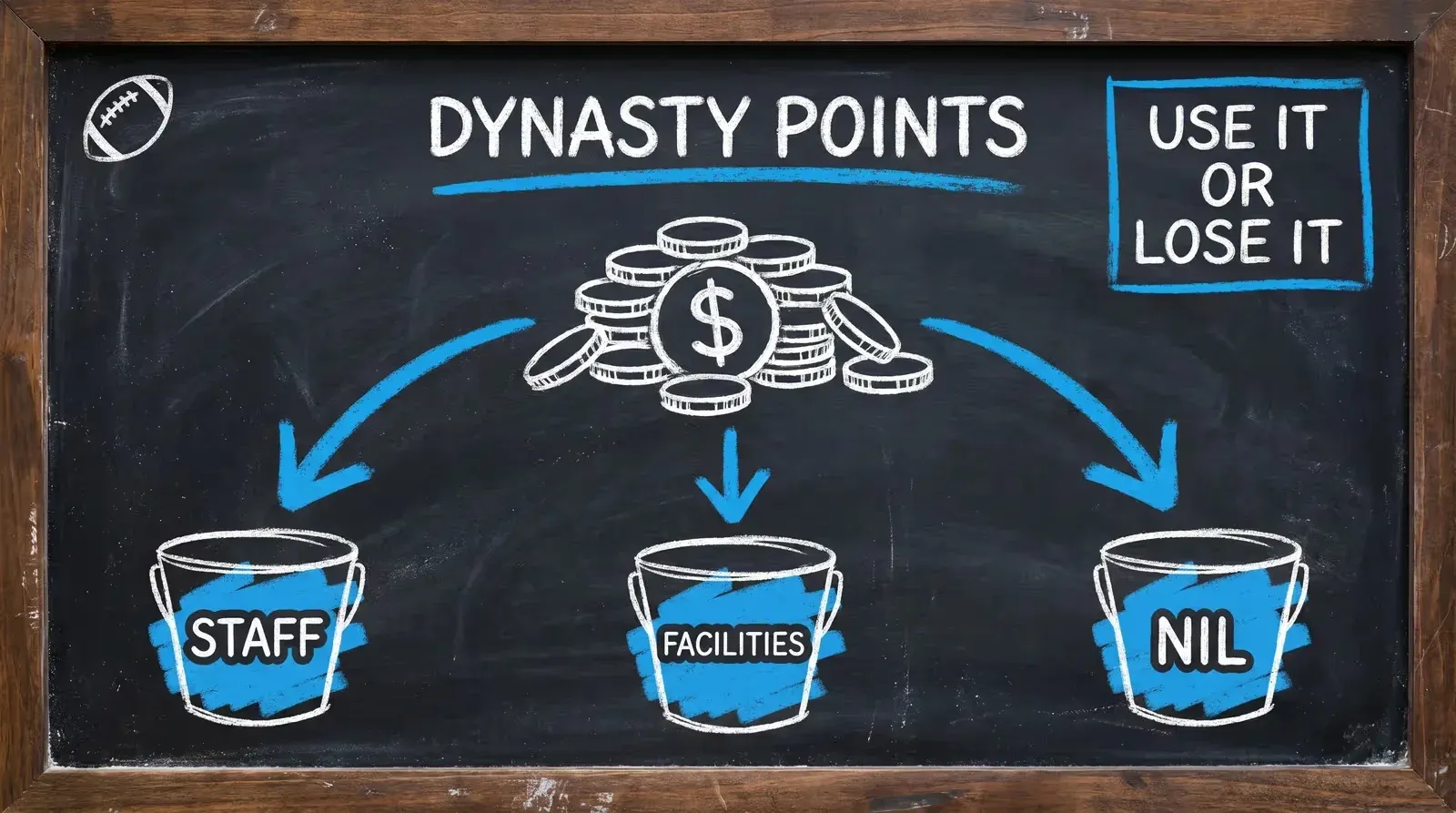
College Football 27 Dynasty Point Hoarding Guide
Master skill point hoarding in CFB 27 Dynasty to cut NIL costs, stop unwanted transfers, and control exactly when players hit their peak.

CFB 27 Best Offensive Playbooks and Settings Guide
Master the post-update meta in CFB 27 with the best offensive playbooks and settings for Oregon State and Colorado.

College Football 27 Best Playbooks and Defensive Settings Guide
Best offensive and defensive playbooks in CFB 27, plus settings adjustments after the running game and blocking updates.
EA Sports College Football 27 has a recruiting system that rewards the coaches who understand its logic. The players who grind blind, stacking every five-star on their board and hoping for the best, consistently lose to dynasties built on smarter scouting. This guide breaks down exactly how to find generational attributes, manage NIL budgets under tightened competition, and avoid the common mistakes that tank recruiting classes before week three.
The community expected generational recruits to arrive as instant impact players, 84-overall freshmen who immediately crack your starting lineup. That is not how the game works. What actually generates are generational attributes: rare physical traits attached to otherwise normal recruits. A 99-speed running back listed at 74 overall. A receiver with 98 speed and 94 acceleration buried in the three-star pool. An athlete who converts to a 6'4" corner.
The best CPU-generated recruit most players encounter arrives around 77 overall. That ceiling is real. Chasing a recruit because he has five stars is less useful than understanding which position and archetype combinations actually produce elite physical traits.
Some positions simply do not generate elite physical numbers. Offensive and defensive linemen rarely produce 99 strength. Speed, on the other hand, shows up constantly at running back, wide receiver, cornerback, and linebacker. The game's generation logic is position-specific, and once you know which archetypes produce which traits, your scouting becomes far more efficient.
This is the most reliable scouting filter in CFB 27 Dynasty. The Playing Time dealbreaker on a recruit's profile correlates with their overall rating. A higher dealbreaker grade means a higher overall floor, and generally better attributes across the board. It does not guarantee a superior development trait, but it does guarantee a higher-ceiling recruit.
Here is the process:
The reason you must separate archetypes is that each one operates within its own overall generation range. A four-star Speedster receiver might generate between 73-77 overall, while a Contested Specialist generates between 74-78. Mixing them makes the Playing Time grade meaningless as a comparison tool because you are comparing across two different generation windows.
After testing across multiple recruiting classes, a B or B+ dealbreaker grade consistently produced higher attributes across more categories than a D or D+ grade at the same star rating. A B- running back from Louisiana produced 99 speed and 93 acceleration. A D-grade back from Florida still produced 94 speed, 93 acceleration, and the Human Joystick ability. Low dealbreaker does not mean bust. High dealbreaker means a higher floor.
Target the East-West Playmaker archetype. This is the fastest RB archetype in the game. Filter four-star East-West Playmakers only, add every one to your board, and compare Playing Time grades. A B+ grade from a three-state pipeline state (Florida, California, Louisiana) is the highest-probability outcome for 99 speed.
Two distinct targets exist here. For speed, filter four-star Speedster receivers only. A B dealbreaker produced the best outcomes in testing, and a C-grade receiver from California produced 98 speed and 94 acceleration.
For the truly rare find, hunt the 6'6" Physical Route Runner. Only one or two generate per recruiting class. They only appear as five-stars. Their speed is not elite (typically 84-85), but their route running, contested catch rating, and press coverage grades are exceptional. They can also convert to tight end. To find them, filter receivers and check heights. The next tallest in most classes is 6'5". A 6'6" recruit is your generational player.
Filter four-star Raw Strength tackles. A+ dealbreaker grades produced 88-90 strength with physical abilities. An A- grade produced 85 strength and busted. The dealbreaker method works here, but the gap between grades is more pronounced than at skill positions.
Middle linebackers cap at 6'3" in CFB 27. To find taller linebackers, filter Signal Caller outside linebackers and look for 6'5" versions. These do not generate every year. In some classes the tallest available is 6'4", still valuable, but the rare 6'5" version is a genuine find. These players can move to middle linebacker or stay at OLB.
Five-star Athlete Pure Runner quarterbacks are position-change candidates. You cannot see their full attribute spread until they arrive on campus, but a 6'4", 224-lb corner is possible from this archetype. Some convert cleanly to defense, some do not. It is randomized, but the upside justifies targeting every five-star Athlete Pure Runner you can afford to recruit.
| Position | Archetype to Hunt | Key Indicator | Top States |
|---|---|---|---|
| RB | East-West Playmaker | B+ dealbreaker | FL, CA, LA |
| WR (speed) | Speedster | B dealbreaker | FL, CA, LA |
| WR (size) | Physical Route Runner | 6'6" height, 5-star only | Any |
| OT | Raw Strength | A+ dealbreaker | Any |
| OLB | Signal Caller | 6'5" height (rare) | Any |
| QB/ATH | Athlete Pure Runner | 5-star, position-change potential | Any |
| ATH | Contested Specialist | 6'5", high speed | Any |
Recent updates tightened NIL competition significantly. Passive scouting strategies that worked in earlier patches no longer hold up. You cannot delay scholarship offers and expect top prospects to wait. Four-star prospects now lock commitments to rival programs faster than before.
Four-star battles against Power 5 programs require 120 to 165 NIL points to secure top placement. Targets like four-star tackles and elite skill players demand premium packages. Three-star recruits who are under-recruited can be secured with 30 to 75 NIL points, making them the backbone of depth-building.
The correct allocation strategy is straightforward: save high NIL budgets for four-star offensive linemen and defensive prospects at positions where you have roster holes. Fill depth with low-cost three-star recruits. Avoid overinvesting at positions where your roster is already healthy.
Bye weeks are the most valuable scouting windows in the calendar. Use them to lock visit schedules, boost prospect momentum, and recover ground in tight recruiting battles. Hard selling balanced with controlled NIL spending prevents budget collapse while keeping your board competitive.
For a deeper look at how coach archetypes affect your recruiting hour allocation and NIL efficiency, the College Football 27 Dynasty Mode coach archetype guide breaks down which trees produce the best long-term recruiting returns.

NIL budget management screen
A widely used exploit involved repeatedly moving recruits on and off your recruiting board until a prospect triggered an instant commit. A recent patch changed this behavior. Removing a recruit from your board now causes them to receive a locked symbol instead of returning to their previous state. The instant-commit cycling method no longer works.
This change was not prominently listed in patch notes, which means many players are still attempting the old method without realizing why it stopped working. If you have been cycling recruits on and off your board expecting a commit, stop. The behavior has changed, and the only path to commitments now runs through legitimate NIL investment and pitch management.
Every recruiting pitch requires selecting a three-trait combination that matches a recruit's motivations. Each recruit has three positive motivations marked by green indicators and several negative factors. A Hard Sell consumes 40 recruiting hours per week. A Soft Sell consumes 20 hours. Many experienced dynasty coaches skip the Soft Sell entirely and bank hours for Send the House before switching to a Hard Sell.
Pitching an incorrect attribute drops your weekly influence gain significantly. The key is identifying the correct three-trait combination before committing hours.
Pipeline tiers multiply the influence points your weekly actions produce. A Tier 5 pipeline applies a 1.50 multiplier, meaning a 40-hour Hard Sell in a Tier 5 territory generates 60 effective influence points. The same pitch in a Tier 1 region yields only 40 points. Building pipelines in the three-state speed corridor (Florida, California, Louisiana) pays dividends across multiple recruiting classes.
Visit scheduling follows a similar logic. If your program holds an A- grade or better in a recruit's dealbreaker category, pitching that dealbreaker activity during a visit yields the highest possible influence. If your dealbreaker grade sits at B+ or lower while an alternative positive motivation has an A or A+ grade, the higher letter grade generates greater net influence. Grade quality beats dealbreaker status when the gap is significant enough.
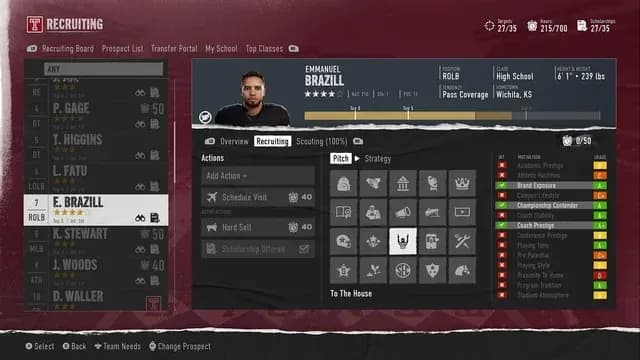
Hard Sell pitch selection screen
The five-star pool has real issues that affect dynasty realism. The game generates too many undersized five-star receivers (heights between 5'7" and 5'9") despite no real-world equivalent existing at that rating level. Positions that would never realistically produce five-star recruits (HB North/South Blocker, TE Pure Blocker, WR/TE Gritty) appear in the five-star pool regularly.
There are also too many five-star busts. A WR or HB with mid-80s speed appearing as a five-star is not realistic and creates frustrating recruiting outcomes. Speed minimums for elite skill positions (WR, HB, CB, FS, SS) should theoretically sit at 90 or above for a five-star designation to make sense, but the game does not enforce this.
The practical takeaway: do not automatically treat five-star status as a quality guarantee. Apply the Playing Time dealbreaker method to five-star recruits the same way you would to four-stars. The star rating tells you something about overall floor, but the dealbreaker grade tells you more about the specific recruit in front of you.
With 18 open roster spots being a common starting position for rebuilding programs, large recruiting classes are not optional. Thin depth and injury vulnerabilities compound across a season, and a single offensive line injury against an elite defensive interior can end a game the way it ended real matchups in Season 3 play.
The correct roster-building sequence is: identify your two or three highest-priority positions based on depth chart holes, allocate premium NIL to those targets, fill remaining spots with under-recruited three-star recruits using the Playing Time dealbreaker method, and use bye weeks to maintain board momentum rather than letting prospects drift toward rivals.
Coach progression also affects how many hours you can allocate per recruit per week. Stacking the Always Recruiting skill across your head coach and both coordinators raises the single-recruit weekly allocation cap from 50 hours up to 80 hours. That difference is significant in tight recruiting battles where every influence point matters. For help planning your Team Builder setup and facility investments that support recruiting, the EA Sports College Football 27 Team Builder guide covers those systems in detail.
For everything else across modes, the full EA Sports College Football 27 strategy guides collection has you covered.