Search games, articles, guides...CtrlK
Sign InGet Started

Master CFB 27 with the best offensive playbooks, defensive formations, and pre-snap adjustments to shut down any opponent.

Written by Abdalla
Content Writer
See more GAMES.GG guides on Google
Add us as a preferred source and our guides show up first in your results.
College Football 27 Best Playbooks and Settings
Speed boosting is gone and aggressive blocking draws flags. Here are the best CFB 27 playbooks and settings for the current meta.
College Football 27 Dynasty Point Hoarding Guide
Master skill point hoarding in CFB 27 Dynasty to cut NIL costs, stop unwanted transfers, and control exactly when players hit their peak.
CFB 27 Best Offensive Playbooks and Settings Guide
Master the post-update meta in CFB 27 with the best offensive playbooks and settings for Oregon State and Colorado.
EA Sports College Football 27 expanded its defensive playbook pool from 9 to 31 distinct options, and the offensive side is just as packed. With over 130 schools available, the sheer volume of formations and schemes can make picking a starting point feel overwhelming. The good news: a handful of playbooks consistently outperform the rest, and the defensive system has been rebuilt with enough depth that learning its mechanics pays off fast.
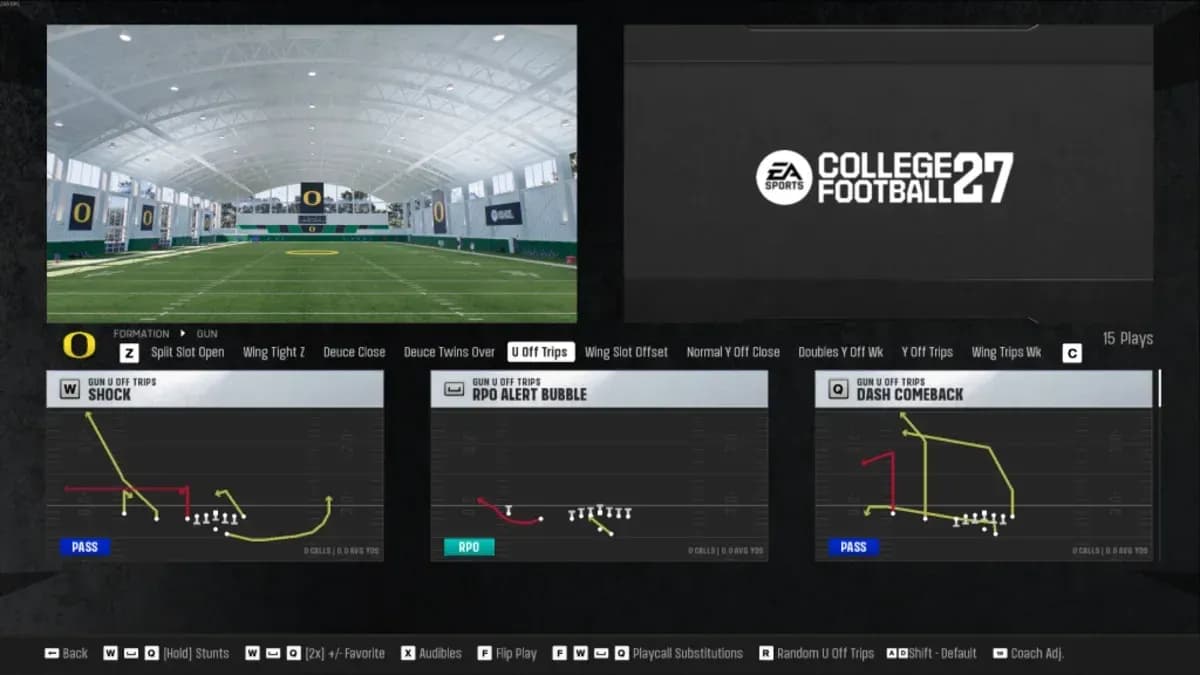
College Football 27 offensive playbook formation select
The answer depends on what you actually want to run. Passing-first players, run-heavy grinders, and balanced attackers all have a clear best option.
Washington State is the go-to for players who want to control games through the air. The formation that makes it work is Gun Bunch X Nasty, which gives you multiple ways to attack different coverage shells. Automated passing presets and layered route combinations make it straightforward to create favorable matchups and punish defensive mistakes.
Despite the pass-heavy identity, Washington State is not one-dimensional. Pistol Trips formations let you establish a ground game when the defense loads the box, which keeps opponents from sitting purely in coverage.
Ohio State is the right call when you want an offense that can threaten defenses in multiple ways without becoming predictable. Bunch X Nasty and Gun Cluster are the two standout formations, both of which attack man and zone coverage while keeping a strong rushing threat alive.
The real value here is unpredictability. Short throws, RPOs, outside runs, and traditional rushing concepts all fit naturally into the same game plan, so opponents cannot simply sit on one tendency.
For players who want even more variety from a balanced attack, Oregon is worth serious consideration. The playbook covers play-action passes, tricky run plays, quick screens, and slants, making it one of the more flexible options for players who prefer adapting on the fly rather than committing to a single identity.
West Virginia is built for players who want to control possession and wear down defenses. The signature formation is Gun Power I Tight, a heavy rushing package that stacks one side of the ball and creates multiple handoff and QB-designed run options. With passing mechanics adjusted in CFB 27, a reliable ground game forces defenses to commit extra defenders to the box, which opens up play-action later.
Florida International is the other strong option for pass-first players. It features a high volume of pre-snap motion and creative passing concepts designed to confuse defensive alignments. Play-action passes work well alongside the inside zone runs in the playbook. It takes time to master, but the reward is a passing attack that is genuinely difficult to prepare for.
Charlotte is the cleanest starting point for players still learning the game. Its Gun Bunch package forms the core of the offense, and a simple four-audible structure gives you a clear decision tree based on defensive alignment. The system is not complicated, but with the right audibles and route combinations it can create real problems for defenses.
| Playbook | Best For | Signature Formation | Complexity |
|---|---|---|---|
| Washington State | Pass-first | Gun Bunch X Nasty | Medium |
| Ohio State | Balanced | Bunch X Nasty / Gun Cluster | Medium |
| Oregon | Balanced/Flexible | Multiple | Medium |
| West Virginia | Run-first | Gun Power I Tight | Low-Medium |
| Florida International | Pass-first (advanced) | Motion-heavy sets | High |
| Charlotte | Beginners | Gun Bunch | Low |
Defensive playbooks in CFB 27 are harder to differentiate because many of them share duplicate plays. The key is finding the playbook with the most useful formation variety.
The base 4-2-5 is the strongest starting point for most players. It covers multiple 4-2-5 packages, several Nickel options, and a couple of 3-3-5 formations, giving you genuine flexibility across game modes. The 3-3 Cub formation within this system provides strong block-shedding opportunities and creative blitz pressure that works especially well against opponents who rely on predictable passing concepts.
For players who want to add Dime and Nickel packages on top of the base structure, the 4-2-5 Man Pressure variant is worth picking up. Those extra packages are particularly useful in online play where pass-heavy offenses are common.
The 3-4 Zone Pressure playbook takes a different approach. Rather than committing to man coverage and aggressive blitzing, it builds around zone structures and pre-snap disguise. Showing one defensive look before the snap and rotating into another after the ball is snapped makes it harder for quarterbacks to read their initial progressions cleanly. Mix zone coverage with selective pressure packages to keep the offense uncertain.
The Dollar playbook, built around the Dollar 3-2 formation, is purpose-built for defending spread passing attacks. It loads the field with defensive backs and includes access to the DB Fire blitz concept. The tradeoff is lighter personnel against the run, so use it situationally rather than as a base defense.
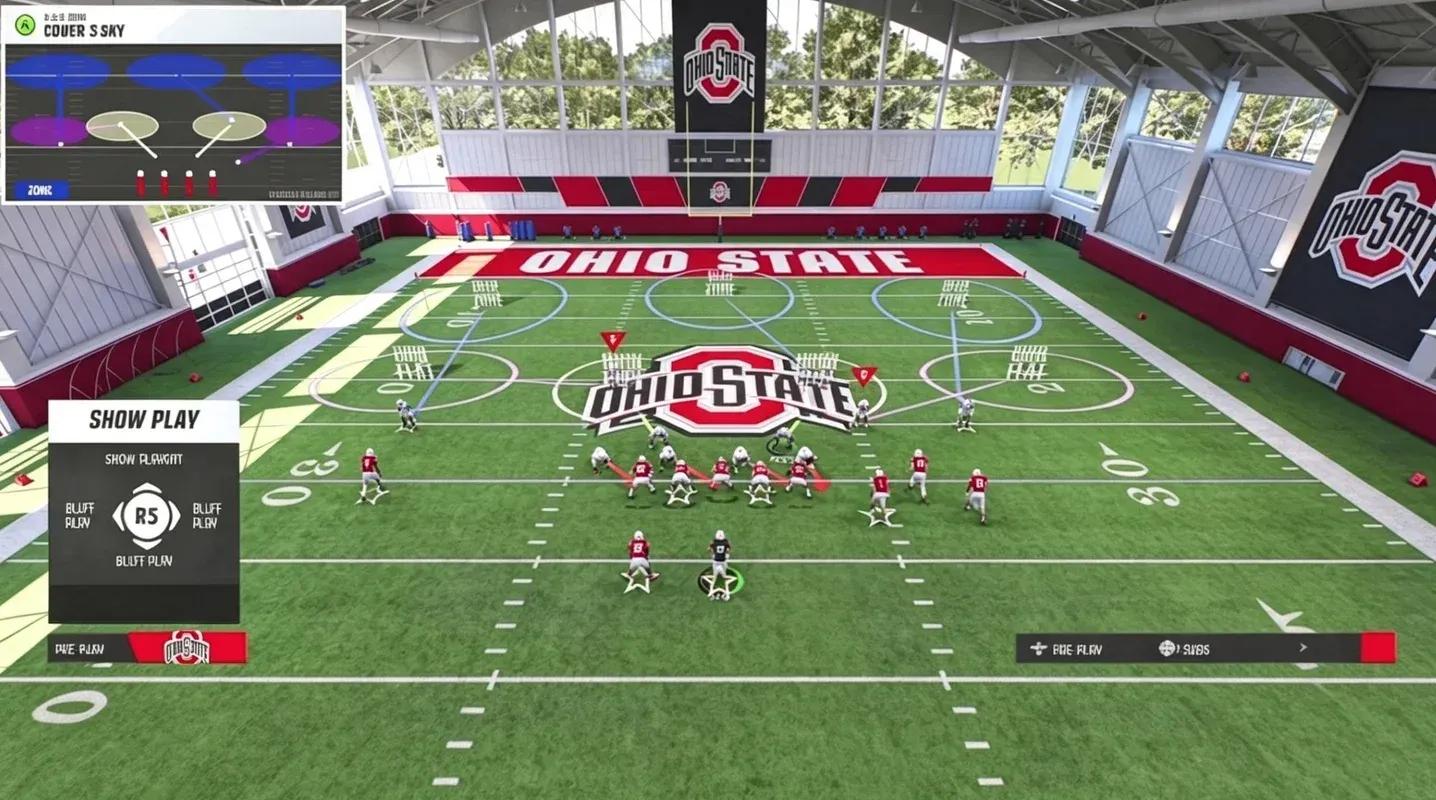
4-2-5 base defensive alignment
Picking the right playbook is only the start. CFB 27 rebuilt the defensive pre-play system from the ground up, and understanding how to use it is what separates players who get torched by spread offenses from players who consistently force punts.
Holding LT/L1 opens the Global Coverage Adjustment Hub, a single overlay that replaces the old multi-menu system. From here you can press, back off, shade leverage, commit to stopping the pass, or adjust zone behavior without cycling through separate menus.
Tapping L1/LB before the snap applies preset defensive game plans instantly: QB Scramble, Play Short Routes, No Deep Passes, and Defend Screen Pass are all available as on-the-fly macro adjustments. Quick double teams are also accessible from this hub by selecting the target receiver's icon and pressing Square/X.
Smart Zones change how zone defenders behave based on game context. The Aggressive setting tells defenders to jump underneath routes aggressively, which chokes out the quick passing game but leaves windows over the top. Conservative settings prioritize depth and cushion against vertical routes. The Look For Work setting is particularly useful because it directs zone defenders to hunt for adjacent threats when their original assignment clears out.
Plaster Logic governs what happens when a mobile quarterback escapes the pocket. Set to Aggressive, all zone defenders abandon their assignments and play strict man coverage. Conservative keeps most defenders in their zones while backside players attach to nearby receivers. The safest trigger condition is Out of Pocket and Time, which prevents defenders from overreacting to pump fakes near the line of scrimmage.
CFB 27 gives you granular control over where your defensive backs line up before the snap. CB depth dictates cushion at the line of scrimmage. CB width lets you shade inside against slants or outside to protect the boundary. Safety depth controls whether your safeties are playing downhill against the run or protecting deep.
Roll coverage lets you deliberately shade deep safety help toward specific threats. Choosing Fastest or Highest OVR automatically shifts coverage priority toward the offense's most dangerous athlete, while Pass Strength leans help toward the side of the formation with the most eligible receivers.
The most consistent defensive players build a small library of reliable pre-snap setups rather than reinventing their approach every down. A few worth building:
Texas Four-Man Stunt: Combines a Texas stunt with a defensive-line spread. Opens interior gaps and creates more pressure opportunities for defensive tackles and edge rushers. Works best from Nickel Over, Single Mug, Nickel Load, 4-3 Over, and Over G formations. Fast edge defenders make this setup significantly more dangerous.
Texas Stunt with QB Contain: Adds a contain defender on the quarterback's rollout side. Against right-handed quarterbacks, containing the right side is a strong default. Adjust the direction based on your opponent's tendencies.
Press Man Shade Inside: Combines press coverage with inside route commitment and inside shading. Takes away quick inside-breaking routes and forces the quarterback to look elsewhere. Be careful with manual bump attempts because aggressive user contact can draw defensive pass interference.
Red Zone Inside-the-10: Start from a Tampa 2 base. Pinch and contain the defensive line, set hook zones around 5 yards, move safeties into inside-quarter responsibilities, and set outside cornerbacks to 10-yard hard flats. This removes easy underneath throws while limiting back-of-the-end-zone routes. Deep corner throws are still a weakness, so user control near the goal line is non-negotiable.
Tampa 2 Mable: Designed to stop corner routes. Set cloud flats around 25 yards and curl flats around 5 yards. The layered structure protects the deep outside area while maintaining underneath coverage. Works from Nickel formations and can be adapted for Dime packages.
Young defensive backs can spiral after giving up an explosive play. CFB 27 tracks composure, and players who drop into a Cold status take a measurable performance hit. You get 3 Coach Chats per game to reset a struggling player's emotional state. Open the Dynamic Subs menu with Right on the D-pad, identify the cold indicator, and press Triangle/Y. Save these for rivalry environments and high-stakes late-game situations.
If none of the stock playbooks fit your style perfectly, CFB 27 lets you build your own. Head to the Create & Share tab and select Custom Playbooks. From there, choose an existing offensive or defensive scheme as your base.
Four pages let you shape the playbook to your preferences:
For more on building your scheme around the current meta, the best playbooks and settings guide for CFB 27 covers the speed-boost removal and aggressive blocking flag changes that have reshaped what works this year.
A strong defensive system needs at least one pass-rush macro, one rollout counter, one man-coverage setup, one red-zone defense, and one conservative late-game coverage package. No single macro is a complete solution because user control remains the most important variable. Identifying seams, deep sideline routes, corner routes, and quarterback rollouts during the play is what makes the macros actually work.
On offense, the best playbook is the one that fits how you naturally want to play. A player who reads coverage well will get more out of Washington State's passing concepts than out of West Virginia's rushing attack, and vice versa. Forcing yourself into a popular scheme that does not match your instincts is a reliable way to play worse than you should.
For everything else you need in CFB 27, from Dynasty Mode coach archetypes to Road to Glory player building, the full EA Sports College Football 27 strategy guide collection has you covered across every mode.