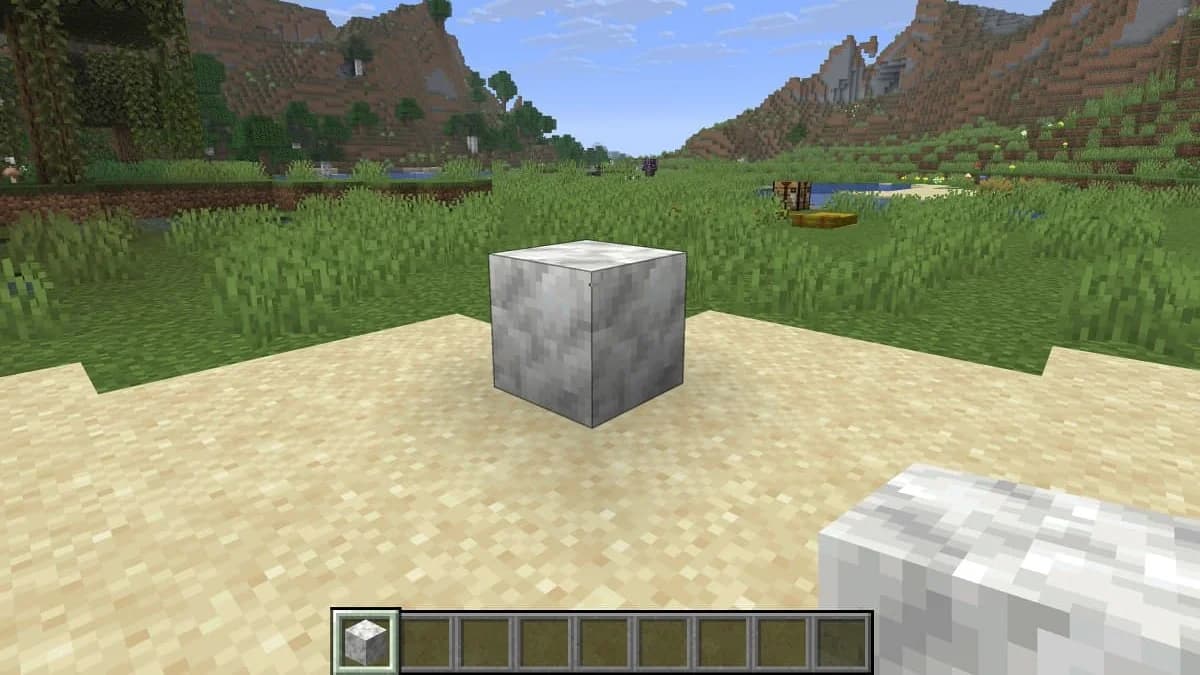

To get calcite in Minecraft, mine it with any pickaxe inside amethyst geodes or on the exposed surfaces of Stony Peaks. This white, streaked block suits marble-style walls, floors, and columns, but collecting enough for a large build means finding natural deposits.
Choose your search route around the terrain you already have nearby. The steps below cover both established locations, the mining requirements, and the extra source and building variants being tested for the upcoming winter drop.
Where to find calcite
Stony Peaks let you collect calcite on the surface. A known amethyst geode is another practical starting point because its calcite forms a distinct shell. Ice Caves provide an additional option in winter-drop test versions.
| Location | Where calcite appears | Availability |
|---|---|---|
| Stony Peaks | Exposed white seams across the stone mountains | Standard release |
| Amethyst geodes | Middle shell between Smooth Basalt and Amethyst | Standard release |
| Ice Caves | Natural deposits inside the caves | Upcoming winter-drop test versions |

Search Stony Peaks for exposed seams
Scan the stone slopes for white patches. Once you find a seam, follow it across the mountain surface and collect the exposed blocks before moving to another patch. You do not need to dig down to a particular underground level for this route.
Stony Peaks are a useful choice for bulk collection because you can spot deposits from outside the mountain. Bring free inventory space and record the coordinates if you expect to make more than one trip.
Spot white seams on stone slopes
Open an amethyst geode's middle shell
A geode has three layers. From outside to inside, they are:
- Smooth Basalt, the outer shell.
- Calcite, the white middle layer.
- Amethyst, the purple interior.
If you encounter Smooth Basalt while exploring underground, open a section until you reach the white layer. Work around that shell to collect calcite. Digging farther inward takes you into the amethyst interior, so follow the curve of the white blocks instead.
This route fits naturally into a cave expedition. If you already know where a geode is, return there before starting a separate mountain search.
Check Ice Caves in winter-drop testing
Ice Caves add another natural calcite source in the upcoming winter drop's test builds. In a standard release world without those features, use Stony Peaks or amethyst geodes.
If your project needs both white stone and ice, plan a shared collection trip for calcite and Brittle Ice in Minecraft. Both occur in Ice Caves, so you can gather materials for the same build without treating calcite as the expedition's only goal.
How to mine calcite without losing it
You can collect calcite with a Wooden Pickaxe or better. No special tool material is required, and Silk Touch is unnecessary.
- Select your pickaxe in the Hotbar.
- Aim at the calcite block and mine it until it breaks.
- Collect the dropped block before moving along the deposit.
Which pickaxe should you use?
For a small deposit, use the pickaxe you already carry. For a larger collection trip, faster tools reduce the time spent breaking each block.
These Java Edition 26.3 mining times assume you are standing on the ground with no enchantments or status effects.
| Pickaxe | Time to break calcite |
|---|---|
| Wooden Pickaxe | 0.6 seconds |
| Stone Pickaxe | 0.3 seconds |
| Copper Pickaxe | 0.25 seconds |
| Iron Pickaxe | 0.2 seconds |
| Diamond Pickaxe | 0.15 seconds |
| Netherite Pickaxe | 0.15 seconds |
| Golden Pickaxe | 0.1 seconds |
Calcite stacks to 64. Four empty inventory slots therefore hold 256 blocks, which gives you a simple way to plan carrying space before a building trip.
Can you craft calcite or its variants?
Base calcite cannot be crafted or farmed. It comes from natural world generation, so clearing a deposit does not create a renewable supply. Large projects require more deposits once the first source runs out.
The upcoming winter drop expands the calcite family in Java 26.4 Snapshot 7 and Bedrock Preview 26.70.23. The recipes below belong to those test versions. They process calcite you have collected; they do not replace gathering the raw block.
Crafting Table recipes in the test versions
Use the Crafting Table to arrange the ingredients shown below. The table lists the input layout without assuming an output quantity.
| Result | Ingredients and arrangement |
|---|---|
| Calcite Pillar | Two Calcite blocks placed vertically |
| Calcite Slab | Three Calcite blocks in one horizontal row |
| Calcite Stairs | Six Calcite blocks in a staircase pattern |
| Calcite Wall | Six Calcite blocks filling two adjacent rows |
| Polished Calcite | Four Calcite blocks in a 2×2 square |
| Polished Calcite Bricks | Four Polished Calcite blocks in a 2×2 square |
Polished Calcite gives you a more even surface than the original block. Polished Calcite Bricks add a visible brick pattern, making them an option for walls where you want separate courses of masonry.
Use the Stonecutter for shaped blocks
The Stonecutter also processes the new calcite block family in the test versions. Use it to select the architectural form you need directly.
Polished Calcite and Polished Calcite Bricks each have slab, stair, and wall variants. Choose the block finish first, then the shape, so you do not convert your building supply into a texture you did not intend to use.
What to use your calcite for
Build with white stone and contrasting materials
Use the original block when you want a marble-style surface with natural streaks. Polished Deepslate and Blackstone make dark borders around calcite walls or floors, while Amethyst Blocks can carry the geode's purple-and-white colors into your base.
For a winter-themed entrance, use calcite as the white stone frame and Packed Ice Bricks in Minecraft for the icework. Keep the materials in separate parts of the design so their different textures remain visible.
Calcite does not burn, but it does not emit light either. Place light sources throughout calcite interiors; the block's pale color does not illuminate the room.
If you only collect a small deposit, reserve it for columns, entrance frames, or an accent wall. Those designs use its texture without requiring enough calcite to cover every wall in the building.
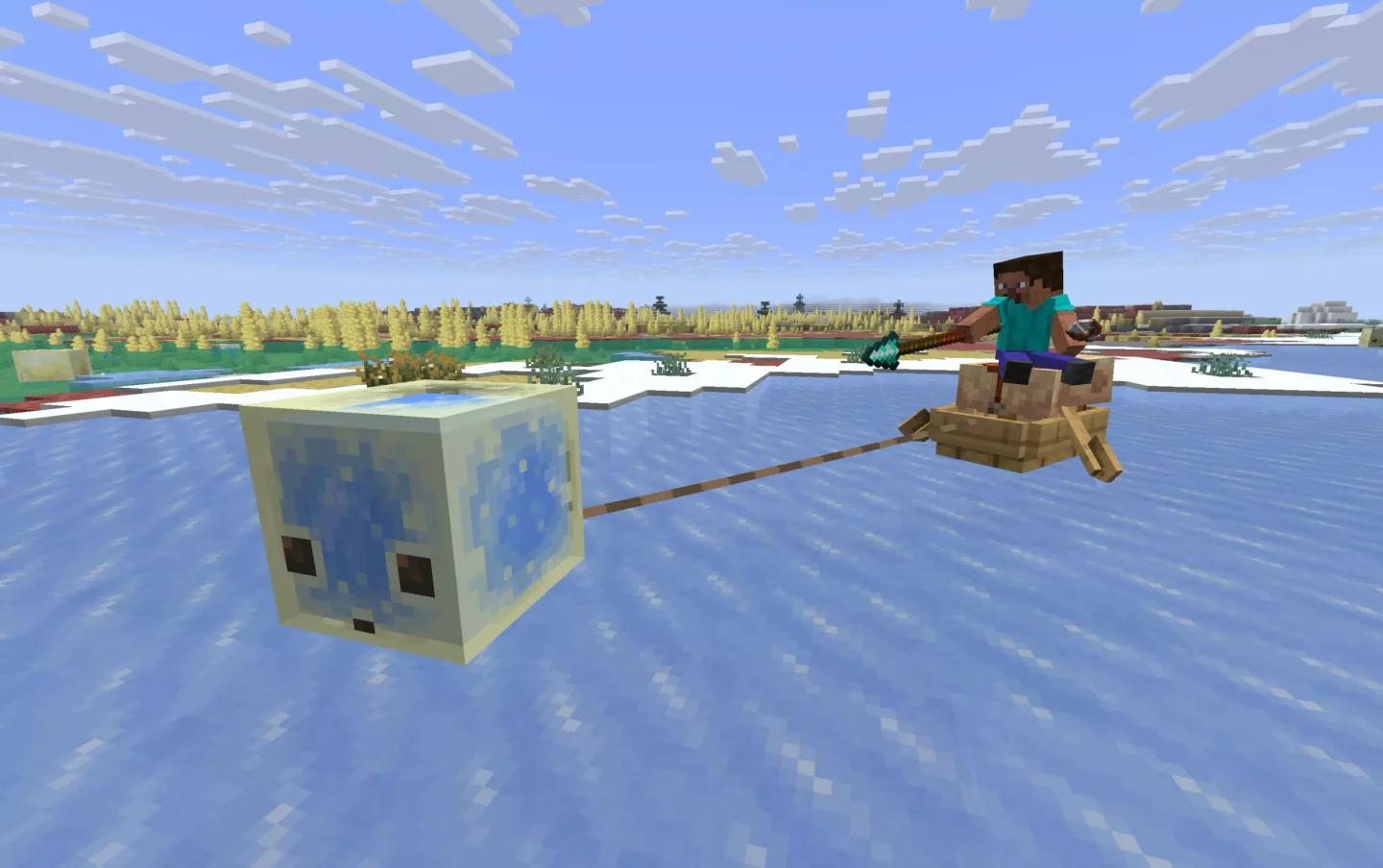
Give a Sulfur Cube its slow, bouncy archetype
Calcite also has a use beyond construction. Feeding it to the Sulfur Cube found in Minecraft Sulfur Caves gives the mob the slow, bouncy archetype.