
World of Chel in NHL 27 has more build depth than any previous entry in the series. EA reworked height and weight effects, re-priced X-Factor AP costs, and moved Ability Point Bonuses, Skill Point Bonuses, and Attribute Cap Increases into the Free Season Pass, which means your progression decisions now have real consequences on the ice. Picking the wrong archetype or dumping points into attributes you never use will hold you back. This guide breaks down every forward, defenseman, and goalie build so you can put your points where they actually matter.

Choosing your WoC archetype
How do builds actually work in NHL 27 World of Chel?
Three systems shape your custom player: Ability Points (AP), Skill Points (SP), and Attribute Cap Increases. Each one does something different, and treating them as interchangeable is one of the fastest ways to end up with a mediocre build.
AP determines which X-Factors you can equip and at what tier. EA adjusted AP costs this year to force a real choice between loading up on cheaper abilities or committing to one or two high-tier X-Factors. Neither path is automatically correct. A specialist who activates their main ability every shift gets more value from expensive AP investment than someone who rarely triggers it.
SP covers foundational attributes and sits inside five categories for skaters: Technique, Power, Playstyle, Tenacity, and Tactics. Goalies use Low, Hands, Quickness, and Positioning instead. SP Bonuses earned through the Free Season Pass add to your available points, so you can push your preferred attributes further as you progress.
Attribute Cap Increases raise the ceiling on a specific attribute without handing you free points. If you unlock a Speed cap increase, you gain the ability to push Speed higher when your build allows it. Season 1 allows attribute caps to increase by up to +2. These are most valuable when you already know which attributes define your role.
Height and weight also feed directly into your attribute potential. EA's revised physical system means your body type is part of your build, not a cosmetic choice. Taller players gain advantages in Stick Checking, Durability, and Fighting Skill while giving up some Speed, Agility, Acceleration, and Deking. Heavier players gain Balance, Strength, and Body Checking but lose Agility, Acceleration, and Endurance. Every physical choice creates a trade-off, and the best builds are the ones that accept those trade-offs deliberately.

Best forward builds in NHL 27 World of Chel
Sniper
The Sniper is the most straightforward offensive build in the game. The entire point is creating separation and getting your shot away before the goalie can set. Prioritize Speed, Acceleration, Shooting, Puck Control, Offensive Awareness, and Agility. A lighter physical profile makes sense here because the movement penalties from excess weight directly undercut what this build needs to do.
For X-Factors, build around abilities that support your primary scoring method. If you score off quick releases, spend AP on abilities that support those situations. Do not equip a high-cost ability just because it sounds powerful. You need to activate it consistently for the investment to pay off.
In 3v3, Snipers are especially dangerous because the extra open ice creates more shooting lanes. In 6v6, you need teammates who understand how to set you up.
Playmaker
The Playmaker is built around possession and distribution. Passing, Puck Control, Speed, Agility, and Offensive Awareness are the core attributes. The build shines in organized 6v6 play where positioning and decision-making matter more than raw skating ability.
For centers specifically, a Two-Way Forward variant of the Playmaker concept works well. After testing this setup across multiple modes, a height of 5'11" to 6'2" and weight between 178 and 195 lbs keeps enough mobility for transitions while supporting the physical demands of the center position. Target Faceoffs at 90, Speed at 87, Acceleration at 86, Passing at 85, Offensive Awareness at 86, and Stick Checking at 86. Fighting and Body Checking can sit lower (71 and 78 respectively) because they are not attributes you will use often enough to justify heavy investment.
For abilities, Elite Edges adds to Speed, Acceleration, and Agility. Stick 'Em Up improves poke accuracy, poke check recovery, and stick speed. Quick Pick helps intercept passes automatically. While working toward those, Send It (for long passing) and One T (for one-timers) keep you competitive earlier in your progression.
If you lean more offensive with the Playmaker, max out Speed, Agility, and Deking first, then put remaining points into Passing, Offensive Awareness, and Puck Control. Quick Release lets you fire shots quickly to catch goalies off guard, and Ankle Breaker gives you a speed burst after successfully deking an opponent. Tape To Tape and Big Tipper are solid early-progression alternatives.
Dangler
Danglers live and die by one-on-one situations. Agility, Puck Control, Deking, Acceleration, Speed, and Offensive Awareness are the priorities. This build rewards players who naturally attack defenders laterally and create their own shooting opportunities through movement.
The most common Dangler mistake is overinvesting in Deking at the expense of skating fundamentals. An advanced deke is worthless if your player cannot reach the position where that move is relevant. Build your skating base first.
Power Forward
NHL 27's physical system makes Power Forward construction more deliberate than in previous entries. Heavier players gain Balance, Strength, and Body Checking potential, which is exactly what this build needs for board battles, puck protection, and net-front presence. Strength, Balance, Body Checking, Puck Control, Durability, Shooting, and Stick Checking are the key attributes.
The trap to avoid: making your player so heavy that transitions become impossible. Strength matters, but a Power Forward who cannot keep pace with the play spends too much time chasing the puck. Keep enough mobility to participate in the rush.
Two-Way Forward
Two-Way is the safest starting point for players who are still figuring out their preferred role. Defensive Awareness, Stick Checking, Speed, Passing, Puck Control, and Endurance all contribute. You will not have the offensive ceiling of a dedicated Sniper or the physical presence of a Power Forward, but you also will not become a liability when the game moves away from your preferred situation. For 6v6 Clubs, this build is particularly practical because team structure demands contribution in every zone.
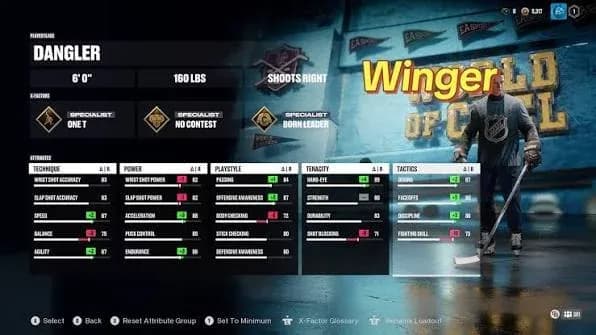
Two-Way Forward SP categories
Best defenseman builds in NHL 27 World of Chel
Defensemen need to answer a different question than forwards: are you here to shut down opponents, move the puck, or both? The answer shapes every attribute and physical decision.
Offensive Defenseman
Speed, Acceleration, Passing, Puck Control, Offensive Awareness, Shooting, and Defensive Awareness are the priorities. The biggest mistake offensive defensemen make is treating the position like a fourth forward. You should join rushes when appropriate, maintain outlet pass availability, and recover quickly after turnovers. Unnecessary pinches create odd-man rushes against your team.
Defensive Defenseman
Defensive Awareness, Stick Checking, Strength, Body Checking, Durability, Speed, and Acceleration define this build. You still need enough skating to contain fast forwards, so a pure tank build with no mobility is genuinely risky. The role is protecting the slot, blocking passing lanes, winning battles, and making safe first passes. Taller physical profiles can help here because the Stick Checking and Durability bonuses from height directly support the defensive role.
Two-Way Defenseman
For 6v6 players who are not always sure which defensive role they will need to fill, the Two-Way Defenseman provides the best balance of skating, defense, passing, physical play, and puck control. You can defend aggressively without becoming completely dependent on physical attributes. This is the most practical choice for organized club play.
How does height and weight affect your build?
| Physical Factor | Attributes Boosted | Attributes Reduced |
|---|---|---|
| Taller height | Stick Checking, Durability, Fighting Skill | Speed, Agility, Acceleration, Deking |
| Shorter height | Speed, Agility, Acceleration, Deking | Stick Checking, Durability, Fighting Skill |
| Heavier weight | Balance, Strength, Body Checking | Agility, Acceleration, Endurance |
| Lighter weight | Agility, Acceleration, Endurance | Balance, Strength, Body Checking |
There is no universally correct physical profile. A smaller, lighter build suits speed-dependent forwards like Snipers and Danglers. A taller, heavier build suits Power Forwards and defensive-minded defensemen. The center Two-Way Forward sweet spot sits between 5'11" and 6'2" at 178 to 195 lbs, which keeps enough mobility for faceoffs and transitions without sacrificing all physical presence.
Best goalie build in NHL 27 World of Chel
Goalie progression runs through four categories: Low, Hands, Quickness, and Positioning. These work differently from skater categories, and spreading points evenly is rarely the right approach.
A Quickness-focused setup suits goalies who rely on reaction time and lateral movement across the crease. A Positioning-focused setup suits goalies who prefer anticipation, arriving in the correct spot before the shot arrives rather than reacting after. If you are still learning goalie mechanics, a balanced distribution is easier to manage while you identify your actual weaknesses. Once you know where you struggle, specialize.
How to use the Free Season Pass to develop your build
Season 1 of World of Chel contains 45 levels of free rewards, mixing AP Bonuses, SP Bonuses, Attribute Cap Increases, WOC Coins, and limited NHL player classes. Beckett Sennecke's PWF, Jesper Wallstedt's HYB, Ivan Demidov's DNG, Matthew Schaefer's TWD, and Connor Bedard's SNP are among the Season 1 earnable classes. These loadouts are also useful for experimenting with different archetypes before committing to a custom build direction.
Completing Weekly, Seasonal, and Event Objectives is the fastest route through the Season Pass. Treat Objectives as part of your normal session rather than optional extras. Events can also provide XP multipliers and Tier Skips, which compound your progression significantly when you are actively playing.
For XP Boosts, the Standard and Deluxe editions include a 2XP WOC Boost, with the Deluxe Edition including 2X WOC Double XP Tokens. Use them during sessions where you can play enough games to actually benefit from the multiplier.
If you miss early seasons, the catch-up system (available starting Season 2) lets you complete dedicated Objectives to earn currency for missed AP, SP, and Attribute Cap rewards from previous seasons. EA designed the system so players joining later can still recover 100% of missed progression rewards, so there is no need to panic about falling behind.
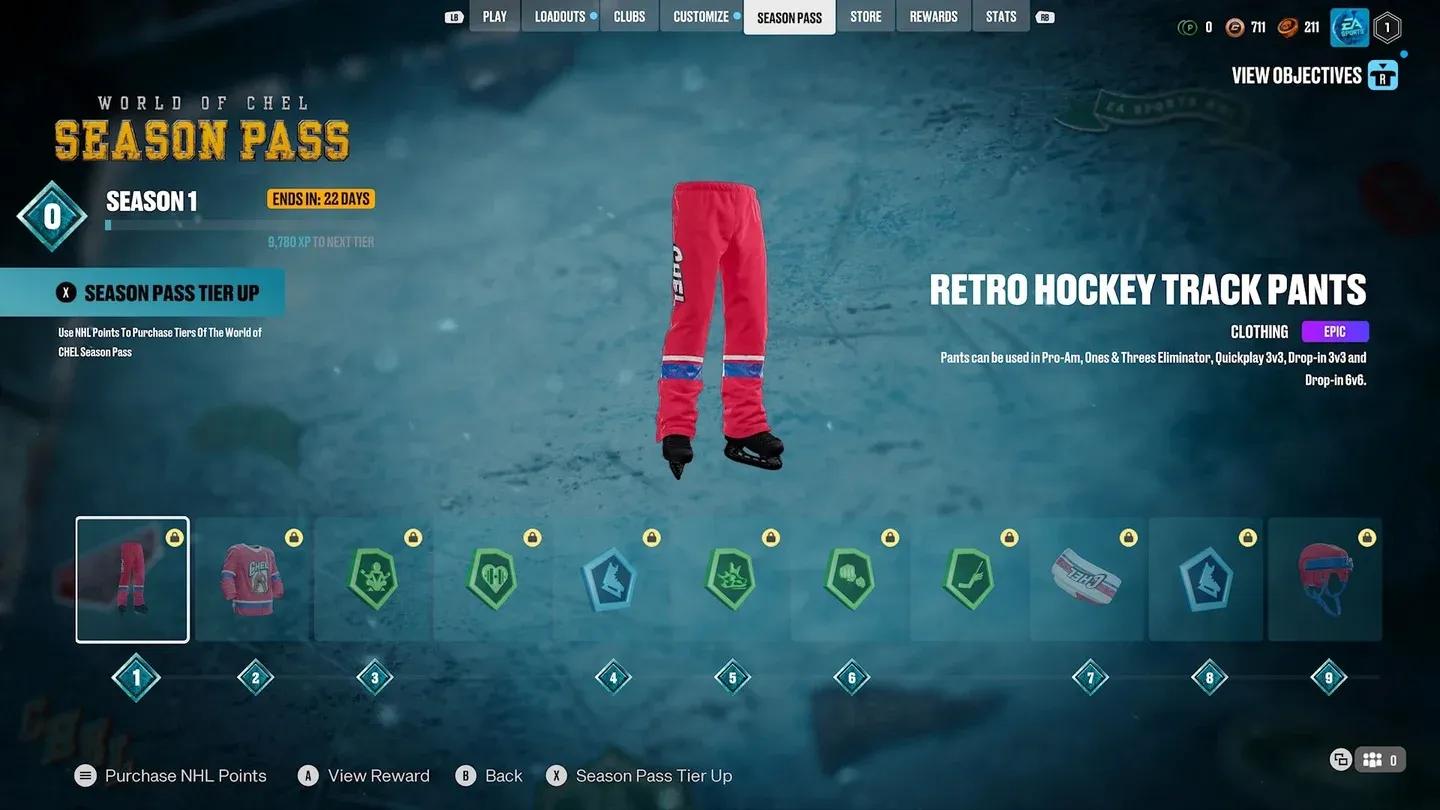
Season Pass progression rewards
What are the most common World of Chel build mistakes?
Copying a high-level player's build without understanding why it works is the most frequent problem. A build tuned for someone with specific controller habits and a specific team role may actively hurt your performance if your playstyle does not match.
Overloading on weight is the second most common error. Strength and Body Checking are useful, but the Agility, Acceleration, and Endurance penalties from excessive weight are real. A Power Forward who cannot keep pace with transitions is a liability.
Spending AP randomly is the third. Every X-Factor you equip should answer one question: will you activate this in most games? If the honest answer is no, those AP points produce more value elsewhere.
Finally, ignoring the difference between 3v3 and 6v6 leads to builds that perform well in one mode and struggle in the other. The extra open ice in 3v3 punishes slow recovery. The team structure in 6v6 rewards role discipline over individual offensive ceilings.
Build decision quick reference
| Build Type | Best For | Key Attributes | Avoid |
|---|---|---|---|
| Sniper | Rush attackers, finishers | Speed, Shooting, Puck Control | Excess weight |
| Playmaker | Possession, setup play | Passing, Puck Control, Agility | Holding puck too long |
| Dangler | One-on-one creators | Agility, Deking, Acceleration | Overinvesting in Deking |
| Power Forward | Physical play, net presence | Strength, Balance, Body Checking | Too much weight |
| Two-Way Forward | Versatile contributors | Defensive Awareness, Speed, Passing | Trying to max everything |
| Offensive Defenseman | Puck-moving blue liners | Speed, Passing, Offensive Awareness | Unnecessary pinches |
| Defensive Defenseman | Shutdown specialists | Def. Awareness, Stick Checking, Strength | Zero mobility |
| Two-Way Defenseman | Balanced club play | Skating, Defense, Passing | Overspecializing |
For more strategies across every mode, the NHL 27 guides collection covers everything from franchise rebuilds to progression tips. NHL 27 sits firmly in the simulation games genre, and the depth of World of Chel's build system reflects exactly that. Build with a purpose, invest in your role, and use every Season Pass reward to push your most important attributes further.