


RuneScape: Dragonwilds drops you onto the continent of Ashenfall with stone tools, three survival meters quietly draining, and no safety net. The game launched on 15 September 2026 for PC, PlayStation 5, Xbox Series X/S, and Nintendo Switch 2, wrapping RuneScape's familiar skill grind inside a survival crafting loop where every piece of gear, every meal, and every rune is handmade. The first few hours reward players who follow the structure laid out for them, and punish those who wander into the wrong region 20 minutes after spawning.
What should you do first in RuneScape: Dragonwilds?
Follow the Dragon Slayer quest. That is genuinely the answer. Head through the opening objectives until you reach the Wise Old Man in Bramblemead Village, talk to him, and let the main questline walk you through shelter construction, hunting, crafting, and enemy preparation before eventually pointing you at General Velgar, the first major dragon encounter.
Players who skip this and go exploring hit a wall fast. Each quest step sends you somewhere new with resources and enemies you have not encountered yet, which is the most efficient way to unlock gear upgrades. Check your Journal regularly since it tracks both main objectives and side quests. Explore around each objective marker rather than sprinting into a higher-level region you are not equipped for.

How do the survival meters work?
Three bars sit in the bottom-left of the screen: Hydration, Sustenance, and Rest. None of them kill you outright mid-fight, but they quietly decide how fast you recover between swings, and that is what actually gets new players killed.
Keep all three in the top quarter before leaving your base. Hydration and Sustenance are the urgent ones. Rest is more forgiving and can sit around half full before penalties kick in. Build your first base next to a water source since your character drinks constantly early on, and boiling dirty water is far less painful when the river is steps from your cooking fire.
Building your first base: what do you actually need?
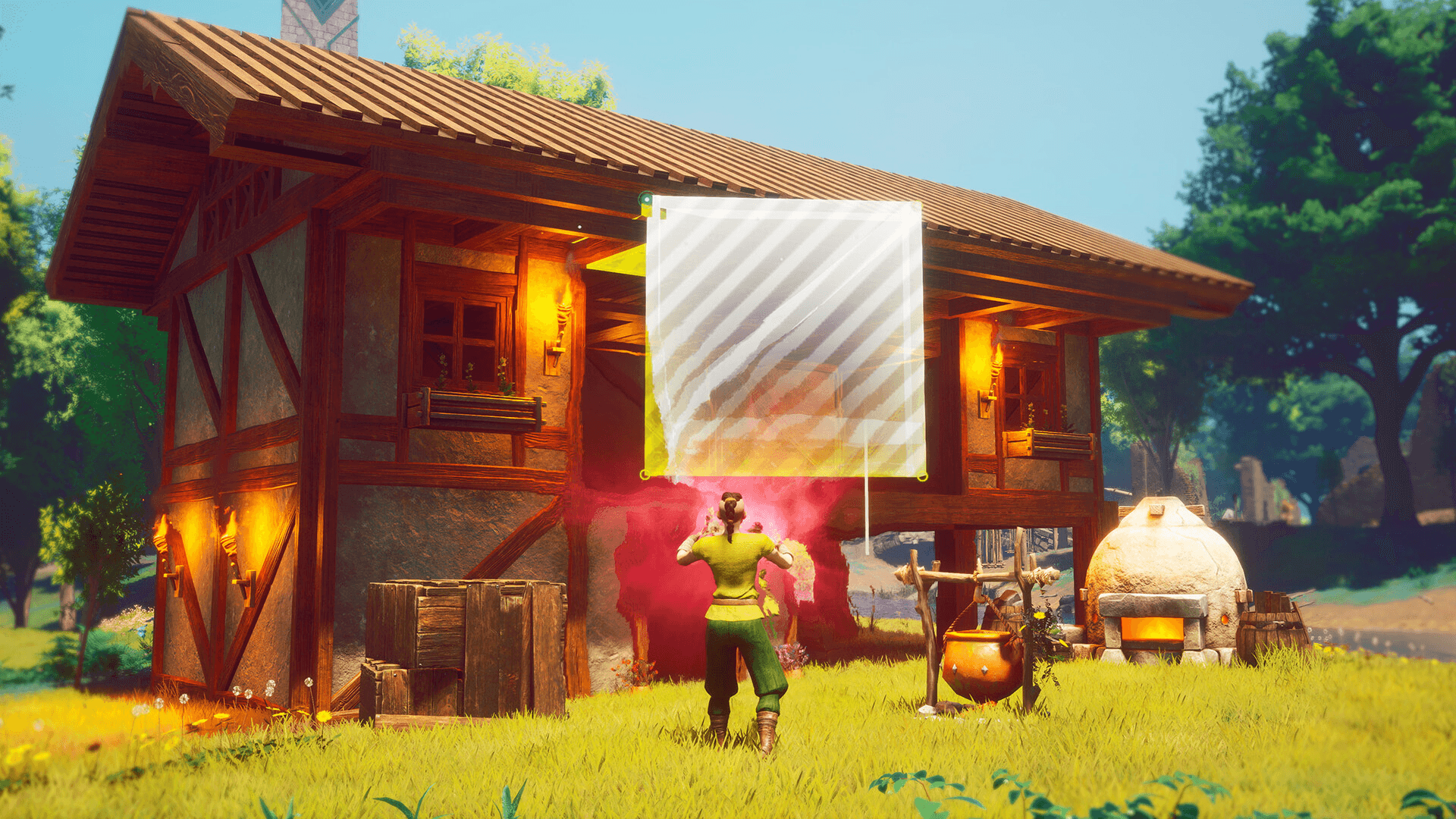
The Wise Old Man asks you to build a shelter in Bramblemead Village, and it makes a sensible permanent base location. You only need space for a bed, some storage, and a handful of crafting stations. Seal it with walls, a roof, and a door, then place and claim a bed inside. That claimed bed sets your respawn point and activates the Cosiness buff.
Start with a Crafting Table and a Campfire, then add whatever stations the main quest requests. Here is what each processing station handles as you unlock them:
Building a second Grindstone once you have the materials cuts down idle waiting. Check which bench produces your next upgrade before heading out to gather, otherwise you come home with the wrong pile of rocks.
Which skills should you level first?
Skills rise by doing the matching activity, so you do not need to stop questing to grind any of them. The skills worth deliberately feeding early are:
- Woodcutting and Mining: logs, stone, and ore are the bottleneck for almost every upgrade path
- Artisan: gates crafting and gear progression at specialised stations
- Cooking: turns raw ingredients into meals that heal and grant temporary buffs like Grounded, Relentless Ranger, and Focused Agility
- Attack, Ranged, and Magic: melee is reliable up close; bows and staves let you fight from a safe distance
- Agility: levels passively as you run around, reducing sprint stamina costs and unlocking movement abilities
- Farming: a steady crop supply removes constant food scavenging
Farming and Cooking together are the quietest power spike in the early game. Plant, water, and harvest crops at your base, cook them into meals that restore both Sustenance and Hydration, and you will rarely scramble for food mid-exploration.

How do recipes unlock in Dragonwilds?
Recipes open up three ways: picking up a material you have never held before, building a new crafting station, and finding plans inside chests or vestiges around the map. That first method is why you should grab one of everything, including items that look worthless.
Processing counts too. Turning logs into planks, hide into leather, or ore into bars often reveals the next tier of items you need. The early materials worth hoarding are:
- Ash Logs
- Stone
- Flax (feeds into thread, which feeds into your first bow)
- Rune Essence
- Animal Bone
- Animal Hide
- Anything edible
Chests around the world and inside dungeons respawn on a regular cycle, so mark the ones you find on your map and loop back through them for free blueprints and supplies.
What are Skill Spells and how do you use them?
Magic in Dragonwilds runs on Anima and Rune Essence. Essence is mined from nodes on the ground, and the rocks floating above those nodes can be knocked down with a single arrow or staff attack before mining. Anima is siphoned from vents by holding the interact key.
Collecting Rune Essence for the first time unlocks the Rune Altar, which crafts seven rune types: Air, Water, Fire, Earth, Law, Nature, and Astral. Build one at your base and convert essence in bulk every time you return, because every spell burns through stacks of it fast.
Skill Spells unlock as individual skills level up and change how fast you gather and travel, not just how much damage you deal:
- Windstep (Agility): crosses gaps, scales terrain, and gets you out of trouble fast
- Axtral Projection (Woodcutting): fells a line of trees at once
- Splinter: breaks stacks of logs apart instantly
- Rocksplosion (Mining): destroys ore deposits without swinging a pickaxe
- Superheat: speeds up crafting stations that use fire, on a short cooldown
- Tempest Shield: a defensive barrier for melee fights
Assign spells to the Spell Wheel before heading out. Some gathering spells also require the matching tool equipped, so Axtral Projection will not fire if your logging axe is sitting in a chest at home.
How does Power Level work?
Your Power Level comes entirely from equipped armour. Mixed pieces are averaged and rounded down, so one strong chestpiece paired with three weak pieces leaves you weaker than the chestpiece alone suggests. Zones carry their own power levels, and any enemy with a skull icon next to its name is two or more levels above you.
Check that number before crossing into a new region. If ordinary enemies are shrugging off your hits or dropping you in two swings, the answer is a full armour upgrade, not a smarter strategy.
How do you heal and increase max health?
Healing potions have been removed from Dragonwilds. Cooked meals are what you carry into a fight. Fish tend to give the strongest direct healing, while other dishes trade some of that healing for temporary buffs. You can eat to heal even on a full Sustenance bar, but there is a short cooldown between bites, so back out of melee range before you start eating.
Permanent health increases come from Sanguine Urns, also called Constitution Shrines, scattered across every region. Each one adds 10 HP, and collecting all of them takes your total to 280. Sweeping a region for urns before moving on is one of the few genuinely permanent upgrades in the game.
What happens when you die in Dragonwilds?
Everything you were carrying goes into a gravestone where you fell, and you respawn at your claimed bed. Recovering it is straightforward early on and genuinely dangerous later, which is why a backup kit at home matters. Keep a spare weapon, a bow with arrows, clean water, and cooked food in a chest so you are never running back with nothing.
Difficulty changes the stakes significantly. On Hard, dying again before recovering a gravestone destroys its contents, and you also lose the skill XP earned since your last level up in that skill.
How does fast travel work with Lodestones?
Lodestones are the fast travel network, and finding or building one should be the first thing you do in any new zone. You can craft your own from 1 Vault Core, 32 Stone, and 20 Rune Essence. Vault Cores are found inside Dragonkin Vaults, with two sitting in each vault. They respawn over time, and most enemies disappear once a vault is cleared, making return trips low risk.
Fast travelling costs Law Runes, which is another reason to keep the Rune Altar running. A Vault Core weighs 50 on its own, so decide per trip whether carrying a spare Lodestone kit is worth the inventory space.
Once you have a Lodestone network running, setting up a second or third base in later regions becomes worthwhile. Each one gives you somewhere to sleep, store loot, and repair gear without a long trek home, turning a death deep in unfamiliar territory from a frustrating setback into a short detour.
The core loop, simplified
Quest, gather, upgrade, push one region further. Everything else on Ashenfall follows from that rhythm. Stick to the Dragon Slayer questline early, keep your survival meters topped up, sweep regions for Constitution Shrines, and build a Lodestone the moment you arrive somewhere new. The game rarely punishes ambition as hard as it punishes unpreparedness.
For deeper coverage of combat mechanics, advanced crafting routes, and boss strategies, the RuneScape: Dragonwilds strategy guides collection has you covered. If you enjoy action games with deep progression systems, there is plenty more worth exploring on GAMES.GG.