
Gene modding in Probably Stolen - Cyberpunk Shopkeeper Sim uses the DNA Manipulator to copy plant traits onto disks and install them on seeds.
For your first project, choose a low-complexity seed and one improvement that solves a specific farming problem. Faster growth, larger harvests, and lower water use require different traits. Extraction also carries a risk that installation does not: you can lose the donor seed. Start by unlocking the equipment, then decide which plant receives the upgrade and which supplies the trait.
How to unlock gene modding
Call Joe Wild’s Assistant on 8376, select Browse Wild’s Service, and open the HYDROPONIC FARMER section on the BASIC tab. Purchase these upgrades in order:
| Upgrade | Wild’s Favor cost | Requirement | What you receive |
|---|---|---|---|
| Retired Farmer | 350 | None | Hydroponic Starter Kit and access to a seed and supply vendor |
| Plant Genetics | 1,250 | Retired Farmer | DNA Manipulator, gene scanner, and blank DNA Data Disks |
The complete route costs 1,600 Wild’s Favor. Plant Genetics remains unavailable until you own Retired Farmer; its unmet requirement appears in red.
The starter kit arrives immediately. The retired farmer visits the following day and returns weekly to sell seeds and hydroponic supplies. Purchasing Plant Genetics also makes DNA manipulation equipment available from Dr. Jackson.
The Hydroponic Farmer starting specialization provides another route into farming, but its starting equipment should not be confused with the separate Plant Genetics upgrade.
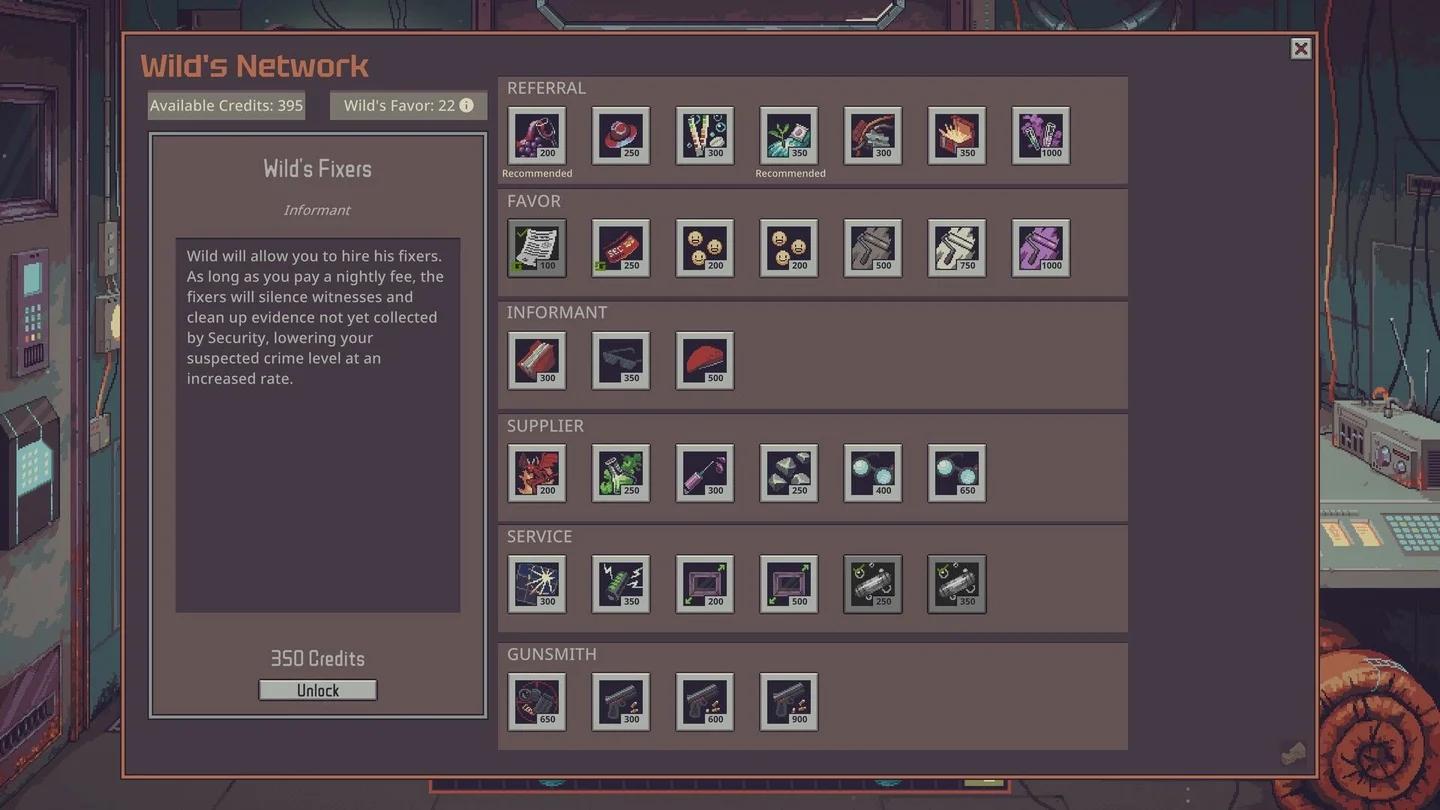
Plant Genetics in Wild’s Network

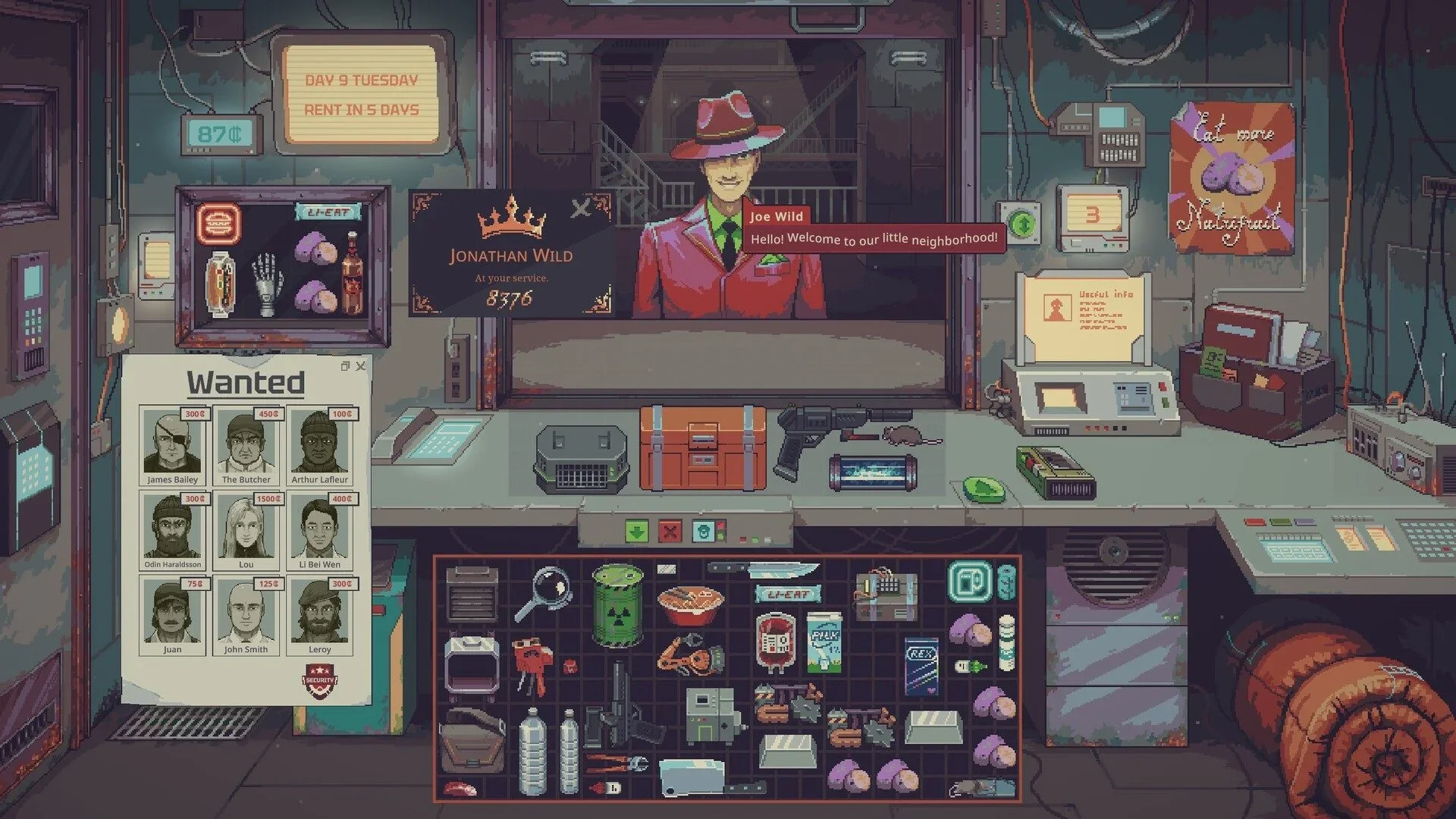
Choose the recipient seed and donor trait
Which seeds make useful starting points?
Treat the recipient and donor as separate decisions. The recipient needs a genome you can work with. The donor needs a trait worth copying, and random extraction may not select the one you want.
| Plant | Useful role | Relevant starting traits | Main consideration |
|---|---|---|---|
| Fillerweed | Early editing recipient | Simple Genome 2, Fast Grower 2, Bountiful 2, Hardy 3 | Also carries drawbacks, including Thirsty 3 and Nutrient-Poor 2 |
| Nutrifruit | Source of growth, yield, and resilience traits | Fast Grower 2, Bountiful 2, Hardy | Complex Genome 2 makes it harder to edit |
| Hydroreed | Water-purification donor or utility crop | Purifying 4, Dense, Hardy | Its base harvest quantity is 0 |
| Bloomberry | Source of persistent growth | Perennial, Edible | Its base harvest does not return seeds |
Fillerweed is a practical first editing target because Simple Genome 2 reduces genetic complexity by eight. Its existing growth and yield traits also let you focus on a specific improvement instead of assembling a useful crop from scratch.
Simple Genome and Complex Genome cannot be transferred. Both are innate traits, so you cannot extract either onto a disk or install either on another plant. Choose your recipient with its genome modifier already in mind.
Choose an improvement that serves the crop
These are rank-one effects. Higher ranks use the trait-strength scaling explained below.
| Trait | Rank-one effect | Choose it when |
|---|---|---|
| Fast Grower | Increases growth speed by 25% | Crops take too long to mature |
| Bountiful | Increases harvest by 20% | You need more produce per harvest |
| Delicious | Increases edible produce selling price by 15% | You are improving an edible crop for sale |
| Drought Resistant | Reduces water use by 25% | Refilling water is a maintenance problem |
| Hardy | Reduces contaminant sensitivity by 30% | Your crop struggles with water contaminants |
| Fertile | Increases seeds returned by 25% | You want better seed returns |
For a sales-focused crop, compare the expected harvest with the alternatives in the Probably Stolen best items to sell guide before spending disks on a price upgrade. A higher selling price is only one part of choosing what to produce.
Specialist traits need more care. Perennial lets a plant remain after harvest and produce again, but reduces harvest by 25%, growth speed by 20%, and seeds returned by 50%. It has a maximum rank of 1.
Purifying removes 10% of each contaminant nightly at rank 1, up to 95% purity. Dream Cap Mush Production serves a different purpose: it adds Dream Cap Mush to harvested items and makes every harvested item contraband.
How to extract a trait onto a DNA Data Disk
Prepare the donor and machine
Switch on the gene scanner and inspect the donor before beginning. Check its traits and ranks, then open the DNA Manipulator.
Follow this sequence:
- Place a blank DNA Data Disk in BLANK DISK.
- Put the donor seed in TARGET.
- Add an Energy Cell with enough energy for the operation.
- Start extraction and let the machine process overnight.
- Check the displayed progress, required energy, and success chance as the job continues.
Extraction copies one random trait unless modules restrict the selection. It can take several nights, and the machine continues processing each night until the job finishes.
Budget for ordinary stock and nightly fees while extraction runs. The Probably Stolen shop economy guide helps keep those costs separate from money committed to farming supplies.
Completed disks appear in OUTPUT. For example, extracting Hardy produces a DNA Data Disk (Hardy). Its tooltip shows the trait’s effects, complexity, and any incompatible traits. You can change the machine setting if you prefer completed disks to remain in their slots.
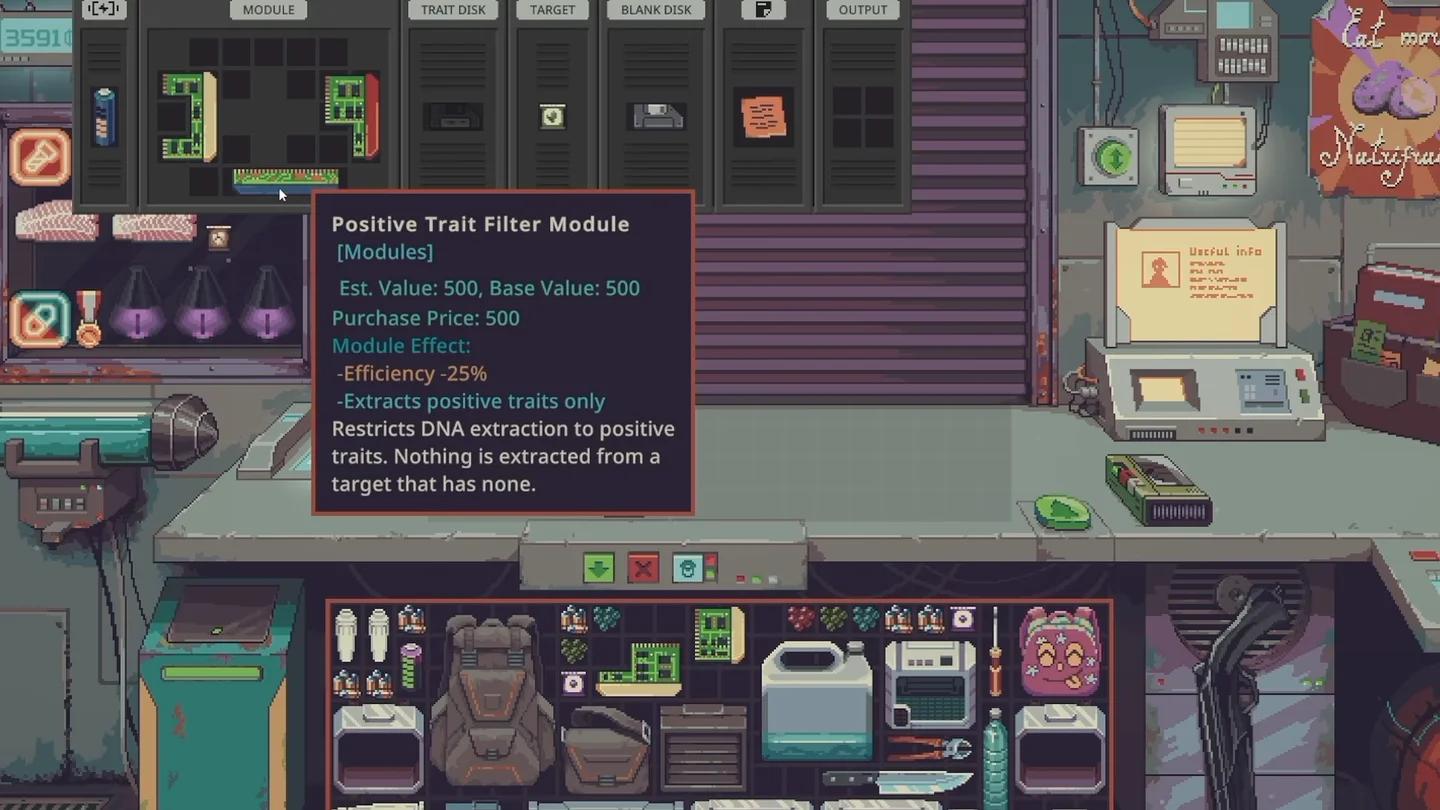
Hardy DNA Data Disk details
How many uses does an extracted disk receive?
The disk’s capacity depends on the trait’s relationship to the donor:
- Innate trait: The disk receives uses equal to the donor’s rank in that trait.
- Other trait: The disk receives one use.
- Matching written disk: You can use a disk already containing a trait the donor carries to add uses to that disk instead of creating a new one.
A high-rank innate trait can therefore supply multiple installations from one extraction. Check the donor’s rank before deciding whether its loss, or the rank reduction from a stabilized extraction, is acceptable.
How to install or upgrade a trait
Place a written DNA Data Disk in TRAIT DISK and the recipient seed in TARGET. Supply the machine with power and allow it to process the installation.
A successful installation has one of two results:
- If the recipient lacks the trait, the operation adds it.
- If the recipient already has the trait, the operation increases its rank by one.
Each success consumes one disk use. Failure does not consume a use, but repeated attempts still affect the seed through genetic heat.
For traits that can increase in rank, strength scales with rank raised to the power of 0.75. Rank 2 produces about 1.68 times the rank-one effect, rank 3 about 2.28 times, and rank 4 about 2.83 times. Four ranks do not produce four times the benefit, so compare another rank against the editing difficulty it adds.
Manage complexity and genetic heat
What determines editing difficulty?
The DNA Manipulator uses the target’s effective complexity to calculate success chance and required work. That calculation includes:
- Added traits, with complexity counted per rank.
- Removed innate traits, so deleting a drawback does not necessarily make later edits easier.
- The adjustment from Simple Genome or Complex Genome.
- The target’s current genetic heat.
Negative traits can contribute negative complexity, but their farming penalties still apply. Keeping Slow Grower may help the editing calculation while leaving you with a slower crop. Choose the compromise based on the plant you intend to grow.
| Calculation | Rule |
|---|---|
| Starting success chance | 95% |
| Complexity penalty | Subtract 5 percentage points per effective complexity point |
| Quality adjustment | Add the machine’s Quality bonus |
| Final success chance | Limited to a minimum of 5% and a maximum of 100% |
| Starting work requirement | 20 |
| Additional work | Add 4 per effective complexity point |
For example, effective complexity 8 with no Quality bonus produces a 55% success chance and requires 52 work. More work means a longer operation unless processing speed also improves.
Why repeated attempts become harder
Every editing operation adds genetic heat equal to two plus the absolute value of the trait’s complexity. Failed attempts add heat too. A trait with complexity 4 therefore adds six heat per attempt.
Heat makes subsequent editing slower and riskier until the target matures. Plan a small set of useful changes, then grow the plant before pushing further modifications. Saving a disk use on failure does not make another immediate attempt cost-free.
Which DNA Manipulator modules should you use?
Prioritize success chance when failures are the bottleneck and processing speed when jobs are simply taking too long. The Probably Stolen modules guide explains how those machine stats fit into the wider upgrade system.
| Module or stat | DNA Manipulator effect | Practical use |
|---|---|---|
| Trait Filters | Restricts random extraction to positive or negative traits | Narrows the donor’s possible results |
| Precision Module | Uses a written disk to select its matching trait for extraction | Gives control over which trait you copy |
| Efficiency | Reduces power consumption | Lowers energy requirements |
| Performance | Improves operation speed | Shortens processing time |
| Quality | Increases success chance | Helps difficult edits succeed |
Trait Filters narrow a category; they do not select one exact trait. Precision provides that finer control once you have a written disk containing the desired trait.
Grow the edited seed
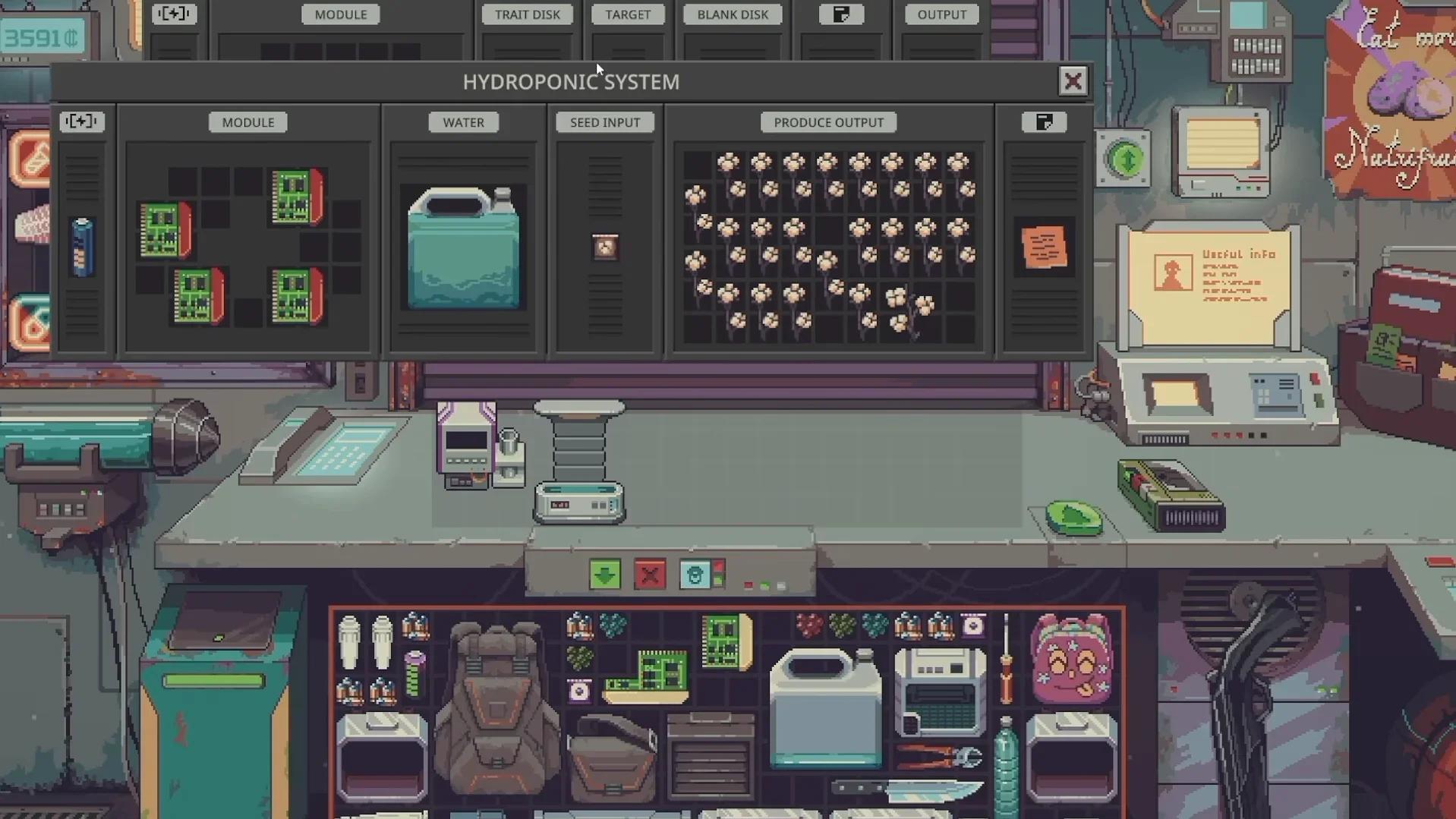
Place the modified seed in the Hydroponic System’s SEED INPUT, then supply a filled water container, Minerals, and a suitable power source. The machine grows crops overnight, and a crop may take a day or two to become harvest-ready.
Check the farm before sleeping:
- Water volume: An empty container cannot support growth, even if the machine displays Status: Ready.
- Water quality: Contaminants can stunt growth.
- Minerals: Both shortages and excessive concentrations can reduce yield; acceptable concentration varies by plant.
- Energy: Replace or recharge the power supply when it no longer holds enough energy.
Judge the harvest against the goal you chose before editing: faster production, more goods, better seed returns, or lower maintenance. Fix water, nutrient, and power problems before committing another disk to a crop whose growing conditions are holding it back.